

Faultlines Without Frontlines: Spillover Risks and the Unquiet Pakistan–Iran Border After the 2026 War

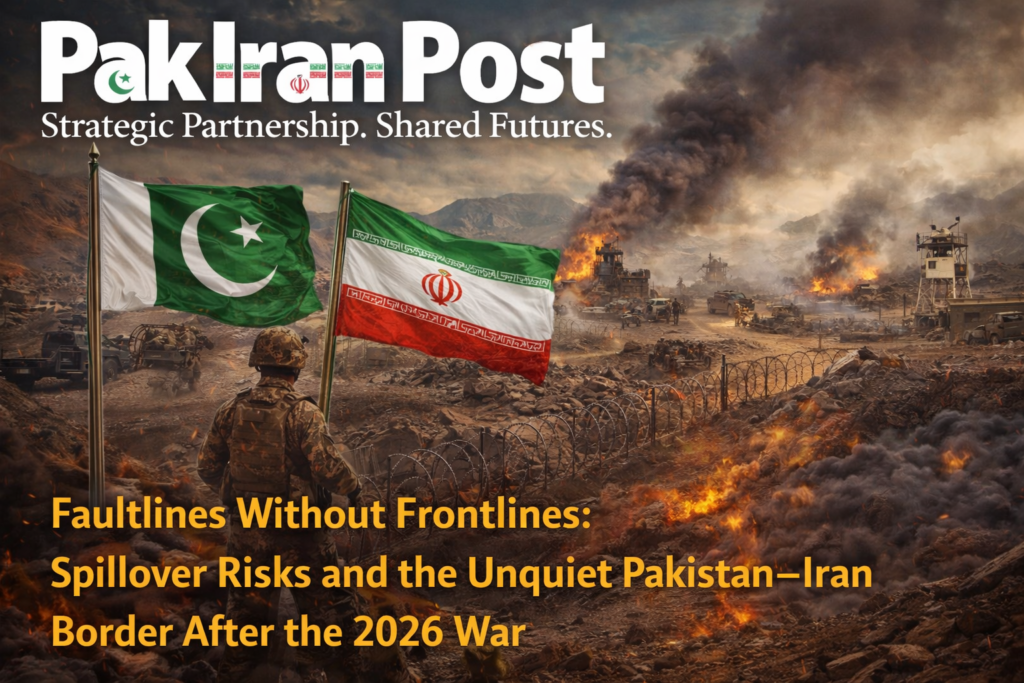
In the aftermath of the 2026 conflict involving Iran, the geography of instability has begun to extend beyond the immediate theatre of war, diffusing into adjacent regions through channels that are as much social and ideological as they are territorial. Nowhere is this diffusion more consequential for Pakistan than along its southwestern frontier, where the long, porous, and historically neglected border with Iran cuts through the province of Balochistan. This frontier, often treated as peripheral in national security discourse, is rapidly acquiring centrality as a vector of conflict spillover, shaped by the convergence of sectarian mobilization, proxy competition, and humanitarian displacement.
Borders, in theory, demarcate sovereignty; in practice, they frequently expose its limits. The Pakistan–Iran boundary exemplifies this contradiction. Stretching across rugged terrain and sparsely governed regions, it has long been characterized by limited statepresence, informal economic networks, and cross-border ethnic linkages that predate the modern nation-state. The Baloch populations on both sides of the border maintain familial, linguistic, and tribal ties that render the dividing line more administrative than absolute. In times of stability, this permeability facilitates trade and social continuity; in times of conflict, it becomes a conduit for insecurity.
The 2026 war has intensified these underlying vulnerabilities by introducing new actors, incentives, and pressures into an already fragile environment. Sectarian organizations, some with transnational ideological affiliations, are poised to exploit instability in Iran to expand their influence within Pakistan’s border regions. These groups operate within a complex matrix of local grievances, religious narratives, and external support, enabling them to mobilize recruits and resources with relative ease. The risk is not limited to episodic violence but extends to the gradual entrenchment of sectarian polarization, which can erode social cohesion and complicate governance in already marginalized areas.
Compounding this threat is the potential reactivation and recalibration of proxy networks. Regional conflicts rarely remain contained; they tend instead to generate secondary arenas of competition in which state and non-state actors pursue their interests indirectly. In the context of the Iran conflict, this could manifest through the support of armed groups operating along the Pakistan–Iran border, either to exert pressure on Tehran or to counter rival actors. For Pakistan, the challenge lies in preventing its territory from becoming a staging ground for such activities, a task that requires not only enhanced security measures but also sustained diplomatic engagement with Iran and other regional stakeholders.
The presence of Baloch insurgent groups adds another layer of complexity to this already intricate landscape. Historically driven by demands for autonomy, resource control, and political representation, these groups have operated with varying intensity over time. The instability in Iran could provide them with new opportunities, including access to cross-border sanctuaries, arms flows, and tactical alliances. While their objectives remain primarily domestic, the evolving regional environment may enhance their operational capabilities and strategic leverage, thereby increasing the difficulty of containment.
Refugee flows represent a further dimension of spillover risk, one that is both humanitarian and strategic in nature. Conflict-induced displacement from Iran into Pakistan, even if limited in scale, would place additional strain on local resources and administrative structures in Balochistan, a province already grappling with underdevelopment and governance deficits. The arrival of refugees can alter demographic balances, intensify competition over livelihoods, and create opportunities for infiltration by militant elements seeking to exploit the cover of civilian movement. Managing such flows requires a delicate balance between humanitarian obligations and security imperatives, a balance that Pakistan has historically struggled to maintain.
The Pakistani state’s response to these emerging challenges is likely to be anchored in a combination of securitization and selective engagement. On the securitization front, efforts to enhance border control have already gained momentum, including fencing, the deployment of paramilitary forces, and the integration of surveillance technologies. These measures are intended to reduce permeability, disrupt illicit networks, and signal state resolve. However, their effectiveness is contingent on sustained implementation and local acceptance, both of which remain uncertain.
An excessive reliance on coercive measures risks alienating local populations, whose cooperation is essential for long-term stability. In regions where the state is perceived as distant or extractive, heavy-handed security practices can exacerbate grievances and inadvertently strengthen the appeal of non-state actors. This underscores the importance of complementing security interventions with socio-economic development initiatives that address the structural drivers of instability. Investments in infrastructure, education, and public services are not merely developmental objectives; they are strategic instruments that can enhance state legitimacy and resilience.
Diplomatically, Pakistan faces the imperative of maintaining functional relations with Iran despite tensions generated by the broader conflict environment. Bilateral mechanisms for border management, intelligence-sharing, and crisis communication are essential for preventing misunderstandings and coordinating responses to shared threats. Such cooperation is complicated by the wider geopolitical context, particularly Pakistan’s relationships with other regional actors whose interests may diverge from those of Iran. Nevertheless, pragmatic engagement remains the most viable pathway for mitigating spillover risks.
The role of external powers further complicates the strategic environment. As the Iran conflict intersects with the interests of global and regional actors, the Pakistan–Iran border could become an arena for indirect competition, where influence is exercised through proxies and partnerships rather than direct confrontation. For Pakistan, avoiding entanglement in such dynamics requires a clear articulation of its strategic boundaries and consistent enforcement of its sovereignty. This is a complex undertaking in a context where economic dependencies and security partnerships constrain policy choices.
At a conceptual level, the situation along the Pakistan–Iran border can be understood through the framework of fragmented sovereignty, a condition in which state authority is unevenly distributed across territory. In Balochistan, this fragmentation is evident in the coexistence of formal governance structures with informal power networks, tribal hierarchies, and illicit economies. The intrusion of external conflict dynamics into this environment risks further eroding state control, creating spaces that can be exploited by a range of actors with competing agendas.
Addressing this challenge requires a shift from reactive crisis management to a more integrated and forward-looking strategy. Such a strategy would treat the border not merely as a line to be defended but as a zone to be governed, where security, development, and diplomacy intersect. It would also require greater coordination between federal and provincial authorities, as well as between civilian and military institutions, to ensure policy coherence and effective implementation.
The economic dimension of border stability is equally significant. Informal cross-border trade has long provided livelihoods for communities on both sides, even as it complicates regulatory oversight. Formalizing and regulating this trade could serve as a mechanism for integrating local economies into the national framework, thereby reducing incentives for illicit activity. At the same time, it could create constituencies with a vested interest in stability, counterbalancing the influence of disruptive actors.
Information dynamics also play a critical role in shaping spillover risks. In an era of rapid digital communication, narratives can travel as quickly as people and goods, amplifying tensions and mobilizing support for various causes. Sectarian propaganda, misinformation, and external influence campaigns can deepen divisions and undermine trust in state institutions. For Pakistan, developing the capacity to monitor and counter such narratives is an increasingly important component of comprehensive border security.
The human dimension of the crisis remains central. The populations of border regions are not passive recipients of geopolitical pressures; they are active participants whose choices and allegiances can influence outcomes. Policies that fail to account for their needs, perceptions, and aspirations are unlikely to succeed. Engaging local communities, incorporating their perspectives into governance frameworks, and ensuring that they benefit from state interventions are essential for building durable stability.
Ultimately, the risks of spillover along the Pakistan–Iran border are contingent rather than predetermined. They depend on the trajectory of the Iran conflict, the behavior of regional actors, and the effectiveness of Pakistan’s policy responses. What is clear, however, is that the margin for error is narrowing. In a context where localized incidents can escalate rapidly, the capacity for anticipation and early intervention becomes as important as the ability to respond.
For Pakistan, the challenge is to navigate this complex environment without succumbing to either complacency or overreaction. It must avoid viewing the border solely through a narrow security lens, even as it strengthens defensive capabilities. It must engage with Iran pragmatically while managing its broader regional relationships. Above all, it must invest in the long-term stability of Balochistan, recognizing that internal cohesion is the foundation of external security.
The Pakistan–Iran border, long regarded as peripheral, is thus emerging as a critical frontier in the evolving geopolitics of the region. It is a space where local and global dynamics intersect, where the boundaries between war and peace are increasingly blurred, and where the consequences of policy choices are both immediate and enduring. In confronting the risks of spillover, Pakistan is not merely defending a boundary; it is shaping the conditions under which its own stability, and that of the wider region, will be determined in the years ahead.
A Public Service Message


