Chabahar’s Strategic Awakening and Its Ripple Effects on Regional Trade Architecture

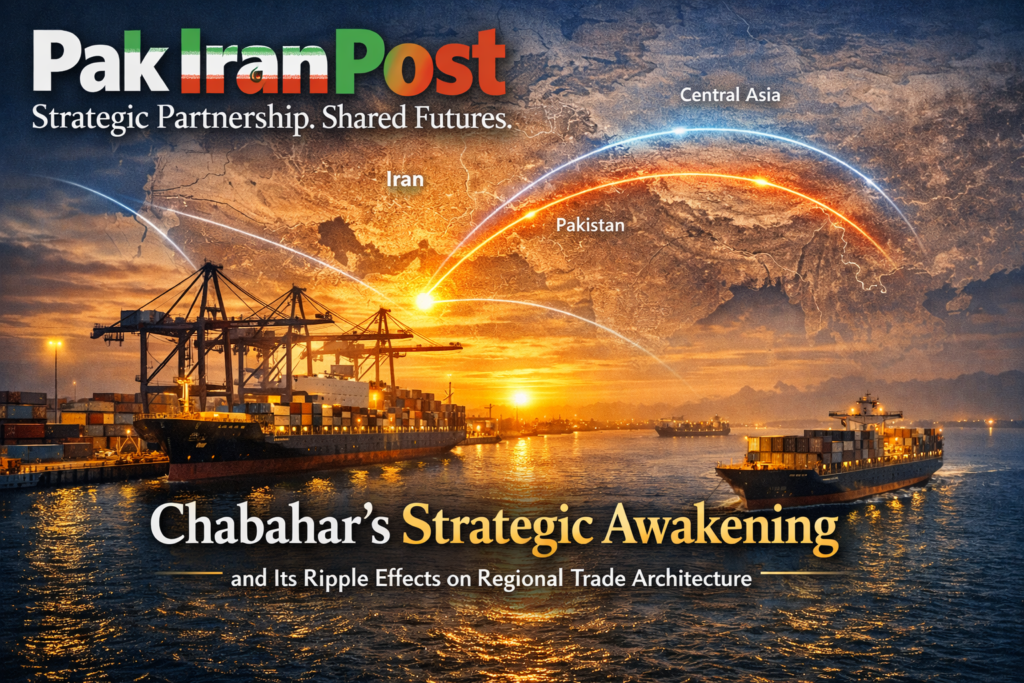
Iran’s strategic calculus has undergone a significant transformation in recent years, driven by the intersecting pressures of international sanctions, shifting regional power alignments, and the persistent challenge of economic diversification. Central to this recalibration is the port of Chabahar, situated on the Makran coast, whose activation as a functional maritime corridor represents both an economic lifeline for Tehran and a geostrategic lever in the broader Indian Ocean architecture. Chabahar’s potential as a rival to Gwadar and the China‑Pakistan Economic Corridor is a manifestation of Iran’s desire to assert influence in maritime trade routes, circumvent geopolitical bottlenecks imposed by sanctions, and anchor its economic outreach in South and Central Asia. Unlike Gwadar, which benefits from Chinese investment and long-term strategic partnership, Chabahar operates under the combined aegis of Iranian state authorities and external partners, notably India, seeking to secure an uninterrupted route for Afghan trade and resource transit. The activation of Chabahar is therefore not merely an infrastructural initiative but a deliberate geopolitical statement signaling Iran’s intent to assert autonomy in regional trade dynamics.
The port’s development gains heightened significance against the backdrop of Iran’s constrained oil revenues and restricted access to global financial systems. Sanctions, while constraining Tehran’s economic latitude, have simultaneously incentivized a search for alternative trade corridors that bypass traditional chokepoints and maritime dependencies. Chabahar is central to this vision, providing a gateway not only for Iran’s eastern provinces but also for landlocked Afghanistan, offering a direct alternative to Pakistan’s Gwadar corridor. This competition, subtle yet consequential, reshapes the calculus for regional trade diversification, influencing decisions taken by Islamabad, New Delhi, and Tehran regarding investment, transit rights, and logistical integration. From Pakistan’s perspective, Chabahar’s activation challenges the primacy of Gwadar in South Asian maritime trade, compelling policymakers to reassess border infrastructure, customs cooperation, and tariff strategies to maintain relevance in regional logistics.
Border dynamics between Iran and Pakistan further accentuate the stakes associated with Chabahar. The eastern Iranian provinces adjacent to Balochistan remain sensitive not only due to cross-border militancy but also because of economic interdependencies and smuggling networks. The dual pressures of enforcing security while facilitating legitimate trade require nuanced policy instruments. Iran’s investment in Chabahar can serve as both a stabilizing and destabilizing factor along the border. On the one hand, the port’s economic magnetism can generate employment and incentivize cross-border commerce; on the other, it may exacerbate perceptions of economic exclusion among communities traditionally aligned with Pakistani trade corridors, creating friction that could manifest in localized unrest. For Islamabad, the imperative is to balance sovereignty concerns with economic pragmatism, ensuring that cross-border trade does not inadvertently bolster transnational networks that threaten domestic stability.
Iran’s recalibration around Chabahar is not limited to economic considerations. Geopolitically, the port functions as an instrument of strategic hedging. The region’s multipolar environment, characterized by US influence in maritime security, Chinese investment in Gwadar, and Indian interest in Afghanistan, requires Tehran to diversify its operational levers. By operationalizing Chabahar, Iran not only secures a tangible trade conduit but also signals its capacity to influence regional supply chains independent of dominant powers. This hedging is particularly relevant in the context of rising tension in the Gulf and the wider Indian Ocean littoral, where maritime chokepoints such as Hormuz remain central to global energy flows. Chabahar’s emergence offers Tehran the option to mitigate dependency on transit routes vulnerable to strategic coercion, thereby enhancing resilience amid sanctions and regional instability.
India’s involvement in Chabahar adds another layer of complexity and opportunity. Indian investment in port infrastructure and transit agreements with Afghanistan reflects New Delhi’s strategic vision to counterbalance China’s presence in Gwadar while facilitating Afghan reconstruction and trade connectivity. This trilateral alignment between Iran, India, and Afghanistan complicates Pakistan’s conventional positioning as the primary transit hub for the region. The resultant competition is subtle, framed less in overt confrontation and more in the nuanced deployment of infrastructure, tariffs, and policy incentives that shape commercial flows. Pakistan’s response requires a sophisticated strategy that preserves its interests in Gwadar while acknowledging Chabahar’s functional advantages, especially in handling landlocked Afghan trade and integrating with broader regional supply chains.
The economic incentives associated with Chabahar are equally significant. The port’s development enables Iran to generate revenue streams from transit tariffs, customs duties, and ancillary logistics services. These inflows are crucial under the current sanctions regime, which constrains conventional export revenue channels. Moreover, the port’s operationalization facilitates industrial clustering along the Makran corridor, offering opportunities for regional employment, energy cooperation, and trade-linked services. For Afghanistan, Chabahar represents a viable conduit for mineral exports, agricultural products, and consumer goods, effectively bypassing Pakistani territory while fostering economic interdependence with Iran and India. For Pakistan, these dynamics necessitate recalibrated border trade policies, targeted infrastructure investment, and engagement with Iranian authorities to ensure that cross-border commercial flows complement rather than undermine national economic interests.
The strategic implications of Chabahar extend to regional security architecture. The port’s activation, while economically motivated, is accompanied by an expanded Iranian military presence aimed at safeguarding maritime assets, deterring potential interference, and projecting authority along the eastern seaboard. For Pakistan, this necessitates nuanced intelligence, border surveillance, and maritime coordination to preclude spillover risks while sustaining cooperative engagement. Similarly, for Gulf actors, Chabahar’s emergence underscores the need to integrate Iran’s eastern economic and logistical footprint into broader regional security calculations. The interplay of infrastructure, military posture, and economic leverage makes Chabahar a microcosm of Iran’s broader strategy to navigate sanctions, assert influence, and hedge against external coercion.
The regional energy landscape further accentuates Chabahar’s strategic role. Iran’s ability to transport petroleum, liquefied natural gas, and industrial inputs through the port enhances its energy diplomacy, providing Tehran with alternative export routes that mitigate vulnerability to maritime interdiction. Pakistan, heavily reliant on imported energy and oil pipelines traversing multiple corridors, must therefore consider the implications of Iran’s energy diversification, balancing its strategic alliance with Saudi Arabia and other Gulf partners against pragmatic engagement with Tehran. The interconnection between economic corridors, energy flows, and regional security underscores the multi-dimensional nature of Chabahar’s activation, highlighting the port’s significance beyond immediate trade calculations.
Diplomatic calculus also shapes Chabahar’s strategic significance. Tehran’s outreach to India, Afghanistan, and multilateral partners signals an effort to construct a coalition of stakeholders capable of sustaining the port’s operations despite external pressures. This multilateral dimension creates a nuanced environment in which Pakistan must calibrate its foreign policy, balancing opportunities for trilateral engagement with the imperative to preserve its own corridor prominence. The negotiation of transit fees, customs protocols, and security arrangements becomes an arena for strategic leverage, where subtle policy shifts can yield outsized influence over regional trade patterns.
In conclusion, Chabahar’s activation represents a defining element of Iran’s strategic recalibration under sanctions, blending economic ambition with geostrategic foresight. The port’s emergence as a rival corridor to Gwadar and a node in the broader Indian Ocean trade network underscores the interconnectedness of economic development, border management, energy flows, and security strategy. For Pakistan, this development presents both challenge and opportunity, demanding a sophisticated response that harmonizes domestic economic priorities, border security imperatives, and regional diplomatic engagement. Chabahar is therefore not merely an infrastructural project but a symbol of Iran’s capacity to navigate adversity, assert influence, and shape the regional architecture in ways that demand careful observation, strategic analysis, and proactive policy formulation.
A Public Service Message