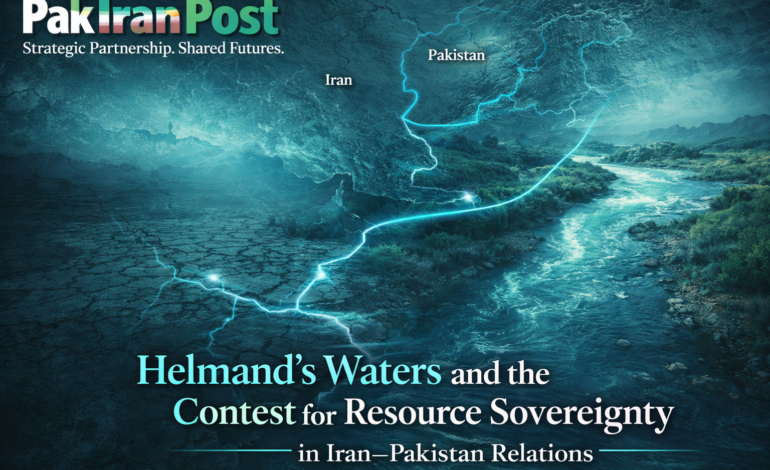
Helmand’s Waters and the Contest for Resource Sovereignty in Iran–Pakistan Relations


The Helmand River, originating in the central highlands of Afghanistan and flowing into Iran’s Sistan‑Baluchistan region, has long been a defining feature of the geopolitical, economic, and environmental landscape of the Iran–Pakistan–Afghanistan triangle. In recent years, this transboundary river has become the focal point of an intensifying struggle over water sovereignty, resource allocation, and climate adaptation, casting a shadow over bilateral relations between Tehran and Islamabad. Iran’s concerns regarding water scarcity, accelerated by upstream dam projects and changing precipitation patterns, intersect with Pakistan’s own imperative to safeguard its border communities and maintain stability in Balochistan. The interplay of natural resource management, state sovereignty, and local livelihoods has transformed the Helmand into a flashpoint, where environmental stress is inseparable from geopolitical calculation.
The intensification of Iran’s Helmand strategy is shaped by both historical precedent and contemporary pressures. The Helmand River Water Treaty, signed in 1973 between Iran and Afghanistan, aimed to establish a framework for equitable distribution, yet the efficacy of this agreement has been continually undermined by upstream dam construction, irregular flow patterns, and prolonged droughts. Iran perceives these developments as existential threats to Sistan’s agrarian economy, its aquifers, and the ecological integrity of the Hamun wetlands. The chronic reduction in river discharge has precipitated not only economic loss but also social dislocation, with rural populations facing migration pressures and diminishing agricultural productivity. Against this backdrop, Iran’s advocacy for greater adherence to treaty obligations is inseparable from its broader strategy to assert influence over transboundary resource governance, demonstrating that water politics in the Helmand basin is a microcosm of regional strategic competition.
The regional security dimension of the Helmand water crisis is acute. Iran’s deployment of border patrols, water monitoring units, and local militia support reflects a broader policy of securitizing natural resources. The border with Pakistan, particularly in the Chagai and Panjgur districts, becomes a space where environmental scarcity intersects with transnational crime, smuggling networks, and militant movement. For Islamabad, this necessitates a delicate balance: safeguarding the sovereignty and welfare of its border communities while mitigating potential diplomatic friction with Tehran. The nexus of water scarcity and cross-border security requires calibrated engagement, as any misstep could exacerbate instability in regions already vulnerable to insurgency and illicit trafficking.
Upstream developments in Afghanistan significantly shape the dynamics of the Helmand. The construction of dams such as Kajaki and Dahla, intended primarily for hydroelectric generation and irrigation, has altered seasonal flow patterns, generating tensions with Iran over water rights and environmental stewardship. Climate change exacerbates these challenges, as shifting precipitation patterns, rising temperatures, and recurrent droughts compound the unpredictability of river discharge. Iran’s framing of these upstream developments as violations of customary law and treaty obligations is entwined with a strategic narrative of existential vulnerability, emphasizing the interdependence of water security and regional stability. For Pakistan, these upstream pressures present both a challenge and an opportunity: the challenge lies in mitigating conflict spillovers and maintaining bilateral cooperation with Iran, while the opportunity exists to serve as a conduit for negotiation and technical collaboration on transboundary water management.
The economic consequences of Helmand water scarcity are profound. Iran’s eastern provinces rely heavily on river-fed agriculture, livestock rearing, and fisheries in the Hamun wetlands. Reduced water availability directly undermines the livelihoods of rural populations, exacerbating migration pressures and inflating the potential for localized unrest. Pakistan’s Balochistan region faces analogous vulnerabilities, with communities dependent on cross-border trade and shared natural resources. The interconnection of economic resilience and resource governance elevates the Helmand from a mere environmental issue to a strategic vector influencing trade, labor mobility, and local political stability. Policymakers in Tehran and Islamabad must therefore integrate water diplomacy with broader economic planning, recognizing that resource scarcity can amplify grievances and precipitate cycles of instability if left unaddressed.
Technological and scientific dimensions of Helmand water management are central to potential solutions. Satellite-based monitoring, hydrological modeling, and joint water-sharing frameworks offer avenues for mitigating scarcity and enhancing predictability. Iran’s investment in hydraulic infrastructure, including canals, dams, and reservoirs, demonstrates an intent to optimize local water use, yet unilateral interventions risk inflaming tensions. Pakistan has the technical capacity to engage in cooperative water management initiatives, leveraging expertise from its Indus basin experience to offer data-driven solutions. Joint commissions, water-sharing protocols, and adaptive policy instruments could serve as stabilizing mechanisms, converting the Helmand from a source of contestation into a platform for cooperative engagement.
The socio-political implications of water scarcity further complicate the Helmand calculus. Local communities in Sistan and Balochistan often perceive central government interventions as inadequate or misaligned with local needs, creating conditions for societal friction. Iran’s efforts to assert authority over resource allocation intersect with nationalist narratives and environmental activism, shaping domestic discourse and influencing Tehran’s posture toward Pakistan. Islamabad, in turn, must navigate domestic sensitivities in Balochistan, where grievances over marginalization, resource distribution, and cross-border coordination remain salient. The interweaving of environmental stress, local governance, and national diplomacy underscores the complexity of the Helmand water issue, demanding multi-layered analysis that accounts for both material scarcity and perception-based drivers of conflict.
International actors also factor into the Helmand equation. Regional powers, particularly those with stakes in Afghanistan’s stability and Iran’s eastern provinces, view water scarcity as a potential lever for influence. Multilateral institutions, environmental organizations, and development agencies have sought to facilitate dialogue, provide technical assistance, and promote confidence-building measures. Iran’s framing of the Helmand as a matter of national survival enhances its diplomatic leverage, compelling Pakistan and other stakeholders to consider environmental diplomacy as an integral component of regional stability. The interplay of bilateral negotiation, technical expertise, and multilateral engagement exemplifies the emerging paradigm in which environmental security is inseparable from traditional geo-strategic concerns.
Climatic factors are increasingly pivotal in shaping the trajectory of Helmand disputes. Prolonged droughts, accelerated evaporation, and soil salinity reduce the effectiveness of existing irrigation infrastructure, amplifying competition over limited water. Iran’s policy response involves both adaptive infrastructure investment and diplomatic pressure on upstream actors, reflecting an integrated approach that links environmental management with strategic security. Pakistan’s role, by contrast, is often reactive, focused on mitigating spillover impacts while engaging in limited bilateral cooperation. A forward-looking strategy would involve proactive collaboration on watershed management, disaster risk reduction, and data-sharing agreements to anticipate scarcity and reduce the risk of escalation.
The Helmand River crisis also illuminates the intersection of environmental stress and regional security architecture. Iran’s militarized posture along the border, coupled with surveillance of water flows and infrastructure, highlights the extent to which natural resources are securitized. Pakistan must reconcile its commitment to border security with the imperative of fostering cross-border cooperation, particularly in trade, migration, and local governance. Mismanagement or unilateral action risks escalating tensions, creating conditions in which water scarcity becomes a trigger for broader conflict rather than a platform for cooperation. The delicate equilibrium required underscores the strategic sensitivity of environmental governance in transboundary contexts.
In conclusion, Iran’s Helmand water strategy exemplifies the convergence of environmental, economic, and security imperatives in contemporary Iran–Pakistan relations. The river, once a shared resource largely managed through treaty frameworks, now embodies a complex web of scarcity, strategic leverage, and local vulnerability. For Tehran, the Helmand is a conduit for asserting sovereignty, mitigating climate-induced risk, and enhancing influence over border regions. For Islamabad, it is both a challenge and a domain for potential engagement, requiring calibrated diplomacy, adaptive governance, and targeted infrastructure investment. The Helmand’s waters are therefore a prism through which the intertwined dynamics of resource security, regional stability, and interstate relations can be understood, highlighting the necessity for policy innovation, strategic foresight, and multi-level cooperation in one of South Asia’s most sensitive environmental and geopolitical arenas.
A Public Service Message