Ethics of Neutral Mediation in Conflict Zones Pakistan Between Normative Neutrality and Strategic Self Interest

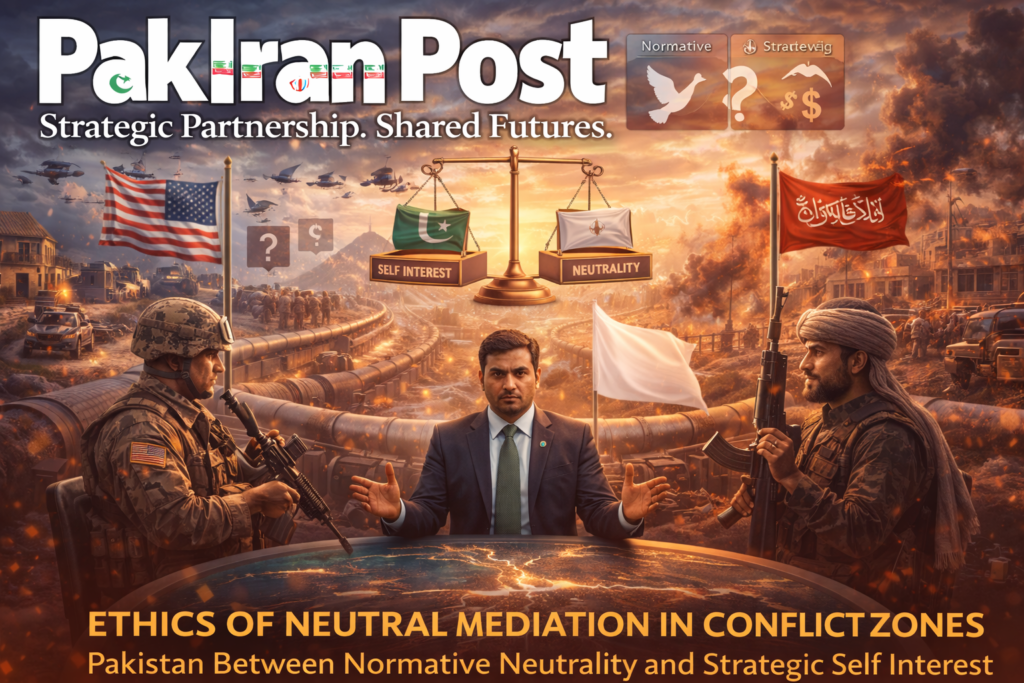
Neutral mediation in conflict zones has long been imagined as a moral posture elevated above the turbulence of power politics, a position from which a state or actor appears to hover above the battlefield of competing interests, offering dialogue where violence dominates and structure where chaos prevails. Yet this imagined neutrality collapses when examined through the dense architecture of international relations, where every gesture of mediation is already inscribed within strategic calculation, historical memory, economic dependence, and symbolic capital. Pakistan’s recurring emergence as a mediator in regional and trans regional conflicts offers a particularly revealing case through which to interrogate whether neutrality is ever truly normative or whether it is always already embedded in strategic self-interest, even when framed in ethical language.
The concept of neutrality itself is not a natural state but a constructed narrative, a moral vocabulary developed within the European experience of interstate warfare and later universalized through international law and diplomatic convention. In practice, neutrality functions less as absence of interest and more as a disciplined performance of restraint, a choreography of language and positioning designed to signal impartiality while often concealing subtle alignments. When applied to conflict zones shaped by asymmetrical power, colonial afterlives, and fragmented sovereignties, neutrality becomes even more unstable. It is here that Pakistan’s mediation practices must be situated, not as isolated diplomatic acts but as expressions of a deeper strategic grammar shaped by security concerns, regional rivalries, ideological positioning, and economic vulnerability.
Pakistan’s mediation engagements in Afghanistan, its diplomatic balancing between Iran and Saudi Arabia, and its positioning in broader Muslim world conflicts illustrate a pattern where neutrality is simultaneously claimed and questioned. On the surface, mediation is framed as ethical commitment to peace, stability, and Islamic solidarity. Beneath this surface, however, lies a layered field of strategic necessity. Geography imposes constraints that are not optional. Proximity to conflict zones produces spillover risks, refugee flows, militant mobility, and economic disruption. Mediation becomes not only a moral act but a form of defensive diplomacy, a way of managing instability before it transforms into internal fragmentation.
To understand this duality, it is necessary to move beyond classical realism and liberal institutionalism and enter what may be termed a trans normative paradigm. This approach does not treat norms and interests as separate categories but as interwoven processes through which states construct legitimacy. In this view, neutrality is not the absence of strategy but the transformation of strategy into moral language. The ethical claim becomes the vessel through which strategic intent travels internationally without triggering immediate resistance or suspicion.
Within this framework, the mediation role of Pakistan can be read as a form of narrative diplomacy. It constructs a story in which Pakistan is positioned as bridge, facilitator, and stabilizer. This narrative is not merely external communication but internal identity formation. States, like individuals, require stories to stabilize their actions. The mediation narrative allows Pakistan to reconcile its security driven foreign policy with its aspiration for international moral recognition. Yet this reconciliation is never complete, because every mediation effort is evaluated simultaneously through ethical and strategic lenses by external observers.
It is at this intersection that the philosophical challenge of neutrality becomes visible. Can an actor embedded in a conflict ecosystem ever stand outside it sufficiently to mediate without bias? Or is mediation itself a continuation of conflict by other means, a symbolic extension of struggle into the realm of discourse? Here the thought of Noam Chomsky becomes particularly relevant, especially his analysis of power, consent, and ideological manufacturing. The work of Noam Chomsky offers a critical lens through which to interpret how narratives of neutrality are constructed and circulated.
Chomsky’s theory of manufactured consent suggests that dominant structures of power shape not only political outcomes but also the framework within which those outcomes are interpreted. Applied to international mediation, this implies that neutrality is not simply claimed by mediators but is recognized or denied within an information ecosystem already structured by power asymmetries. In other words, whether Pakistan is perceived as neutral or self serving is not solely a function of its actions but also of how global media, strategic alliances, and dominant geopolitical actors frame those actions.
In conflict zones, mediation is therefore never purely bilateral between mediator and parties in conflict. It is triangular, involving the mediator, the conflict parties, and the global narrative environment that validates or delegitimizes mediation efforts. This environment is shaped by states with greater discursive power, international institutions, and media systems that filter complex realities into simplified moral binaries. Within such a structure, neutrality becomes a contested sign rather than a stable attribute.
Pakistan’s experience illustrates this tension. When acting as a facilitator in Afghan peace processes, its role is alternately described as indispensable mediation or strategic manipulation depending on the observer’s position within the global power hierarchy. Similarly, its attempts to balance relations between Tehran and Riyadh are interpreted either as responsible diplomacy or opportunistic positioning. The ethical evaluation of mediation thus becomes inseparable from geopolitical alignment.
Yet reducing mediation entirely to self interest would be equally simplistic. Such a reduction ignores the genuine normative commitments that emerge within diplomatic institutions, where individuals and bureaucracies internalize ideals of peace, stability, and humanitarian concern. These commitments are not merely masks for strategy but can become real motivational structures that shape decision making. The ethical and the strategic coexist not as opposites but as overlapping layers of intention.
The paradox of neutral mediation lies precisely in this coexistence. A mediator may act out of sincere ethical concern while simultaneously advancing strategic objectives, often without clear separation between the two. The human mind and the institutional state both operate through layered rationalities rather than singular logics. This is why mediation in conflict zones often appears inconsistent, sometimes idealistic, sometimes pragmatic, sometimes constrained by external pressure, and sometimes driven by internal conviction.
If we extend this analysis into philosophical metaphor, mediation can be imagined as a river flowing between two burning landscapes. The river appears calm, reflective, and separate from fire, yet its course is shaped by the heat on both sides, by the gradient of terrain, and by subterranean pressures that determine direction. Neutrality in this sense is not still water but moving water shaped by forces it does not fully control. Pakistan’s mediation role similarly flows through pressures of regional insecurity, global expectation, economic dependency, and ideological positioning.
The trans normative dimension emerges when these forces are not treated as contradictions but as co constitutive elements of diplomatic identity. In this view, norms do not sit above strategy but are produced through strategic interaction. Neutrality is not a prior moral state but an outcome of continuous negotiation between what a state is compelled to do and what it wishes to be seen doing. The ethics of mediation therefore cannot be judged solely by outcomes or intentions but must be analyzed as an evolving field of meaning making.
This has profound implications for how international mediation is assessed. If neutrality is always partially constructed, then accusations of bias cannot be resolved purely through factual verification of actions. They must instead be understood as struggles over interpretive authority. Who has the power to define neutrality determines whether mediation is accepted as legitimate or dismissed as self serving. This returns us to Chomsky’s insight that power operates not only through coercion but through control of interpretive frameworks.
In practical terms, Pakistan’s mediation efforts exist within a global system where certain states possess greater capacity to define legitimacy. Media ecosystems based in major global centers often shape the narrative environment within which mediation is judged. As a result, smaller or mid tier powers engaged in mediation must constantly perform additional layers of justification, ensuring that their actions are legible within dominant normative frameworks. This performative burden itself influences the nature of mediation, pushing it toward rhetorical alignment with globally accepted ethical language.
However, this does not mean that mediation is merely performative. In many cases, mediators do succeed in reducing tensions, facilitating dialogue, and preventing escalation. These outcomes have real material consequences regardless of narrative framing. The ethical dimension of mediation therefore cannot be dismissed as illusion. Instead, it must be understood as embedded within a contested field where real effects and constructed meanings continuously interact.
The question of whether Pakistan’s mediation is normatively neutral or strategically self serving thus resists binary resolution. It is both, neither, and something more complex. It is both because strategic necessity and ethical aspiration coexist within state behavior. It is neither because pure neutrality and pure self interest are theoretical abstractions that rarely exist in practice. And it is something more because mediation operates within trans normative space where ethics and strategy merge into a single dynamic process of positioning.
One might say that mediation is the art of speaking in a language that simultaneously conceals and reveals intention. Every statement is double coded, addressed both to the parties in conflict and to the global audience that evaluates legitimacy. In this sense, mediators are translators between incompatible worlds, but also authors of narratives that shape future possibilities of conflict and peace.
The philosophical challenge, therefore, is not to decide whether neutrality is real or fake but to understand how the concept functions within global political consciousness. Neutrality is a necessary fiction, not in the sense of falsehood but in the sense of structural imagination. It allows actors to coordinate, to trust, and to negotiate even in the absence of complete transparency. Without such fiction, diplomacy would collapse into raw confrontation.
Pakistan’s mediation role should thus be seen as participation in this necessary fiction while also being constrained by it. The state must continuously balance between being seen as neutral and acting in ways that preserve its strategic interests. This balancing act is not hypocrisy but structural condition of modern diplomacy.
Returning to Chomsky’s analytical lens, one might argue that the global system of mediation evaluation is itself embedded in asymmetries of informational power. Narratives about neutrality are not evenly produced but filtered through institutions that reflect existing hierarchies. This means that the ethical evaluation of any mediator, including Pakistan, is never purely objective but always mediated by structures of perception.
In conclusion, neutral mediation in conflict zones cannot be understood as a stable ethical category separate from strategy. It is a dynamic and contested space where norms and interests intertwine, where narratives shape realities, and where actors continuously negotiate between moral language and geopolitical necessity. Pakistan’s role exemplifies this complexity, revealing mediation not as absence of interest but as sophisticated management of overlapping imperatives. In the end, neutrality is not a destination but a language through which conflict itself is partially transformed, even as it continues to persist beneath its surface.
A Public Service Message