
Domestic Political Pressures Shape Pakistan Iran Foreign Policy Signalling Dynamics

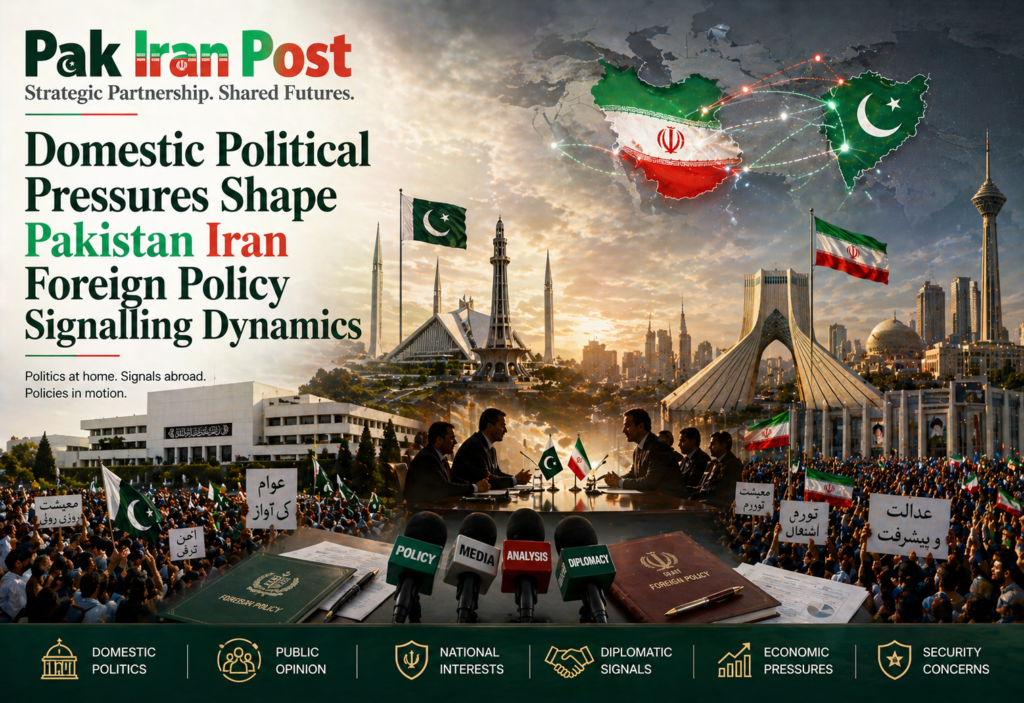
Foreign policy between Pakistan and Iran is often described in conventional diplomatic language as a function of geography, shared borders, trade potential, and periodic security cooperation. Yet such descriptions increasingly fail to capture the deeper and more volatile substrate on which bilateral relations are constructed. Beneath official communiqués and carefully staged visits lies a far more consequential reality: both states are increasingly constrained, and at times even driven, by their internal political pressures, where elections, legitimacy crises, institutional rivalries, protest cycles, and media ecosystems collectively shape how each country speaks to the other, and when it chooses to speak at all.
In this sense, Pakistan and Iran are not merely neighbours engaging in diplomacy. They are two politically complex systems whose external signalling is increasingly an extension of internal management strategies. Foreign policy, particularly in moments of tension or transition, is not only about external alignment but about domestic narrative control. Statements issued in Islamabad or Tehran are often simultaneously messages to the other side and coded communications to domestic audiences, security institutions, and fragmented political coalitions.
Pakistan’s foreign policy posture towards Iran is deeply intertwined with its civil military configuration. The military establishment remains a dominant actor in security and external affairs, particularly along sensitive border regions such as Balochistan. Civilian governments, whether elected or transitional, often operate within constraints where strategic continuity is preserved by non-elected institutions. This produces a layered decision-making environment in which foreign policy signalling is rarely singular. A statement from the foreign office may reflect diplomatic caution, while parallel signals from security officials reflect operational realities on the ground.
Iran, by contrast, operates under a theocratic republican structure where elected institutions coexist with powerful unelected clerical bodies and security agencies. Foreign policy towards Pakistan is influenced not only by the presidency and foreign ministry but also by the Supreme Leader’s strategic orientation, the Islamic Revolutionary Guard Corps, and competing political factions that differ on the extent of regional engagement and ideological posture. Domestic unrest, whether driven by economic pressures, sanctions, or social demands, further complicates Tehran’s external signalling, as the state often seeks external stability narratives during internal turbulence.
In both countries, electoral cycles play a subtle but significant role in shaping bilateral rhetoric. In Pakistan, elections generate heightened sensitivity around sovereignty, border security, and national dignity, often leading to sharper rhetoric even when underlying diplomatic channels remain stable. Governments approaching elections tend to emphasise strength and control, especially in relation to border management and counter militancy narratives. Iran, while operating under a different electoral logic, also experiences periodic political recalibration during presidential transitions, where competing factions use foreign policy signalling to demonstrate ideological consistency or pragmatic flexibility.
The result is a pattern in which bilateral relations experience cyclical fluctuations not necessarily because of structural breakdowns but because of internal political timing. Periods of domestic consolidation tend to produce calmer diplomatic language, while periods of political uncertainty generate sharper, more performative signalling. This creates a rhythm in Pakistan Iran relations that is less linear than reactive, less strategic than adaptive.
Civil military relations in Pakistan are particularly influential in shaping this rhythm. Security incidents along the Pakistan Iran border, especially in Balochistan and Sistan Balochistan regions, often trigger immediate security driven responses. Yet these responses are typically followed by rapid diplomatic de-escalation, suggesting the presence of strong internal coordination mechanisms aimed at preventing escalation beyond a controllable threshold. This pattern reflects an understanding that border instability is not merely a bilateral issue but a domestic governance challenge for both states, particularly in regions where state authority is contested by non-state actors.
Iran’s internal political dynamics also shape its external behaviour towards Pakistan in similar ways. Economic pressures arising from sanctions, combined with periodic social protests, have reinforced the need for external stability narratives. Pakistan, in this context, is often framed as a manageable and necessary neighbour through which trade corridors, energy discussions, and regional connectivity projects can be sustained despite broader geopolitical isolation. This framing is not purely strategic but also domestic, as it signals state capacity to maintain regional engagement despite external constraints.
One of the most under examined dimensions of Pakistan Iran relations is the role of media ecosystems in constructing and amplifying perceptions of tension or alignment. Traditional media in both countries often operate within national narrative frameworks that emphasise sovereignty, security, and ideological coherence. However, digital platforms have introduced a more fragmented and volatile information environment where sectarian, nationalist, and politically motivated narratives circulate with greater speed and less institutional mediation.
In Pakistan, media narratives around Iran are frequently filtered through security concerns, regional alignments, and occasionally sectarian undertones, even when official policy emphasises diplomatic engagement. In Iran, media portrayals of Pakistan oscillate between strategic neighbourly framing and episodic concern over border security incidents or external alignments. Social media further complicates this landscape, as transnational religious and political networks amplify selective incidents, often detaching them from broader diplomatic context.
This divergence between state level strategic intent and media level narrative construction produces what can be described as narrative dissonance. At the state level, Pakistan and Iran often share pragmatic interests in border stability, trade facilitation, and regional coordination. At the media and public discourse level, however, these shared interests are frequently obscured by episodic amplification of conflict events, identity politics, and external geopolitical narratives.
The domestic political environment in both countries acts as a filter through which foreign policy signals are produced and interpreted. In Pakistan, coalition politics, civil military coordination, and regional security pressures shape a foreign policy environment where messaging must satisfy multiple internal stakeholders simultaneously. In Iran, factional competition within the political system, combined with the strategic priorities of security institutions, produces a similarly complex signalling environment where consistency is often less important than controlled ambiguity.
Border security incidents between Pakistan and Iran illustrate this dynamic clearly. When incidents occur, immediate responses tend to be assertive, reflecting domestic pressures to demonstrate control and sovereignty. Yet these episodes are often followed by rapid diplomatic engagement aimed at de-escalation. This cycle suggests that both states have developed informal mechanisms for crisis containment that operate alongside formal diplomatic channels. These mechanisms are likely reinforced by shared recognition that prolonged escalation would disproportionately harm border stability and internal security in already sensitive regions.
The speed of diplomatic repair following such incidents also reveals an important feature of contemporary Pakistan Iran relations: escalation is increasingly performative and limited, while de-escalation is structured and relatively predictable. This suggests a form of managed instability, where both sides signal resolve without allowing conflict to expand beyond a defined threshold.
Elections and leadership transitions further complicate this pattern. In Pakistan, changes in government often lead to recalibration in foreign policy messaging, even if core strategic positions remain unchanged. New administrations tend to emphasise distinct rhetorical tones, particularly on sovereignty and regional engagement, as a means of establishing domestic legitimacy. Iran experiences similar dynamics during presidential transitions, where competing political factions seek to influence external relations in ways that reflect their ideological positioning.
Protest politics in both countries adds another layer of complexity. In Iran, periodic waves of protest introduce uncertainty into the domestic political environment, prompting the state to seek external stability narratives and emphasise regional partnerships as a counterbalance to internal pressures. In Pakistan, protests linked to political competition or regional grievances can similarly influence foreign policy tone, particularly when border regions are involved. In both cases, domestic unrest tends to increase the importance of controlled external messaging.
What emerges from this complex interplay is a bilateral relationship that is less driven by linear strategic planning and more by adaptive signalling under domestic constraint. Pakistan and Iran do not operate in isolation from their internal political environments; rather, their foreign policies are extensions of those environments. Each statement, visit, or diplomatic gesture is shaped by a calculation that includes not only external strategic considerations but also internal political risk management.
These dynamic challenges conventional interpretations of Pakistan Iran relations as either purely strategic or purely ideological. Instead, it suggests a more fluid reality in which domestic politics, media narratives, institutional competition, and crisis management all interact to produce a constantly shifting diplomatic equilibrium.
In such an environment, stability is not the absence of tension but the capacity to manage it. Pakistan and Iran appear to have developed a pragmatic understanding of this principle. Their relations are characterised not by the elimination of friction but by its containment within predictable bounds. Foreign policy signalling, therefore, becomes less about achieving final resolutions and more about maintaining manageable uncertainty.
As regional geopolitics continues to evolve, particularly under shifting Middle Eastern alignments and changing global power structures, the domestic political foundations of Pakistan Iran relations will likely become even more significant. External diplomacy will increasingly reflect internal political logic, and bilateral signalling will remain deeply embedded in the domestic contestations of both states.
In this sense, understanding Pakistan Iran relations requires moving beyond traditional diplomatic analysis and engaging with the deeper political architectures that shape how both states perceive stability, manage crisis, and communicate intent. It is within these architectures that the real grammar of their foreign policy signalling continues to evolve.
A Public Service Message