
From Symbolism to Systems Institutionalising Pakistan Iran Economic Dialogue

The economic relationship between Pakistan and Iran has long been trapped in a paradox of proximity without integration. Geography suggests inevitability, history suggests familiarity, and political rhetoric repeatedly invokes brotherhood, yet the structural reality is one of fragmented trade channels, underdeveloped financial connectivity, and intermittent policy attention. In the emerging geopolitical economy of South and West Asia, where corridors of energy, logistics, and digital trade are being rapidly reconfigured, the persistence of symbolic rather than systemic economic engagement between Islamabad and Tehran is becoming increasingly untenable.
The dominant characteristic of Pakistan Iran economic interaction has been its episodic nature. Periods of diplomatic warmth generate ambitious declarations about expanding trade volumes, establishing energy pipelines, and creating border markets, yet these commitments rarely translate into durable institutional architecture. Trade figures fluctuate modestly but remain far below potential, constrained by sanctions regimes, banking restrictions, customs inefficiencies, and policy discontinuities. Despite repeated political statements expressing intent to elevate bilateral trade significantly, structural bottlenecks persist, and implementation gaps remain wide.
This gap between aspiration and execution is not merely technical. It reflects a deeper epistemic problem in how both states conceptualise economic relations. Trade is often treated as an extension of diplomatic goodwill rather than as a self sustaining system governed by institutional rules, regulatory predictability, and infrastructural continuity. As a result, economic engagement becomes vulnerable to political cycles, external pressures, and episodic crises.
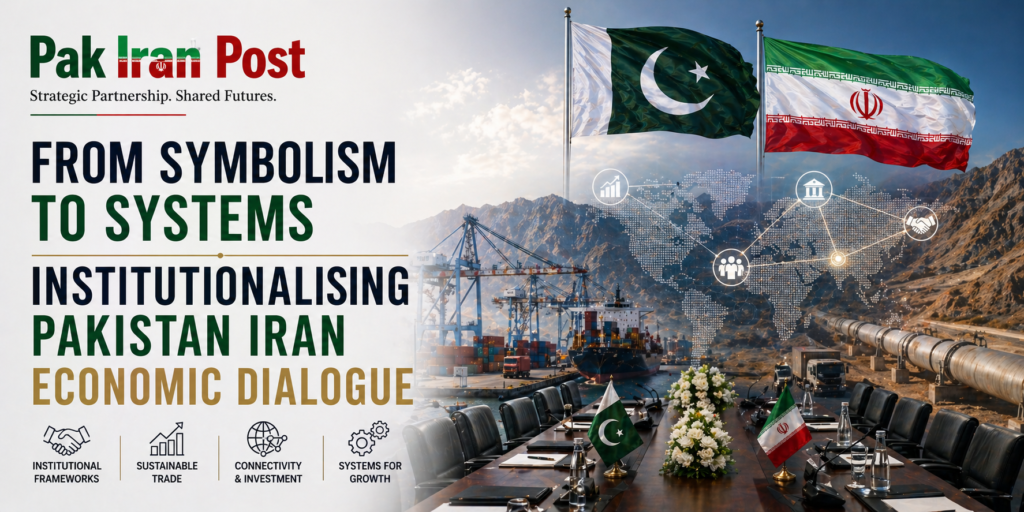
The argument for institutionalising Pakistan Iran economic dialogue is therefore fundamentally an argument for transforming symbolism into systems. Symbolism operates through gestures, announcements, and high level meetings. Systems operate through rules, institutions, and predictable processes. Without this transformation, economic engagement will continue to oscillate between rhetorical optimism and practical stagnation.
The first requirement of systemic transformation is institutional permanence. A recurring weakness in Pakistan Iran economic engagement is the absence of a standing bilateral economic mechanism with implementation authority. Existing dialogues tend to be ad hoc, convened in response to political visits or crisis moments, and lack continuity. A permanent economic coordination chamber, jointly staffed and technically empowered, would provide an institutional anchor capable of sustaining policy dialogue beyond political cycles. Such a body would not merely facilitate discussion but monitor implementation, resolve operational bottlenecks, and ensure continuity of agreed reforms.
This institutionalisation becomes particularly important in a context where both countries face significant internal economic pressures. Pakistan’s external account vulnerabilities and Iran’s sanctions constrained financial system create asymmetries that limit conventional trade expansion. In such an environment, only structured and rule based systems can reduce uncertainty and transaction costs sufficiently to enable meaningful economic exchange.
The second pillar of systemic transformation is customs harmonisation. At present, border trade is characterised by procedural fragmentation, manual documentation systems, and inconsistent enforcement practices. These inefficiencies not only slow legitimate trade but also create space for informal and illicit flows that distort economic incentives. In recent years, informal fuel and goods trade across the Pakistan Iran border has expanded significantly, highlighting the gap between formal regulatory frameworks and on ground economic realities. Such patterns indicate not merely enforcement failures but systemic design weaknesses.
Addressing this requires digitisation of customs processes, standardisation of tariff classifications, and real time data sharing between border authorities. The objective is not simply to increase trade volume but to formalise existing economic activity into regulated channels. Without such reform, informal economies will continue to dominate cross border exchange, undermining state capacity and revenue collection on both sides.
The third dimension is financial architecture. Perhaps the most significant constraint on Pakistan Iran trade is the lack of reliable banking channels due to international sanctions and compliance restrictions. This has forced both sides to rely on indirect mechanisms, barter arrangements, or third party intermediaries, all of which increase transaction costs and reduce transparency. While sanctions constraints cannot be ignored, they also cannot be allowed to fully determine the structure of bilateral economic relations.
Alternative financial mechanisms must therefore be explored within a compliance aware framework. These may include local currency settlement arrangements, limited barter systems for energy and essential commodities, and the use of third country clearing mechanisms where direct transactions are not feasible. While none of these solutions are ideal, they represent pragmatic adaptations to structural constraints rather than attempts to circumvent them.
Energy cooperation remains the most strategically significant yet persistently stalled component of Pakistan Iran economic relations. The idea of energy connectivity, particularly through gas pipelines and electricity trade, has been repeatedly discussed for decades but remains unrealised due to financing challenges, sanctions pressures, and shifting geopolitical conditions. However, energy demand asymmetries between the two countries continue to create underlying economic logic for cooperation.
A systemic approach would reframe energy cooperation away from large scale binary projects and towards modular, incremental arrangements. These could include electricity swaps in border regions, localized grid interconnections, and flexible supply agreements that can operate within existing regulatory constraints. Such approaches reduce political risk while preserving the long term possibility of deeper integration.
The fourth pillar of institutionalisation is transport and logistics integration. Pakistan and Iran occupy a critical geographic position connecting South Asia, the Middle East, and Central Asia. However, this potential remains underutilised due to fragmented transport agreements and limited infrastructure coordination. A systems based approach would prioritise corridor development thinking, linking road, rail, and port infrastructure into integrated logistics chains rather than isolated bilateral projects.
This would also align with broader regional connectivity trends, where Eurasian trade routes are being reconfigured through multiple competing corridors. In this context, Pakistan Iran connectivity should not be viewed in isolation but as part of a wider regional logistics ecosystem in which efficiency, predictability, and interoperability determine strategic relevance.
In contemporary media narratives, Pakistan Iran economic relations are often overshadowed by security centric framing. Economic underperformance is frequently interpreted as an inevitable consequence of geopolitical constraints rather than because of institutional underdevelopment. This narrative framing has the effect of naturalising stagnation and reducing pressure for reform. By contrast, a systems-based approach reframes economic underperformance as a governance challenge rather than a geopolitical destiny.
The shift from symbolism to systems therefore also requires a shift in narrative architecture. Economic relations must be discussed in terms of institutional capacity, regulatory efficiency, and infrastructural integration rather than abstract political affinity. Without this discursive shift, policy inertia is likely to persist even in the presence of political goodwill.
Ultimately, the institutionalisation of Pakistan Iran economic dialogue is not merely a technical reform agenda but a structural transformation of how both states conceptualise their bilateral relationship. It requires moving from a diplomacy of gestures to a governance of systems, from episodic engagement to continuous coordination, and from symbolic declarations to measurable implementation frameworks.
In a region defined by shifting economic corridors, sanctions regimes, and competitive connectivity projects, the cost of remaining at the level of symbolism is increasing. Systems, unlike symbolism, accumulate value over time. They create predictability, reduce friction, and enable scale. For Pakistan and Iran, the challenge is not to imagine new forms of economic cooperation, but to build the institutional foundations that allow cooperation to become routine rather than exceptional.
The future of Pakistan Iran economic relations will therefore depend less on the intensity of political rhetoric and more on the depth of institutional design. Only by embedding economic dialogue within durable systems can both countries move beyond the cycle of expectation and disappointment that has long defined their economic engagement.
A Public Service Message