

Border Frontiers Redefine Emerging Pakistan Iran Strategic Security Architectures Across Eurasia

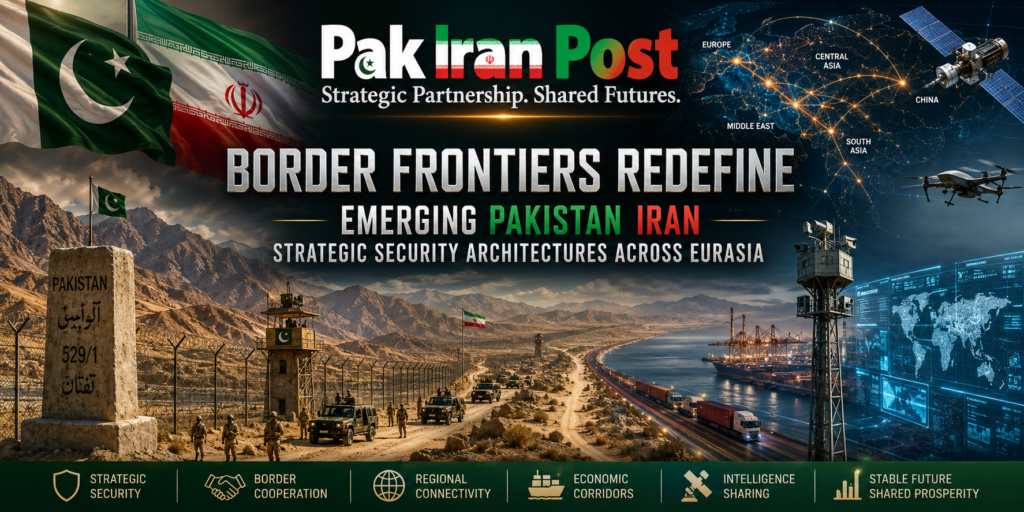
The geography separating Pakistan and Iran has historically been interpreted through the language of distance, suspicion, and peripheral instability. Yet the strategic meaning of this frontier is undergoing a profound transformation under the pressures of regional fragmentation, post American uncertainty, and the accelerating competition over Eurasian connectivity. What was once viewed merely as a volatile borderland between two unevenly aligned states is increasingly emerging as a critical geopolitical membrane connecting South Asia, the Middle East, Central Asia, and the northern Arabian Sea. In this evolving environment, strategic depth is no longer measured through territorial buffers or conventional military positioning alone. It is now being reconstructed through infrastructural resilience, intelligence synchronization, corridor governance, and the management of transnational vulnerabilities.
For decades, both Islamabad and Tehran approached their bilateral relationship through a cautious and often reactive security framework shaped by competing alliances, sectarian anxieties, and geopolitical mistrust. Pakistan’s strategic dependence upon Gulf monarchies and Western security partnerships frequently complicated its engagement with Tehran, while Iran historically viewed Pakistan through the prism of external influence and regional balancing. Nevertheless, the gradual erosion of the unipolar regional order, combined with the withdrawal of Western military power from Afghanistan, has fundamentally altered the strategic calculations of both capitals.
Afghanistan’s prolonged instability has transformed the Pakistan Iran frontier into a highly sensitive security corridor vulnerable to militant mobility, narcotics trafficking, illicit economies, and insurgent infiltration. The resurgence of transnational militant networks operating across Balochistan and Sistan Baluchestan has exposed the inadequacy of traditional border policing mechanisms. As a consequence, both states are incrementally moving toward hybrid security governance combining selective military coordination with infrastructural consolidation and intelligence cooperation.
This shift reflects a broader transformation occurring across contemporary geopolitics. Strategic depth in the twenty first century is increasingly infrastructural rather than exclusively territorial. States now seek security through the protection of supply chains, transport corridors, digital systems, energy routes, and economic nodes rather than through conventional military expansion alone. Pakistan and Iran, despite their political divergences, are gradually recognizing that unmanaged instability along their frontier threatens not only territorial security but also future economic viability within the wider Eurasian order.
The changing role of China in the region has accelerated this recalibration. Beijing’s long term investments in regional infrastructure, particularly through the China Pakistan Economic Corridor, have elevated the strategic significance of western Pakistan and adjacent maritime routes. For China, instability along the Pakistan Iran frontier represents a potential threat to corridor security and logistical continuity. Consequently, the frontier is no longer viewed merely through bilateral Pakistani Iranian calculations but increasingly within the broader architecture of Eurasian connectivity.
At the same time, Iran’s growing integration into trans regional connectivity initiatives has altered Tehran’s regional posture. Isolated economically by sanctions yet strategically indispensable because of geography, Iran has sought to reposition itself as a central transit node linking the Gulf, Central Asia, Russia, and South Asia. This ambition inevitably intersects with Pakistan’s own aspirations to transform from a security dependent state into a connectivity driven regional actor. The result is a reluctant convergence shaped less by ideological alignment than by infrastructural necessity.
However, this convergence remains constrained by powerful external pressures. Gulf monarchies continue to perceive Iranian regional influence through a competitive and often securitized lens. Simultaneously, Western strategic discourse frequently frames the Pakistan Iran frontier as a potential theatre of proxy conflict, sectarian escalation, and geopolitical destabilization. These narratives are amplified through international media ecosystems that repeatedly portray border regions as inherently ungovernable spaces characterized by extremism, informality, and chronic instability.
Such portrayals serve important geopolitical functions. By framing the frontier primarily through the language of militancy and insecurity, external actors reinforce perceptions of regional fragility that justify interventionist security frameworks while discouraging independent regional integration. The politics of narrative construction therefore becomes inseparable from the politics of infrastructure and sovereignty. In contemporary geopolitics, states are increasingly compelled to defend not only their territorial boundaries but also their informational legitimacy.
This dynamic is particularly visible in the discourse surrounding Balochistan. International narratives frequently reduce the region to an insurgency ridden periphery disconnected from wider strategic transformations. Yet Balochistan today occupies a pivotal location within competing visions of Eurasian integration, maritime trade, and corridor politics. Its instability is not merely a domestic security challenge for Pakistan and Iran. It is also embedded within wider struggles over regional influence, infrastructural control, and strategic orientation.
Consequently, both Islamabad and Tehran are experimenting with new forms of technologically mediated border governance. The deployment of biometric systems, digital surveillance platforms, fencing projects, predictive intelligence mechanisms, and drone monitoring reflects the emergence of algorithmic sovereignty across vulnerable frontier regions. These technologies are intended to compensate for weak institutional penetration and difficult terrain while limiting insurgent mobility and illicit economic flows.
Yet the expansion of surveillance driven governance also carries significant risks. Excessive securitization without parallel socio economic integration can deepen alienation among marginalized border populations already distrustful of centralized authority. Borderland communities historically dependent upon informal cross border trade networks often experience state securitization as economic exclusion rather than stabilization. This creates conditions where militant recruitment, smuggling economies, and anti state sentiment can persist despite technological enforcement.
The deeper challenge for both Pakistan and Iran therefore lies not merely in securing the border but in transforming the political economy of the frontier itself. Sustainable stabilization requires the creation of legitimate economic alternatives capable of integrating peripheral populations into broader developmental frameworks. Border markets, transport connectivity, energy cooperation, and localized economic zones possess the potential to convert frontier regions from zones of vulnerability into zones of mutual interdependence.
This logic increasingly shapes strategic thinking within sections of both states’ policy establishments. There is growing recognition that economic fragmentation and security fragmentation reinforce one another. Under conditions of persistent underdevelopment, infrastructural neglect, and political marginalization, borderlands become vulnerable to exploitation by militant actors, criminal networks, and external geopolitical manipulation. Conversely, controlled economic integration can create stabilizing incentives that reduce the appeal of insurgent economies.
The Gwadar Chabahar dynamic illustrates this evolving strategic complexity. For years, both ports were framed within zero sum geopolitical narratives emphasizing Chinese Indian rivalry and regional competition. Yet changing global trade realities, disruptions in maritime shipping routes, and the restructuring of energy corridors are gradually encouraging more pragmatic interpretations. Increasingly, regional analysts recognize that the future viability of both ports may depend less upon strategic exclusion and more upon functional complementarity within a wider Indian Ocean commercial ecosystem.
This possibility remains politically sensitive. Pakistan must carefully balance its strategic partnership with China while avoiding perceptions that deeper engagement with Iran threatens Gulf relationships or Western economic interests. Iran similarly seeks regional integration without appearing strategically subordinate to external powers. Nevertheless, the pressures of economic uncertainty, sanctions constraints, and shifting global trade patterns are compelling both states to reconsider older geopolitical rigidities.
The transformation of connectivity into the central currency of modern geopolitics further intensifies this recalibration. Infrastructure is no longer economically neutral. Roads, pipelines, railways, ports, and fiber optic systems now function as instruments of strategic influence capable of shaping political alignments, economic dependencies, and regional hierarchies. The contest over Eurasian integration is therefore not simply about commerce. It is fundamentally about the architecture of future power.
Within this environment, Pakistan and Iran occupy a uniquely consequential position. Their geography connects multiple strategic theatres simultaneously. South Asia, the Gulf, Central Asia, the Arabian Sea, and western China intersect across their territorial space. This convergence grants both states significant geopolitical leverage but also exposes them to external competition and internal vulnerability.
The emerging regional order increasingly rewards states capable of managing interdependence rather than resisting it entirely. Strategic autonomy today derives less from isolation than from the ability to diversify partnerships, regulate connectivity, and prevent overdependence upon singular geopolitical patrons. Pakistan and Iran therefore face a historic strategic choice. They can remain trapped within reactive security paradigms shaped by mistrust and external pressure, or they can pursue calibrated geo economic coordination capable of enhancing regional relevance and internal stability.
Achieving such a transition requires institutional maturity and long term strategic vision. Episodic diplomatic engagement is insufficient. Both states require permanent bilateral mechanisms focused upon intelligence coordination, border governance, economic integration, and infrastructural security. These mechanisms must be insulated from temporary political crises and sectarian pressures.
Equally important is the need for narrative sovereignty. Pakistan and Iran must develop indigenous intellectual and media frameworks capable of articulating regional integration from within rather than allowing external powers to monopolize geopolitical storytelling. The battle over perception increasingly shapes investment flows, diplomatic legitimacy, and strategic partnerships. Without coherent narrative construction, even viable connectivity initiatives risk international skepticism and domestic fragmentation.
The future of the Pakistan Iran frontier will therefore depend upon whether both states can move beyond inherited geopolitical anxieties and recognize the structural realities of an interconnected Eurasian order. Borderlands once associated primarily with militancy and instability are gradually becoming central to the politics of infrastructure, logistics, and regional connectivity. The frontier is no longer merely a line of separation. It is becoming a strategic corridor whose management may shape the future balance of power across South and West Asia.
In the coming decade, the durability of Pakistan Iran relations will be determined less by rhetorical diplomacy and more by the ability to construct sustainable frameworks of infrastructural cooperation, technological governance, and economic resilience. Strategic depth has entered a post territorial era. States now defend themselves not only through military preparedness but through the protection of corridors, systems, narratives, and peripheral societies from fragmentation and external disruption. For Pakistan and Iran, adapting to this reality is no longer optional. It is becoming an existential geopolitical imperative.
A Public Service Message


