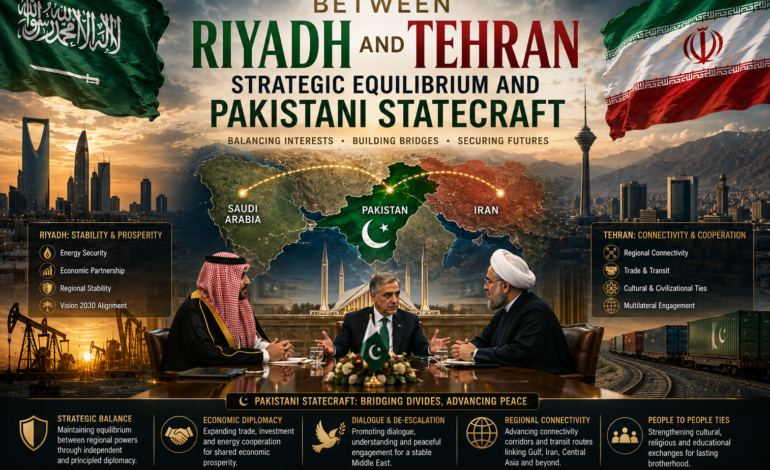
Between Riyadh and Tehran Strategic Equilibrium and Pakistani Statecraft

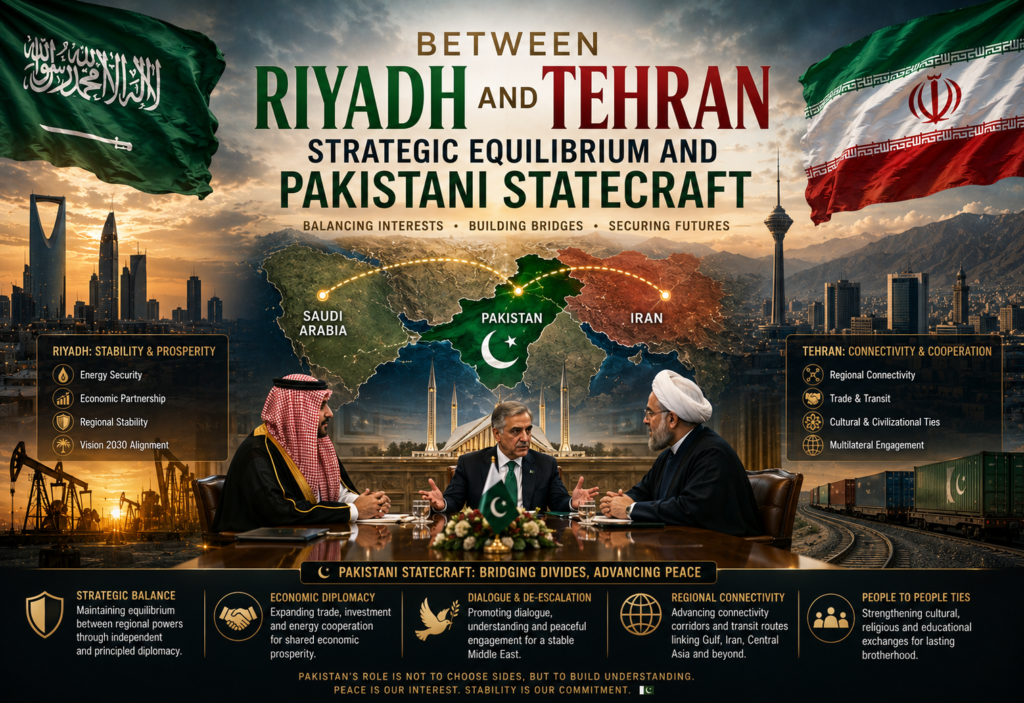
simultaneity in which survival is contingent upon sustaining equilibrium between two historically antagonistic yet structurally indispensable regional powers, namely the Kingdom of Saudi Arabia and the Islamic Republic of Iran. This equilibrium is not a product of diplomatic elegance but of geopolitical compulsion, economic fragility, and the evolving fragmentation of the Middle Eastern order. Within this triangular configuration, Pakistan operates less as an autonomous strategic actor and more as a calibrated balancing node embedded within overlapping systems of energy dependence, labor export economics, sectarian identity politics, and frontier security management. The resultant diplomatic posture is neither neutrality in its classical sense nor alignment in its rigid form, but rather a continuously adjusted mode of managed ambiguity shaped by shifting external pressures and internal vulnerabilities.
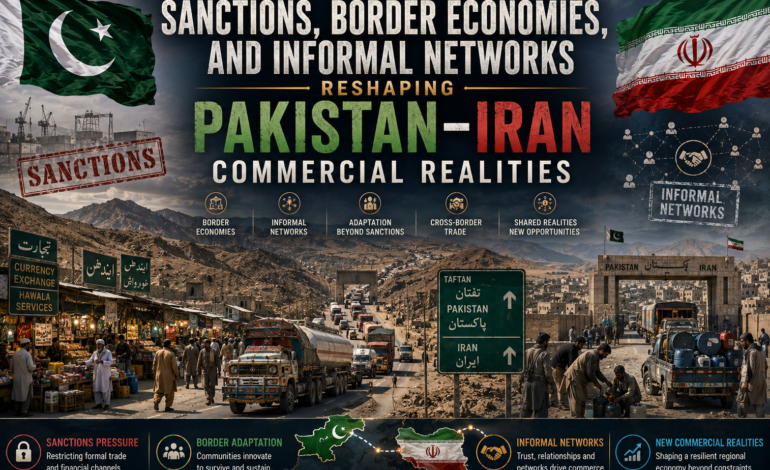
The historical genealogy of Pakistan’s relations with Saudi Arabia and Iran reveals an embedded asymmetry of functional dependencies rather than ideological alignment. Saudi Arabia has traditionally functioned as a macroeconomic stabilizer for Pakistan, offering oil deferments, financial assistance, and remittance absorption through migrant labor networks that form a structural pillar of Pakistan’s foreign exchange inflows. This economic interdependence has gradually acquired strategic dimensions, particularly as fiscal fragility has constrained Pakistan’s ability to diversify external partnerships. Conversely, Iran represents a geographically contiguous yet institutionally constrained partner whose significance lies not in macroeconomic volume but in infrastructural adjacency, border permeability, and potential energy corridor integration. The 900 kilometer frontier between the two states transforms Iran from a distant ideological reference point into a proximate security variable embedded within Pakistan’s internal cohesion calculus.
Recent geopolitical developments have further complicated this equilibrium. The partial normalization between Riyadh and Tehran, facilitated by external mediation mechanisms, has introduced a temporary reduction in overt hostility but has not eliminated underlying structural competition. Instead, rivalry has shifted into more subtle domains including maritime influence in the Gulf and Red Sea corridors, digital narrative competition across transnational media platforms, and competing visions of Islamic leadership legitimacy. This transformation has significant implications for Pakistan, which is simultaneously embedded in both economic ecosystems and security concerns emanating from each.
Contemporary analysis must therefore move beyond binary sectarian interpretations of Saudi Iranian rivalry and instead conceptualize it as a multi layered contest over infrastructural influence, ideological legitimacy, and post oil economic transition strategies. Saudi Arabia’s ongoing diversification agenda, centered on sovereign investment expansion and technological modernization, reflects a shift from ideological patronage to performance based legitimacy. Iran, in contrast, continues to operationalize a doctrine of asymmetric endurance shaped by sanctions exposure, proxy network entrenchment, and strategic resistance narratives. These divergent trajectories produce distinct but intersecting pressures on Pakistan’s foreign policy apparatus.
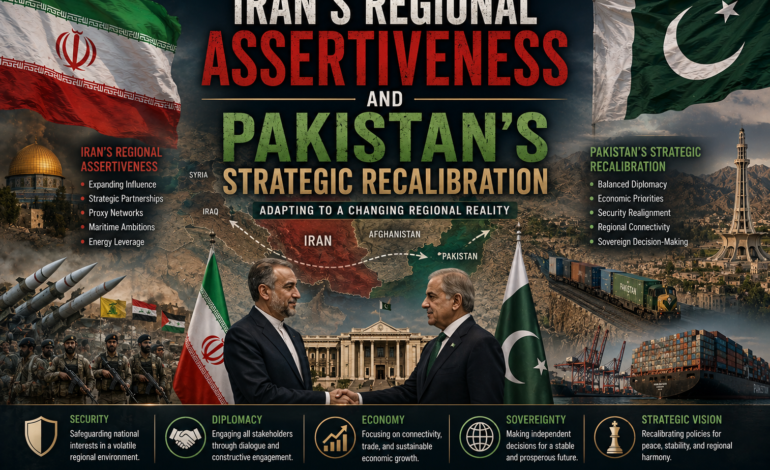
Within this context, Pakistan’s balancing strategy emerges as a form of structural necessity rather than discretionary choice. The state’s fiscal dependency on Gulf financial inflows, combined with its geographic exposure to Iranian instability in Balochistan, produces a dual constraint environment in which excessive alignment with either pole generates immediate systemic risks. Alignment with Riyadh risks domestic sectarian politicization and diplomatic isolation from Iran, while over engagement with Tehran risks financial instability and geopolitical friction with Gulf partners and Western financial institutions. The result is a persistent oscillation between rhetorical solidarity and operational caution.
Media ecosystems play a decisive role in amplifying and distorting this equilibrium. Transnational satellite channels, digitally networked religious seminaries, diaspora political networks, and algorithmically driven social media platforms construct competing narratives of Islamic legitimacy and geopolitical allegiance. Saudi aligned media infrastructures often frame regional politics through the lens of Sunni civilizational leadership and economic modernization, whereas Iranian aligned platforms emphasize resistance against Western hegemony and regional subordination. Within Pakistan, these narratives are not merely external influences but are actively internalized within political discourse, religious identity formation, and partisan media competition. The consequence is the transformation of foreign policy balancing into a domestically contested ideological battlefield.
The securitization of sectarian identity further complicates this environment. External rivalries are increasingly refracted through domestic social cleavages, producing episodic tensions that risk destabilizing internal cohesion. Pakistan’s policy establishment must therefore manage not only interstate diplomacy but also intrastate narrative regulation, ensuring that external geopolitical rivalries do not evolve into internal conflict dynamics. This requires the development of informational sovereignty mechanisms capable of filtering transnational ideological flows without resorting to excessive censorship or political suppression.
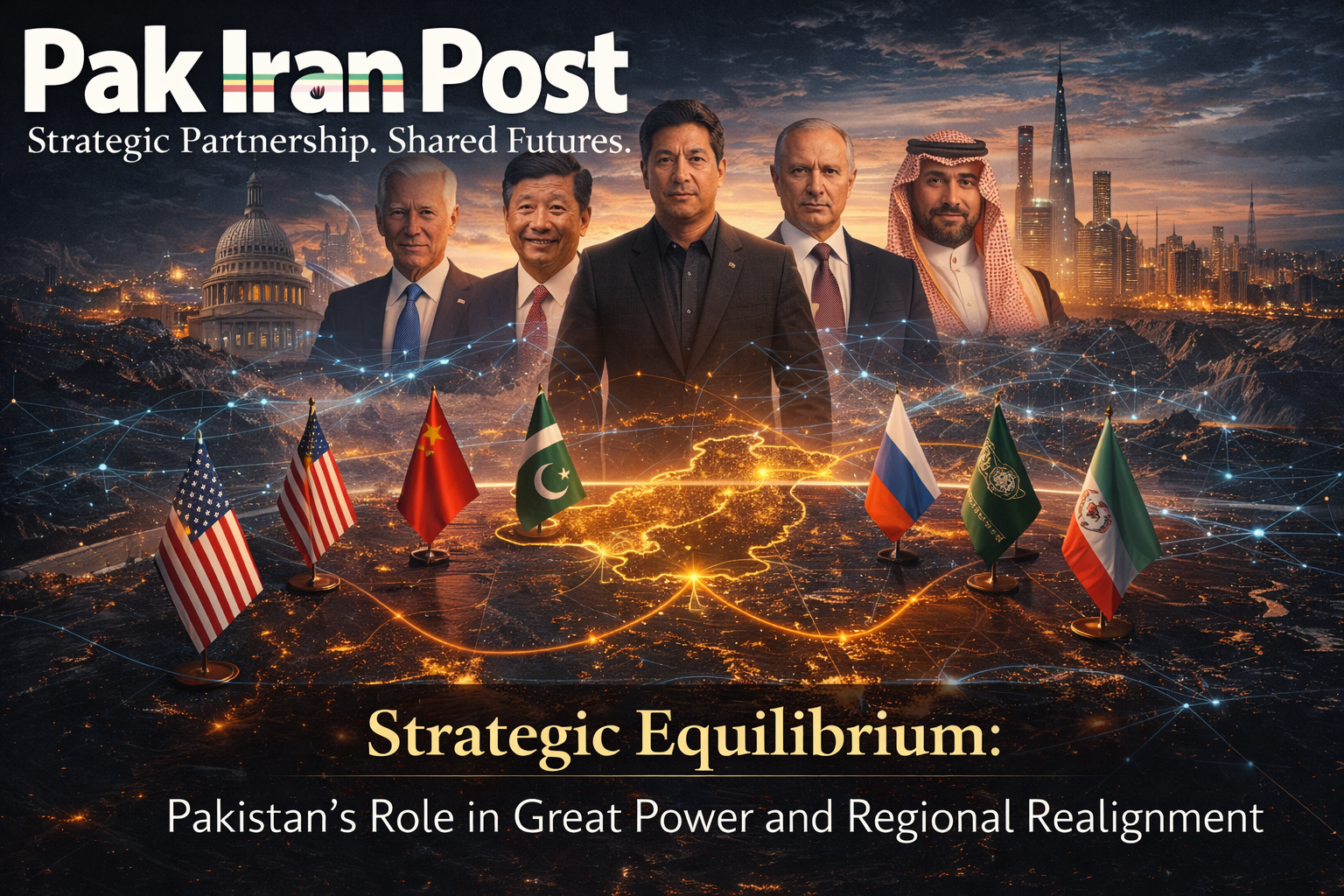
At the structural level, Pakistan’s engagement with both Saudi Arabia and Iran is increasingly shaped by the broader transformation of global power distribution. The gradual erosion of unipolar American dominance has created space for middle powers to assert greater regional autonomy, yet this autonomy is constrained by enduring financial and technological dependencies. China’s expanding presence through infrastructure investment and energy corridor development introduces alternative options for Pakistan, but simultaneously embeds new forms of dependency structured around debt, technology transfer asymmetries, and long term strategic commitments. Similarly, the United States continues to exercise systemic influence through dollar centrality, sanctions regimes, and financial governance institutions despite reduced direct military engagement.
Within this multipolar but asymmetrical environment, Pakistan’s strategic behavior must be understood as adaptive rather than assertive. The state is engaged in continuous recalibration across multiple axes of dependency, attempting to extract maximum utility from each relationship while minimizing exposure to coercive leverage. This form of diplomacy is inherently reactive, shaped by crisis management rather than long term strategic design. However, recent developments suggest an incremental shift toward more proactive positioning, particularly as Pakistan seeks to reposition itself as a potential diplomatic intermediary between competing regional actors.
The emergence of Pakistan as a potential mediation node in broader regional crises reflects both opportunity and constraint. On one hand, its geographic proximity to Iran, historical ties with Gulf states, and maintained communication channels with Western actors provide a unique triangulated diplomatic platform. On the other hand, this positioning increases exposure to reputational risk, political backlash, and strategic overextension. Mediation, therefore, becomes both a source of influence and a mechanism of vulnerability.
Policy implications of this evolving equilibrium are significant. Pakistan must transition from reactive balancing to institutionalized strategic equidistance. This requires diversification of energy imports, expansion of regional trade corridors, development of independent financial stabilization mechanisms, and strengthening of border governance institutions with Iran. Simultaneously, Pakistan must deepen economic interdependence with Gulf states while avoiding overconcentration of fiscal reliance. Diplomatic architecture must evolve toward modular engagement strategies that allow differentiated alignment across issue specific domains rather than holistic bloc positioning.
Equally important is the necessity of constructing narrative resilience within domestic media ecosystems. Without informational sovereignty, external geopolitical rivalries will continue to penetrate internal political discourse, amplifying instability risks. Regulatory frameworks must therefore be complemented by educational and institutional reforms that promote analytical literacy and reduce susceptibility to externally engineered ideological polarization.
Ultimately, Pakistan’s position between Riyadh and Tehran is not a transient diplomatic dilemma but a structural condition embedded within the architecture of the regional order. Its survival depends on the ability to transform this condition from a constraint into a managed system of calibrated engagement. Equilibrium, in this sense, is not stability but continuous adjustment. The future of Pakistani statecraft will therefore be defined not by the elimination of tension but by the institutionalization of mechanisms capable of sustaining tension without collapse.
A Public Service Message