IMF Energy Tax Pressure Rewrites Pakistan Iran Trade

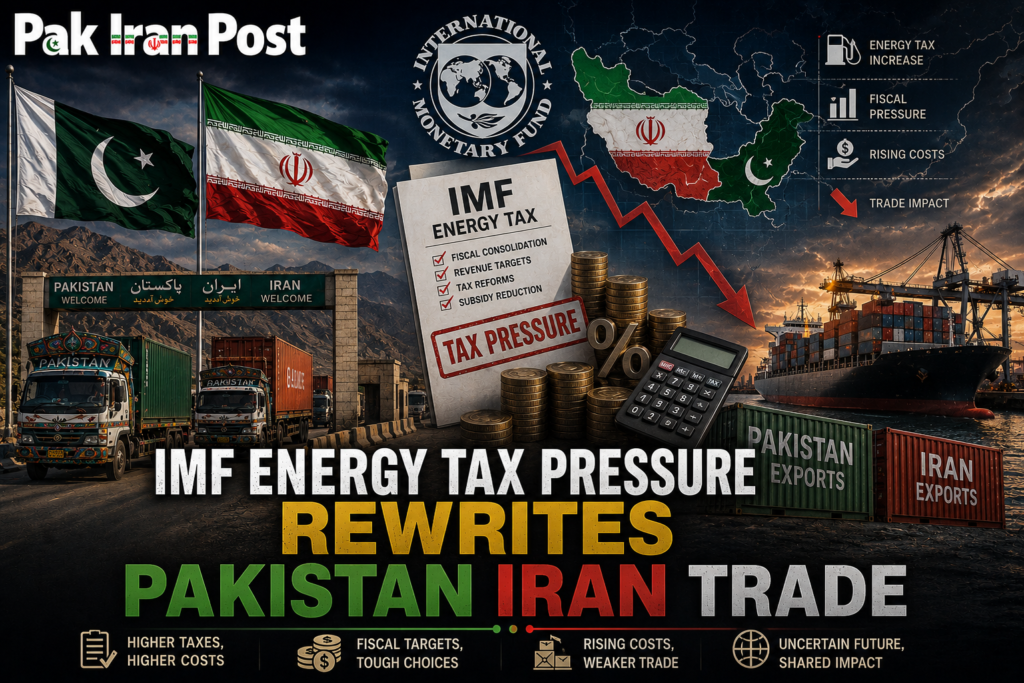
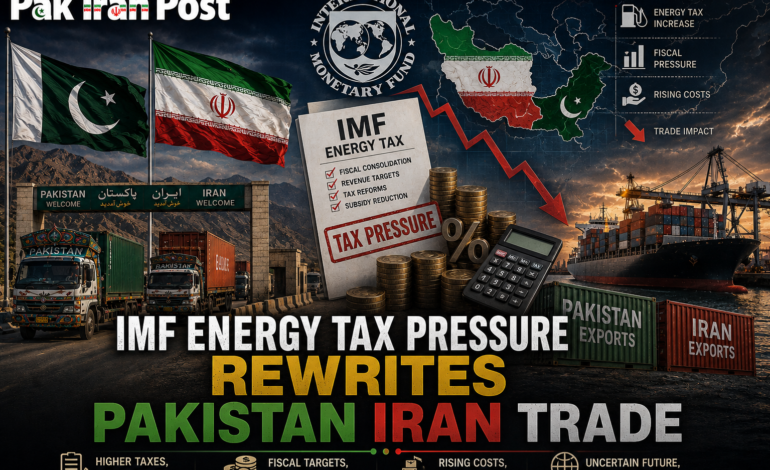
The evolving economic relationship between Pakistan and Iran is increasingly being shaped not only by bilateral diplomacy or regional connectivity ambitions but by a deeper and more structural force: the intersection of International Monetary Fund supported fiscal consolidation frameworks in Pakistan and the constrained energy export environment of Iran under sustained sanctions regimes. In 2026, this intersection is producing a distinct form of policy tension in which domestic energy taxation reforms, external financing conditionalities, and regional trade necessity are colliding in ways that are reshaping the very feasibility of cross border energy cooperation.
Pakistan’s macroeconomic management continues to operate under a narrow fiscal corridor defined by revenue augmentation requirements, energy sector restructuring, and currency stabilisation imperatives. Within this architecture, energy taxation has emerged as one of the central instruments of adjustment. The expansion of petroleum levies, electricity tariff rationalisation, and indirect taxation on fuel consumption are not merely budgetary tools but structural commitments embedded within IMF programme logic. These measures are designed to reduce fiscal deficits, limit quasi fiscal losses in the energy sector, and stabilise external account pressures that have historically constrained Pakistan’s balance of payments position.
However, these same reforms are generating a secondary and less visible consequence. As energy prices rise domestically due to taxation adjustments and subsidy withdrawal, the structural demand for alternative energy sourcing intensifies across industrial production networks, transport systems, and agricultural supply chains. This creates a paradoxical policy environment in which fiscal stabilisation efforts simultaneously increase the strategic attractiveness of external energy partnerships that lie outside conventional supply routes. Among these, the Pakistan Iran energy interface remains the most geographically proximate and structurally intuitive, yet it is also the most politically constrained due to sanctions exposure and external financial risk considerations.
The International Monetary Fund framework itself does not explicitly govern bilateral energy trade decisions, but its conditionality environment indirectly shapes them through macroeconomic discipline requirements. Pakistan’s obligation to maintain external account stability, limit fiscal slippages, and ensure transparency in external transactions produces a compliance ecosystem in which energy procurement strategies are increasingly evaluated not only on cost and availability but also on financial traceability and sanction compatibility. This introduces a structural limitation on the operationalisation of any large scale energy corridor involving Iran, regardless of geographic logic or economic complementarity.
On the Iranian side, the economic environment is defined by prolonged exclusion from global financial systems, restricted hydrocarbon export channels, and reliance on regionalised trade networks that often bypass conventional banking structures. In this context, Iran’s energy diplomacy has adapted toward flexible pricing mechanisms, non dollar denominated exchange arrangements, and barter like transactional frameworks with neighbouring economies. Pakistan, due to its geographic proximity and energy deficit profile, occupies a structurally relevant position within this adaptive export strategy. Yet the alignment between supply flexibility and demand constraint remains incomplete due to Pakistan’s exposure to external financial oversight mechanisms.
The result is a fragmented energy interaction space in which both countries exhibit structural incentives for cooperation but lack a fully compliant financial and institutional mechanism to operationalise it at scale. This fragmentation is not accidental but systemic. It reflects the interaction between three overlapping constraint regimes: sanctions enforcement affecting Iran, IMF governed fiscal adjustment affecting Pakistan, and global energy market volatility affecting both.
Recent global energy market developments have further intensified this complexity. Maritime disruptions affecting major shipping corridors, fluctuating oil and LNG price cycles, and increased insurance premiums for energy cargoes have all contributed to a heightened perception of energy insecurity in import dependent economies such as Pakistan. In principle, this should strengthen the case for proximate energy sourcing. In practice, however, the activation of such sourcing channels is mediated by financial governance constraints that limit the ability to engage in transactions perceived as non compliant with international sanction frameworks.
Within Pakistan’s domestic policy establishment, this tension is increasingly recognised as a structural rather than cyclical challenge. Energy planners and fiscal authorities are confronted with a dual imperative. On one hand, there is a need to reduce import dependence on high cost and volatile global energy markets. On the other hand, there is a need to maintain strict adherence to external financing conditions that underpin macroeconomic stability. This duality produces a form of policy caution that prioritises financial continuity over strategic energy diversification, even when the latter appears economically rational.
The introduction and expansion of energy taxation under IMF aligned reform agendas adds another layer to this dynamic. Energy taxes function not only as revenue instruments but also as behavioural modifiers intended to reduce consumption, improve efficiency, and align domestic pricing with global market realities. However, in economies with structurally inelastic energy demand, such measures tend to increase the relative burden on productive sectors, thereby intensifying political and economic pressure for alternative supply arrangements. This creates a feedback loop in which fiscal reform increases the perceived necessity of external energy partnerships while simultaneously constraining the financial pathways required to implement them.
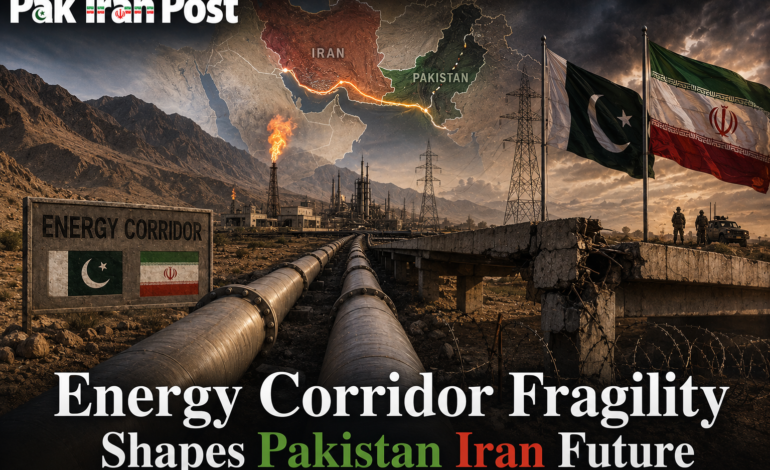
The Pakistan Iran energy corridor, particularly in the form of the long discussed gas pipeline project, thus exists in a state of suspended operational ambiguity. It is neither formally abandoned nor actively implemented. Instead, it functions as a strategic residual project, periodically reactivated in diplomatic discourse but persistently constrained in financial execution. This condition reflects a broader pattern in regional infrastructure development where geopolitical alignment and economic necessity are insufficient on their own to overcome external financial governance constraints.
From a multilateral perspective, this situation raises important questions regarding the unintended structural effects of prolonged sanction regimes and tightly conditioned fiscal adjustment programmes. While these frameworks are designed to enforce macroeconomic discipline and geopolitical compliance, they also contribute to the emergence of alternative economic behaviours at the regional level. These behaviours include informal trade expansion, non institutionalised energy exchanges, and adaptive pricing mechanisms that operate outside conventional regulatory oversight.
For Pakistan, the establishment concern is increasingly centered on maintaining policy coherence across three competing domains: fiscal discipline mandated by external financial programmes, energy security demands driven by domestic economic pressure, and strategic connectivity aspirations linked to regional geography. The challenge lies in reconciling these domains without triggering instability in any single one. This requires a form of policy engineering that prioritises sequencing over immediacy, allowing for gradual alignment of energy diversification strategies with fiscal and financial compliance frameworks.
For Iran, the strategic objective remains the expansion of regional economic embedding as a counterweight to external isolation. Energy exports function not only as a revenue stream but also as a geopolitical instrument of continuity. However, the effectiveness of this strategy is increasingly mediated by the willingness and ability of neighbouring economies to absorb sanction sensitive transactions within their own compliance architectures. Pakistan’s constrained position limits the scale at which such absorption can occur, resulting in a structurally asymmetrical relationship.
From an investor perspective, the Pakistan Iran energy interface presents a complex risk return configuration. The downside risks are primarily regulatory, geopolitical, and currency related. These include exposure to sanction volatility, potential disruptions in financial clearing mechanisms, and macroeconomic instability associated with external account pressures. The upside potential, however, lies in infrastructure gap filling, energy demand persistence, and the long term possibility of corridor normalisation under changing geopolitical conditions. This creates a scenario in which investment logic is heavily dependent on policy trajectory rather than current market conditions.
The establishment level concern extends beyond bilateral considerations to include broader regional financial stability implications. If energy trade flows increasingly migrate toward informal or semi formal mechanisms due to external constraint regimes, the result may be a gradual erosion of transparency in regional trade accounting. This could complicate macroeconomic monitoring, weaken policy predictability, and increase systemic risk in already vulnerable external account structures. At the same time, overly rigid enforcement of compliance frameworks may further incentivise the expansion of parallel economic systems.
The central policy dilemma, therefore, is not whether to engage in energy cooperation, but how to structure engagement in a manner that preserves both financial legitimacy and strategic flexibility. This requires innovative institutional design, potentially including escrow based energy payment systems, phased infrastructure activation models, and regionally anchored compliance frameworks that can operate within broader international financial norms while accommodating localized economic realities.
In the medium term, the most plausible trajectory is one of continued partial divergence. Energy cooperation between Pakistan and Iran will likely persist at the level of political dialogue and limited trade interaction, while full scale infrastructure integration remains contingent on shifts in external financial governance conditions. This creates a persistent gap between strategic intent and operational execution, which defines the current state of the corridor.
Ultimately, the interaction between IMF driven fiscal reform in Pakistan and sanctions constrained energy export capacity in Iran is producing a structurally unique economic environment. It is an environment characterised not by absence of cooperation, but by constrained possibility. Within this space, policy outcomes will depend less on formal agreements and more on the evolving capacity of both states to navigate overlapping constraint regimes without destabilising their respective macroeconomic or geopolitical positions.
A Public Service Message