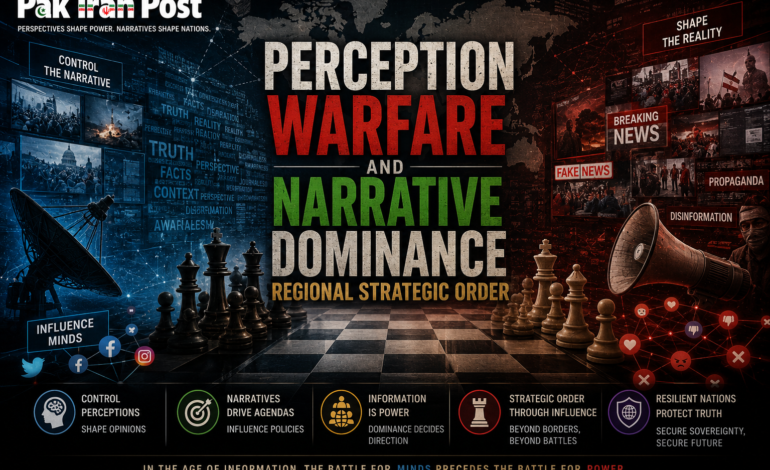
Perception Warfare and Narrative Dominance Regional Strategic Order

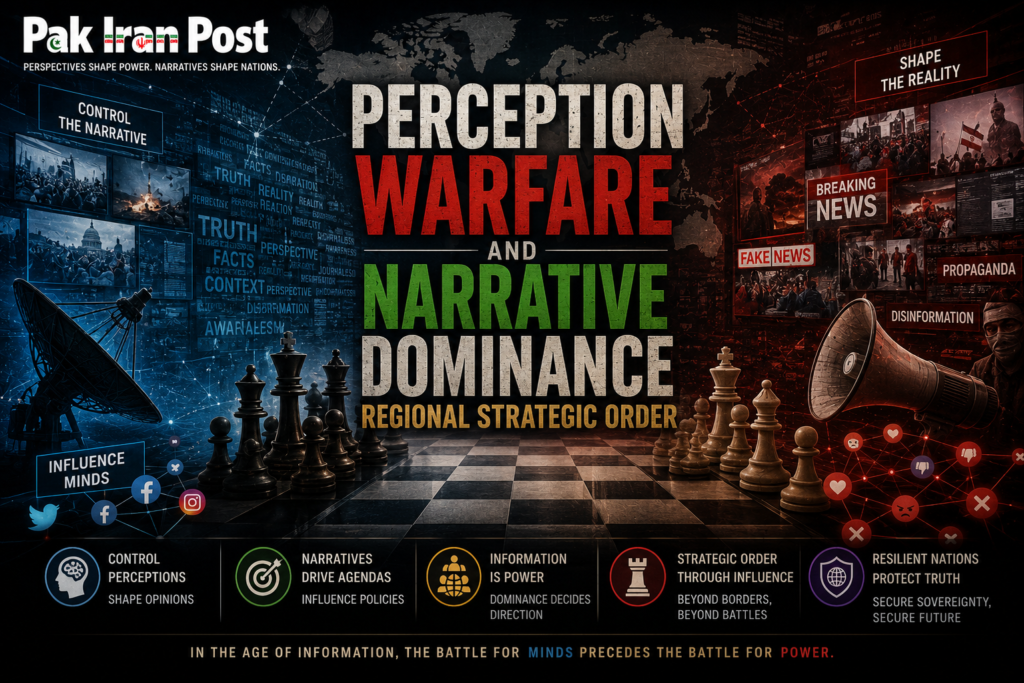
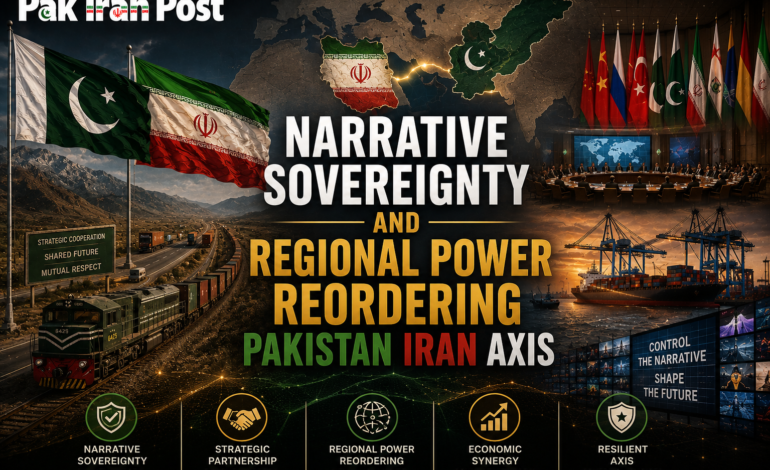
The contemporary regional geopolitical environment is increasingly being structured around an emergent axis of power that is less visible in traditional security architectures yet profoundly decisive in shaping strategic outcomes, namely perception warfare and narrative dominance. In the evolving interplay between Pakistan, Iran, and adjacent regional actors, the classical determinants of power, including conventional military capability, diplomatic alignment, and even economic leverage, are progressively being reconditioned by the capacity of states and non state actors to influence interpretive frameworks through which events are understood, legitimized, and operationalized within global discourse systems.
This transformation reflects a deeper epistemic shift in international relations, wherein reality is no longer merely reported but continuously constructed through layered informational environments, algorithmically mediated dissemination channels, and institutionally reinforced narrative hierarchies. Within such a system, geopolitical agency is increasingly contingent not only upon action but upon the perceived meaning of action, thereby placing interpretive control at the center of strategic competition.
For Pakistan and Iran, this environment introduces both structural vulnerability and strategic opportunity. On one hand, both states operate under persistent narrative asymmetries shaped by external media ecosystems, policy framing institutions, and transnational information flows that often pre configure interpretive outcomes before official diplomatic clarifications are issued. On the other hand, this same environment offers the possibility of deliberate narrative engineering, wherein coherent strategic messaging, aligned institutional communication, and calibrated diplomatic signaling can generate disproportionate influence relative to material constraints.
The concept of perception warfare extends beyond conventional information operations. It encompasses the systematic shaping of geopolitical cognition, where competing actors seek not merely to disseminate information but to define the cognitive parameters within which information is interpreted. In this sense, narrative dominance becomes a form of pre emptive strategic positioning, where the legitimacy of actions is contested at the level of interpretation rather than execution. The result is a geopolitical landscape in which outcomes are often determined in the informational domain prior to their manifestation in diplomatic or economic arenas.
Within the Pakistan Iran strategic space, this dynamic is particularly pronounced due to the intersection of multiple overlapping narratives. These include security centric narratives associated with regional instability, economic narratives linked to sanctions regimes and financial dependency structures, and civilizational narratives that attempt to situate both states within broader ideological frameworks of resistance, alignment, or neutrality. The convergence of these narrative layers produces a complex discursive environment in which policy actions are continuously reinterpreted through competing frames of reference.
The increasing centrality of narrative dominance has also altered the temporal structure of geopolitics. Traditionally, strategic decision making operated within relatively stable cycles of assessment, response, and adjustment. However, the acceleration of information flows has compressed these cycles, producing what may be described as narrative simultaneity, where interpretation, reaction, and counter interpretation occur almost instantaneously. This compression reduces the strategic advantage of delayed response and increases the premium on anticipatory narrative positioning.
In this context, states that fail to develop coherent narrative infrastructures risk strategic marginalization, regardless of their material capabilities. Narrative incoherence can generate reputational volatility, which in turn affects investment flows, diplomatic credibility, and alliance stability. Conversely, narrative coherence can function as a force multiplier, enabling states to project stability, predictability, and strategic intent even in conditions of material constraint.
For Pakistan, the challenge lies in reconciling domestic political plurality with external narrative discipline. The multiplicity of internal voices, while reflective of democratic diversity, can generate external interpretive fragmentation if not strategically harmonized within a coherent foreign policy communication framework. For Iran, the challenge is compounded by long term external framing associated with sanctions discourse and security centric interpretations, which often overshadow alternative narratives related to regional connectivity and economic integration potential.
In both cases, perception warfare is not merely an external imposition but also an internal governance challenge. The ability to align domestic policy articulation with external narrative expectations has become a critical component of state capacity. This requires institutional synchronization between foreign policy apparatuses, economic planning bodies, and strategic communication units, ensuring that policy decisions are not only implemented but also intelligibly projected into global discourse systems.
The role of non state actors in this environment further complicates the strategic landscape. Media institutions, digital platforms, analytical networks, and transnational advocacy structures now participate in the production of geopolitical meaning. These actors often operate with significant autonomy, shaping narratives that may diverge from official state positions while still influencing international perception. This diffusion of narrative authority reduces the monopoly of states over strategic communication and necessitates more sophisticated engagement strategies.
In parallel, the rise of algorithmically mediated information distribution has introduced structural biases into narrative visibility. Content that aligns with prevailing engagement metrics often achieves disproportionate amplification, regardless of its substantive accuracy or strategic intent. This creates an environment in which emotional resonance, conflict framing, and simplification are often rewarded over analytical depth and contextual nuance. For states such as Pakistan and Iran, this represents a structural disadvantage unless counterbalanced by proactive narrative design and sustained informational engagement.
The strategic implications of this shift are significant. Military deterrence and diplomatic engagement now operate within a broader informational envelope that can amplify or diminish their perceived effectiveness. A successful diplomatic initiative can be undermined by adverse narrative framing, while a constrained material position can be partially offset by effective narrative positioning. This inversion of traditional hierarchies of power underscores the growing importance of cognitive and symbolic dimensions of geopolitics.
Within the broader Muslim world, narrative fragmentation has further intensified these dynamics. Competing interpretations of regional crises, divergent alignments with global powers, and inconsistent economic trajectories have produced a fragmented narrative ecosystem in which collective positioning is increasingly difficult to sustain. In this environment, Pakistan and Iran occupy a potentially pivotal role as narrative bridge actors, capable of articulating alternative frameworks of regional cooperation and strategic autonomy, provided they can overcome internal and external narrative constraints.
Policy implications arising from this analysis point toward the necessity of institutionalizing narrative strategy as a core pillar of national security doctrine. This includes the development of integrated strategic communication frameworks, investment in analytical capacity for real time narrative tracking, and the creation of counter framing mechanisms capable of responding to external narrative distortions with precision and coherence. Additionally, diplomatic training must increasingly incorporate narrative literacy, ensuring that representatives are equipped not only to negotiate agreements but also to anticipate and shape interpretive outcomes.
At the multilateral level, engagement with institutions such as the United Nations system and associated global governance frameworks requires a more sophisticated understanding of narrative signaling. Participation in these structures is not merely procedural but discursive, shaping how state behavior is categorized and understood within global normative hierarchies. Effective engagement therefore requires alignment between policy substance and narrative presentation.
Ultimately, perception warfare does not replace traditional forms of power but reconfigures their operational context. It introduces a layer of strategic complexity in which meaning becomes as consequential as material capability, and where narrative coherence becomes a prerequisite for geopolitical effectiveness. For Pakistan and Iran, adapting to this environment will require a fundamental reorientation of strategic thinking, moving from reactive communication to proactive narrative construction, from episodic messaging to sustained interpretive engagement, and from fragmented articulation to integrated strategic storytelling.
In this emerging order, narrative dominance is not merely an auxiliary instrument of power but a central determinant of strategic positioning. Those actors capable of shaping perception with consistency, depth, and credibility will increasingly define the boundaries of geopolitical possibility, while those unable to do so risk strategic invisibility regardless of their material strength.
A Public Service Message