

Grief Without Borders, Truth Without Custodians

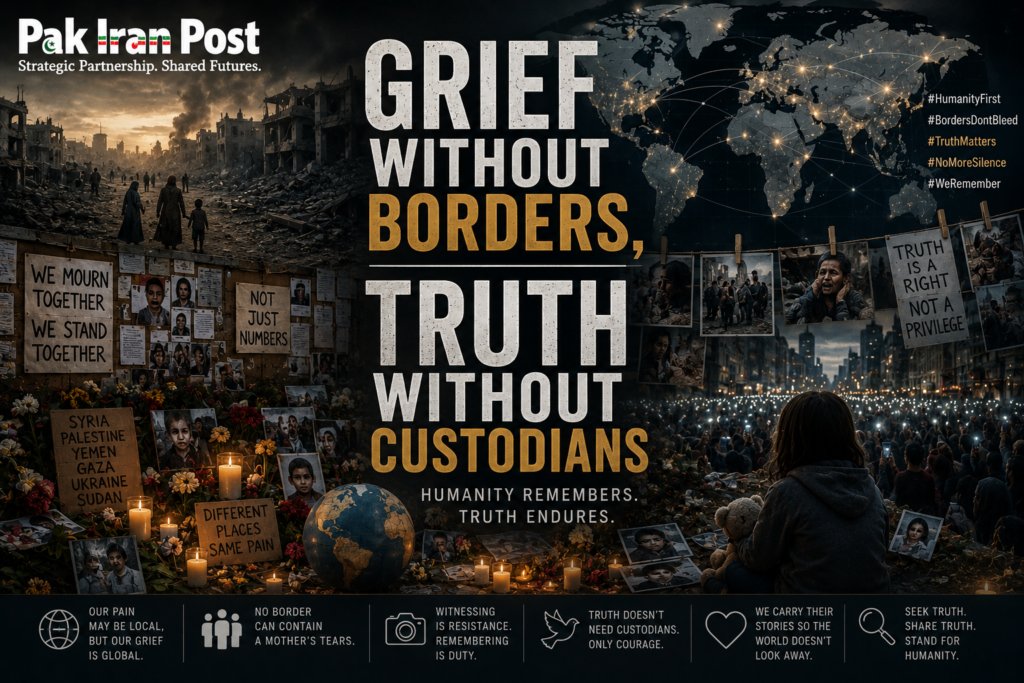
We are witnessing a civilizational passage in which meaning no longer resides in stable institutions, inherited hierarchies, or territorially bounded epistemologies, but instead moves as a continuous flow across digital infrastructures, emotional economies, and fractured social imaginaries. In this unfolding condition, grief and truth have both undergone a quiet but profound transformation. Grief no longer belongs exclusively to the private sphere of human suffering or the ritual frameworks of communal mourning; truth no longer belongs exclusively to institutions, scholarly lineages, or state-sanctioned narratives. Both have been unmoored from their traditional custodians. Both now circulate without fixed guardianship. Both now exist in motion.
This is not merely a technological shift. It is an ontological reconfiguration of how societies feel, interpret, and stabilize reality. In earlier civilizational arrangements, grief was contained through ritual, religion, and social structure. It had a beginning, a public acknowledgment, and an end-point of collective reintegration. Truth, similarly, was anchored in custodial frameworks: the state certified facts, religious institutions authenticated moral order, and academic systems verified knowledge. These structures did not eliminate contestation, but they contained it within recognizable boundaries. Today, those boundaries have thinned. What remains is circulation without finality, visibility without closure, and resonance without a stable origin.
Grief without borders is not simply metaphorical. It is the lived condition of societies immersed in continuous exposure to distant suffering, mediated through instantaneous digital witnessing. A tragedy in one geography is no longer temporally delayed in another; it arrives in real time, unfiltered, emotionally compressed, and algorithmically amplified. The result is a shared emotional atmosphere that transcends geography but does not necessarily produce shared interpretation. Empathy expands horizontally while coherence weakens vertically. People feel together, but they do not necessarily understand together.
In this expanded emotional field, grief becomes both connective tissue and destabilizing force. It produces moments of global solidarity while simultaneously generating interpretive fragmentation. One event may produce mourning in one community, political justification in another, and contested narrative warfare in a third. The same image, the same testimony, the same loss becomes multiple realities depending on the informational ecosystem in which it circulates. Grief thus ceases to be a singular human experience and becomes a contested epistemic site.
Parallel to this emotional transformation is the more structural erosion of custodial truth. Narrative authority, once concentrated in institutions, has become decoupled from origin. A statement no longer derives its legitimacy primarily from who produces it, but from how widely it circulates, how intensely it resonates, and how effectively it embeds itself in attention economies. In this environment, truth is no longer a static attribute attached to propositions; it is a dynamic condition produced through circulation. It becomes less about verification and more about amplification.
This does not mean that institutions have disappeared. Rather, they now exist alongside competing systems of narrative production that operate with different logics of legitimacy. State institutions, religious authorities, academic bodies, and traditional media still produce knowledge, but they no longer monopolize its recognition. They compete with decentralized digital networks, algorithmically amplified voices, transnational influencers, and rapidly forming interpretive communities. The result is not the absence of authority, but the multiplication of authorities without a single coordinating hierarchy.
In Muslim societies, this transition carries complexity because traditional epistemologies have historically relied on structured transmission of knowledge. The authority of religious interpretation was grounded in chains of scholarship, disciplined study, and institutional validation. In the contemporary informational environment, these structures coexist with fragmented digital interpretations that circulate outside classical frameworks. Religious meaning is no longer solely mediated by scholarly institutions but is also shaped by digital platforms where accessibility, emotional resonance, and immediacy often outweigh methodological rigor. This creates a layered epistemic field in which sacred knowledge is continuously reinterpreted through competing communicative systems.
Pakistan and Iran exemplify this tension in distinct but interconnected ways. Both societies are deeply embedded in civilizational memory systems shaped by Islamic intellectual traditions, yet both are also fully immersed in global informational flows that reconfigure identity, politics, and cultural expression. In both contexts, the nation-state remains a central organizing principle, but it is increasingly intersected by transnational identities, diasporic consciousness, and digital communities that do not align neatly with territorial boundaries. The result is a complex layering of belonging in which individuals simultaneously inhabit multiple interpretive worlds.
In such a condition, identity becomes less a fixed inheritance and more an ongoing negotiation. It is shaped by inherited traditions, contemporary socio-political realities, and global cultural exposures that interact in unpredictable ways. Individuals no longer simply belong to one coherent narrative structure; they navigate overlapping narratives that may reinforce, contradict, or destabilize one another. Identity becomes a process rather than a possession, a continuous recalibration rather than a stable state.
The psychological implications of this transformation are profound. Societies increasingly experience a form of ambient uncertainty in which interpretive stability is difficult to maintain. Attention is fragmented across multiple streams of information, each demanding emotional and cognitive engagement. The human mind is thus placed in a condition of constant translation, shifting between narratives, contexts, and emotional registers. This produces both fatigue and adaptability, both fragmentation and flexibility.
At the collective level, this produces what may be described as social fragmentation without silence. Communication does not break down; it multiplies. Voices proliferate faster than shared frameworks can stabilize meaning. The problem is not lack of information, but excess of competing interpretations. In such an environment, consensus becomes fragile not because dialogue is absent, but because the conditions for shared epistemic grounding are weakened.
The notion of a trans-normative era emerges from this condition. It describes a phase in which norms are no longer stable inheritances but continuously generated and dissolved through circulation. Norms are not eliminated, but they lose their fixed temporal and institutional anchoring. They become adaptive, situational, and responsive to shifting informational environments. What is considered acceptable, true, or legitimate becomes increasingly contingent on context, audience, and platform dynamics.
In this sense, societies are moving from norm stability to norm fluidity. This does not necessarily imply moral collapse, but it does indicate a structural transformation in how moral and epistemic order is produced. Stability is no longer assumed; it must be actively constructed and continuously maintained within unstable environments. This requires new forms of cognitive, institutional, and cultural adaptation.
Grief without borders intensifies this condition by expanding emotional interdependence across global systems. The same infrastructures that distribute information also distribute emotion. Suffering becomes globally visible, but its interpretation remains locally contested. This produces a paradox of simultaneous connection and disjunction: people are emotionally closer than ever before, yet epistemically further apart in terms of shared understanding.
Truth without custodians deepens the same paradox from another direction. Without stable guardianship, truth becomes a matter of circulation dynamics rather than institutional validation. This creates both democratization and destabilization. On one hand, more voices participate in the production of meaning. On the other hand, the absence of stable adjudication mechanisms makes epistemic consensus increasingly difficult. Truth becomes less a destination and more a trajectory within information flows.
Within Muslim societies, this transformation raises critical questions about the future of epistemic authority. Can traditional frameworks adapt to decentralized informational environments without losing their structural coherence? Can new forms of authority emerge that combine accessibility with rigor? Or will authority itself remain perpetually fragmented across competing interpretive systems? These questions do not have immediate answers, but they define the intellectual horizon of the present moment.
What is emerging is not simply a crisis of information, but a deeper reconfiguration of how meaning itself is produced and sustained. In earlier civilizational arrangements, meaning was stabilized through institutions, rituals, and shared narratives that persisted across time. In the emerging trans-normative condition, meaning is continuously assembled in real time, subject to rapid revision, and embedded in dynamic networks of circulation.
This does not necessarily point toward collapse. It also opens possibilities for new forms of pluralism, new configurations of identity, and new modalities of collective engagement. Yet these possibilities are accompanied by instability, uncertainty, and interpretive overload. Societies are thus navigating a threshold condition in which old frameworks no longer fully hold, but new frameworks have not yet fully stabilized.
Grief without borders and truth without custodians together define this threshold. One expands the emotional field beyond territorial and temporal limits; the other dissolves the institutional anchors of epistemic authority. Together, they produce a world in which feeling is global but interpretation is fragmented, in which visibility is universal but understanding is distributed unevenly, and in which meaning is constantly made but never fully settled.
The central question of this emerging condition is not whether truth or grief still exist, but how they exist when their traditional boundaries no longer apply. It is in this question that the trans-normative character of the present becomes most visible. We are no longer dealing with isolated changes in media, politics, or culture. We are witnessing a deeper transformation in the architecture of meaning itself, where circulation replaces origin, and where stability becomes an exception rather than an assumption.
A Public Service Message