

Border After Fire. Pakistan, Iran and the New Frontier

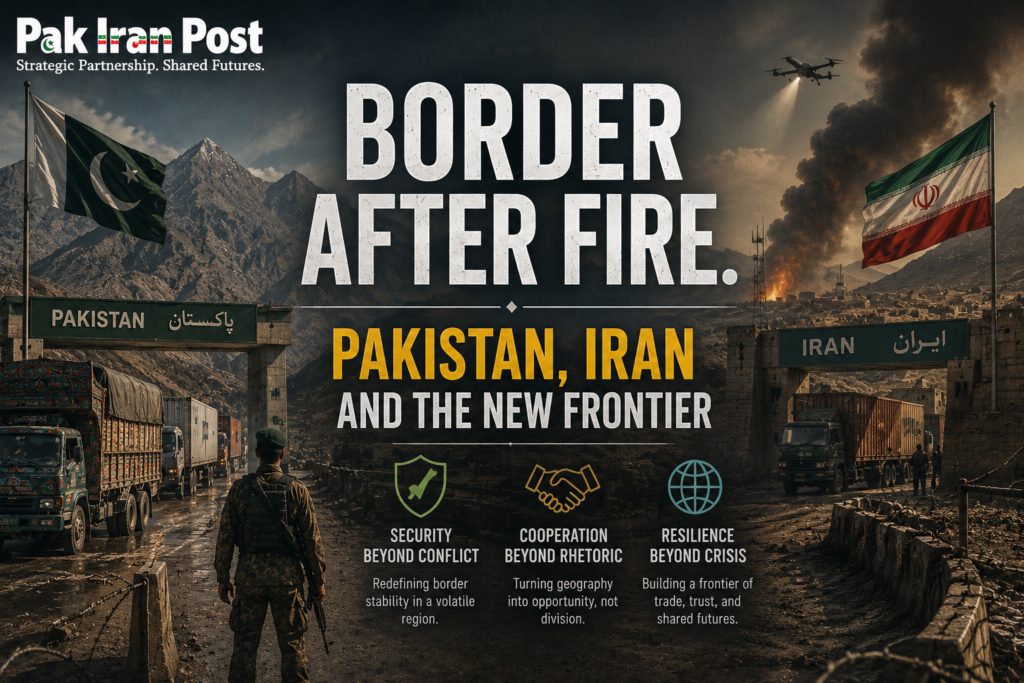
For years, Pakistan’s frontier with Iran sat in the hierarchy of national security as a troublesome but secondary theatre: important enough to require periodic military attention, diplomatic management and border coordination, but rarely central enough to reorder the state’s strategic imagination. That hierarchy is no longer sustainable. The post-conflict regional environment has altered the meaning of the Pakistan–Iran border. What was once treated as a peripheral zone of smuggling, undocumented movement, sectarian seepage and episodic militant sanctuary is becoming a pressure point where several theatres of insecurity now intersect at once: Iran’s confrontation with Israel and the United States, the expanding internal influence of the Islamic Revolutionary Guard Corps, the chronic fragility of Balochistan, the politics of cross-border Baloch militancy, sanctions-driven illicit trade, refugee risk, and the possibility that future escalation around Iran could spill into Pakistan’s western security architecture faster than Islamabad can absorb. The central question for Pakistani policy is therefore no longer whether the border can be “managed” in the old administrative sense. It is whether two militarised neighbours can prevent a regional war system from metastasising into a shared frontier that neither side fully controls and both sides increasingly securitise.
This shift matters because the Pakistan–Iran relationship has always been structurally contradictory. At the level of capitals, the relationship has often been described in polite diplomatic language: two neighbouring Muslim states, linked by geography, history, trade, pilgrimage routes and periodic declarations of goodwill. At the level of the borderlands, however, the relationship has long been harder, more suspicious and more coercive. Iran has viewed the Pakistan side of Balochistan through the lens of Sunni militant infiltration, narcotics flows and the operations of Jaish al Adl and related anti-Iran groups. Pakistan, for its part, has viewed the Iranian side through the lens of insurgent safe havens, covert influence networks, fuel smuggling economies and the risk that instability in Sistan and Baluchestan can ricochet into Pakistani Balochistan. The frontier has therefore never been a soft civilisational bridge; it has been a thinly stabilised security seam. What has changed after the Iran crisis is not the existence of these concerns, but their strategic weight. Border instability is no longer merely a bilateral irritant. It is becoming the mechanism through which wider regional conflict could alter Pakistan’s internal threat environment.
That is why the January 2024 exchange of cross-border strikes between Pakistan and Iran, though brief, should be read not as an aberration but as an early warning of the new era. The episode demonstrated three things with unusual clarity. First, both states are willing, under sufficient provocation or perceived embarrassment, to violate the old etiquette of restraint and use overt military force across the frontier. Second, the distinction between counter-terrorism action and strategic signalling has narrowed; a strike aimed at militants also becomes a message to domestic audiences, rivals and regional observers about resolve, deterrence and sovereign red lines. Third, crisis communication between Islamabad and Tehran may be functional enough to stop a slide into war, but not yet institutionalised enough to prevent coercive episodes from occurring in the first place. That matters because a frontier that has already normalised retaliatory logic is far more vulnerable to miscalculation during a period of wider regional tension.
The Iran–Israel confrontation and its aftermath deepen that vulnerability in several ways. Iran under pressure does not become strategically irrelevant to Pakistan; it becomes more consequential. A state under external attack, sanctions strain and internal security stress does not simply look inward. It hardens, prioritises regime protection, delegates more authority to coercive institutions and becomes more suspicious of peripheral zones through which sabotage, infiltration or proxy activity may occur. In the Iranian case, that means the southeastern belt adjoining Pakistan becomes not less important to Tehran, but more so. If the IRGC continues to consolidate influence inside the Iranian state, the management of Sistan and Baluchestan is likely to be treated less as a provincial governance question and more as a counter-infiltration and counter-subversion theatre. For Pakistan, this raises a serious concern. A more security-dominated Iranian posture on the frontier may not distinguish neatly between anti-Iran militants, smugglers, dissident networks, transnational Baloch actors and the wider ecosystem of movement that characterises a historically porous border. The more Iran sees its southeastern flank as a vulnerability in wartime or near-war conditions, the greater the chance that it will adopt a doctrine of forward disruption, hot pursuit, covert pressure or public accusation that places Pakistan under direct security and diplomatic strain.
Islamabad must therefore recognise that the western border is now nested inside a larger escalation chain. In the old frame, the Pakistan–Iran frontier produced bilateral incidents whose consequences were largely bilateral. In the new frame, an incident at the frontier could be triggered by events far beyond the frontier itself. A strike on Iranian territory by Israel or the United States, sabotage against Iranian military assets, intensified pressure on Iran’s internal security apparatus, or unrest in Iran’s border provinces could all produce downstream effects in Pakistani Balochistan. Tehran may tighten crossings, increase intelligence collection, pressure Islamabad over militant sanctuaries, or react aggressively to perceived cross-border facilitation. Refugees, students, traders and pilgrims may begin moving through Taftan and other crossings in larger numbers. Smuggling networks may adapt to sanctions disruptions and become more intertwined with militant logistics. Baloch insurgent groups on either side may exploit state distraction. Sectarian actors inside Pakistan may use the conflict to mobilise rhetorically, fundraising ideologically and organising locally. None of this requires Pakistan to be a belligerent in a Middle Eastern war. It requires only that a regional war system continues to radiate instability through adjacent theatres, and that the Pakistan–Iran frontier remains one of the most plausible channels of transmission.
Pakistan’s problem is compounded by the fact that Balochistan is already overburdened as a security theatre. The province is not merely a border region; it is the convergence point of several unresolved national dilemmas. It contains a long-running insurgency, weak civilian governance, chronic underdevelopment, contested resource politics, strategic infrastructure tied to Gwadar, cross-border criminal economies, and a history of distrust between the state and peripheral populations. To this must now be added the prospect that Iran-related escalation could redraw Pakistan’s threat prioritisation inside the province. In practice, this means security resources that are already stretched across counter-insurgency, infrastructure protection and border control may have to absorb new missions: refugee management, protection of transit routes, surveillance of sectarian mobilisation, intelligence liaison with Tehran, and contingency planning for Iranian requests, accusations or unilateral actions. A state can manage one difficult frontier under strain. Managing two or three layers of insecurity simultaneously in the same province is a different order of challenge.
The policy risk here is not simply “spillover”, a term often used too loosely to obscure the mechanics of threat transmission. The real danger is strategic congestion. Strategic congestion occurs when multiple security problems, each manageable in isolation, begin interacting faster than institutions can separate them. A Baloch insurgent attack, an Iranian accusation about cross-border militant movement, an influx of Pakistani nationals fleeing conflict in Iran, a sectarian rally in Quetta, a spike in fuel smuggling due to sanctions dislocation, and an intelligence warning about foreign proxy activity may appear on paper as distinct files. In operational reality they may be linked, concurrent and mutually reinforcing. The result is not just more work for the state. It is a degraded capacity to discriminate among threats, sequence responses and preserve escalation control. This is the environment in which tactical actions generate strategic consequences.
One illustration is the question of undocumented and semi-documented movement across the frontier. Pakistan’s recent shift toward a stricter visa and passport regime at crossings such as Taftan reflects a broader “one document” logic designed to regularise movement and strengthen state oversight. On paper, this is rational. A frontier that may become a conduit for militants, couriers, illicit finance, refugees and intelligence assets cannot be governed indefinitely through permissive local arrangements and inherited informal practices. Yet documentation alone will not solve the problem. The Pakistan–Iran border is not simply a line waiting to be digitised; it is a social and economic ecosystem in which formal authority has historically coexisted with negotiated informality. Communities straddle the frontier. Livelihoods depend on small-scale trade, transport and mobility. Crackdowns that do not create alternative legal pathways risk pushing movement deeper into informal channels, where the state sees less, not more. A document regime can improve control only if it is matched by border infrastructure, biometric integration, cargo scanning, local compensation mechanisms, intelligence-led targeting and, crucially, bilateral data-sharing arrangements with Iran. Otherwise it becomes a symbolic assertion of sovereignty that criminalises routine border life without materially improving strategic visibility.
The intelligence dimension is even more consequential. Pakistan and Iran do cooperate against anti-state militants, but the relationship is characterised less by deep trust than by managed suspicion. Each side fears that the other either cannot control or does not fully prioritise the militant ecosystems operating near the frontier. Each side also worries about covert influence, information asymmetry and selective enforcement. In quieter periods, such distrust can be contained through periodic visits, hotline diplomacy and local commanders’ meetings. In periods of regional confrontation, however, distrust becomes combustible. If Tehran believes that hostile actors are using Pakistani territory, knowingly or otherwise, to facilitate operations against Iran, pressure on Islamabad will intensify. If Pakistan believes that Iran is tolerating or instrumentalising groups whose actions destabilise Balochistan, its own tolerance will shrink. Intelligence liaison without trust is still better than none, but it is insufficient in a crisis environment where attribution is contested and time horizons collapse.
The IRGC’s growing weight inside Iran adds another layer of complexity because the Guard’s institutional logic is not identical to that of a conventional foreign ministry. Even when Tehran maintains diplomatic channels, a more empowered IRGC can push policy toward securitised threat perception, denser border control, covert action, strategic signalling and a lower threshold for kinetic response against perceived non-state threats. Pakistan need not assume that Iran is eager for confrontation with it. But it would be strategically negligent to assume that an Iran shaped more heavily by military-security actors will behave according to the same risk calculus that Islamabad became accustomed to in quieter periods. Border management under such conditions ceases to be an administrative matter between interior ministries. It becomes a deterrence and crisis-management problem between security establishments.
There is also the maritime extension of the problem. Pakistan’s western security imagination has historically focused on land, yet the Pakistan–Iran interface increasingly connects the land border to the Arabian Sea and the wider Gulf security environment. Gwadar’s location, the vulnerability of sea lanes, the role of Chabahar, and the possibility of wider confrontation involving maritime interdiction, sabotage or commercial disruption mean that Balochistan can no longer be understood as a purely terrestrial theatre. If Iran’s conflict environment sharpens competition in the Gulf and Arabian Sea, Pakistan’s coastal infrastructure, energy routes and naval planning will be affected. A border crisis in the west may therefore not remain a border crisis. It could become part of a broader western seaboard security challenge linking land corridors, ports, surveillance and external partnerships.
Refugee and civilian movement pressures deserve more attention than they usually receive in strategic discourse. Pakistan has extensive experience dealing with large refugee populations from Afghanistan, but the institutional lessons from the Afghan theatre do not automatically transfer to an Iran contingency. Movement from Iran would likely include a mixed flow of Pakistani pilgrims, students, traders, transporters, dual-linked families, documented residents and possibly Iranian civilians seeking temporary safety in border districts. The screening, sheltering and onward movement of such populations would strain provincial administration, local health services, transport nodes and law enforcement. More importantly, mixed civilian flows are always vulnerable to infiltration by non-state actors, intelligence couriers and criminal facilitators. The humanitarian and the security dimensions therefore cannot be separated. Pakistan requires pre-designed reception, screening and dispersal protocols for western-border contingencies, not improvised arrangements triggered after a crisis has already begun.
The sectarian dimension, though not the focus of this prompt, cannot be excluded from the security picture because the Pakistan–Iran relationship has never been insulated from domestic religious politics. A regional confrontation involving Iran can reactivate rhetorical alignments, symbolic solidarities and grievance narratives inside Pakistan. These do not automatically produce violence, but they complicate policing, intelligence collection and political messaging in already stressed provinces. If border instability coincides with sectarian mobilisation, the state faces a dual challenge: preventing violence while avoiding the perception that it is acting as a proxy instrument in someone else’s regional rivalry. Strategic communication therefore becomes part of border security. Islamabad must articulate the western frontier not as a sectarian line, but as a sovereign stability line whose defence is rooted in internal order, civilian protection and national interest.
What then should Pakistan do? The first requirement is conceptual. Islamabad needs to stop treating the Pakistan–Iran border as a subsidiary law-and-order file and elevate it to the level of integrated strategic planning. That means placing the frontier within a dedicated western theatre framework that links foreign policy, military planning, intelligence coordination, border management, refugee preparedness, sanctions monitoring and provincial governance. At present, too much of the response remains compartmentalised. Border security is handled by one chain, diplomacy by another, Balochistan governance by a third, and sanctions or energy questions elsewhere. A militarised regional environment punishes fragmentation. Pakistan should establish a permanent Pakistan–Iran Frontier Security Cell under the National Security Division or an equivalent inter-agency mechanism, with representation from the military, intelligence community, foreign office, interior ministry, Balochistan government, FIA, customs, border management authorities and maritime stakeholders. Its purpose would not be ceremonial coordination, but continuous joint assessment, scenario planning, incident review and crisis simulation.
Second, Pakistan should pursue a formalised bilateral border compact with Iran focused narrowly on frontier stability rather than broader political symbolism. The mistake in many Pakistan–Iran engagements is to overload bilateral diplomacy with maximalist ambitions that neither side is structurally able to deliver. A frontier compact should be modest, technical and enforceable. It should include real-time communication channels between sector commanders; agreed procedures for notifying the other side of imminent counter-terrorism concerns; a prohibition on unilateral cross-border strikes except under explicitly defined emergency conditions; shared watchlists for designated militant entities; mechanisms for coordinated pursuit up to the line but not across it; protocols for civilian evacuation and repatriation during conflict; and quarterly intelligence reviews focused exclusively on the border belt. Such a compact will not eliminate mistrust, but it can slow the pathway from suspicion to retaliation.
Third, Islamabad must harden the border without militarising it blindly. Fencing, surveillance towers, drone coverage, biometric posts, cargo scanners and integrated databases are necessary, but they are not enough. A frontier becomes governable when the state can distinguish licit from illicit movement at scale, not when it merely raises the cost of movement. Pakistan should therefore create a tiered border regime. At major crossings, it should invest in modern customs, passenger screening and secure holding facilities. At secondary crossings, it should introduce controlled local trade permits tied to biometric registration, reducing the incentive for communities to rely on smuggling routes. Along known infiltration corridors, it should expand intelligence-led monitoring rather than broad punitive sweeps that alienate local populations. The objective should be selective visibility, not theatrical hardness.
Fourth, Balochistan must be treated not only as a security object but as a strategic stabilisation theatre. It is impossible to insulate the Pakistan–Iran border from regional escalation if the Pakistani side of the border remains politically brittle and economically dependent on informal networks. Every time the state neglects governance in Balochistan, it subsidises the very conditions in which border insecurity thrives. This is not a rhetorical development point; it is a strategic one. District administration in Chagai, Gwadar, Panjgur, Kech and adjacent areas requires stronger civil capacity, better transport connectivity, functioning markets, fuel regulation, youth employment schemes and dispute-resolution mechanisms. Border populations that can access lawful livelihoods are easier to register, easier to engage and less vulnerable to recruitment by smugglers, militants or external handlers. The military can suppress immediate threats; only governance can reduce the supply of future ones.
Fifth, Pakistan should prepare explicitly for the contingency of Iranian instability without publicly signalling alarmism. Scenario planning should cover at least four cases: a limited Iran–Israel escalation with no direct frontier violence but heavy refugee and trade disruption; an Iranian internal security crisis in Sistan and Baluchestan causing militant displacement toward Pakistan; an Iranian cross-border strike triggered by alleged militant sanctuary; and a wider Gulf conflict that disrupts maritime trade while pushing civilian traffic through Taftan. Each scenario should produce pre-approved civil-military response templates, stockpiles, screening protocols, media lines, and diplomatic outreach plans to China, Saudi Arabia, the Gulf states and key Western capitals. The value of contingency planning is not prediction. It is institutional speed.
Sixth, Pakistan must resist the temptation to allow other theatres to hollow out attention to the Iran frontier. The Afghan border will continue to demand enormous bandwidth. India will remain the primary conventional military reference point. Internal political turbulence will continue to consume elite focus. Yet the western border with Iran is precisely the kind of theatre that becomes dangerous when it is noticed only after a crisis. The frontier’s importance lies in its ability to transform other people’s wars into Pakistan’s internal burdens. A state that waits for visible spillover has already waited too long.
Finally, the political leadership and the security establishment should align around one strategic proposition: Pakistan’s interest is not in choosing between Tehran and its rivals on the frontier; it is in preventing the frontier from becoming a battlefield for the strategic anxieties of all of them. That requires disciplined neutrality in rhetoric, firmness in sovereignty, seriousness in border control and realism about Iranian internal change. Pakistan does not need an anti-Iran posture. It needs an anti-escalation posture backed by credible capacity. It does not need performative diplomacy. It needs enforceable frontier arrangements, resilient provincial governance and a clearer doctrine for how regional wars alter internal security priorities.
The Pakistan–Iran relationship has indeed entered a new phase, but not because the language of bilateral friendship has disappeared. It has entered a new phase because the border is no longer merely the edge of the relationship; it is becoming the core test of it. If Islamabad and Tehran cannot prevent insecurity in their borderlands from being absorbed into the larger militarisation of West Asia, then the frontier will cease to be a buffer and become a transmission belt. For Pakistan, that would mean something larger than another difficult border. It would mean the western periphery of the state being reorganised by crises that begin elsewhere but settle at home. In strategic terms, that is the real warning of the post-conflict moment: the most consequential consequences of a regional war may not arrive first in capitals, airspaces or sea lanes. They may arrive in border districts, through small crossings, frightened civilians, deniable militants, accusatory intelligence notes and one retaliatory strike too many. By the time such a frontier announces itself as a national emergency, the policy failure has already occurred.
A Public Service Message


