
Mediation at the Edge of Pakistan’s Strategic Reach

BY SHAFQAT ALI QURESHI
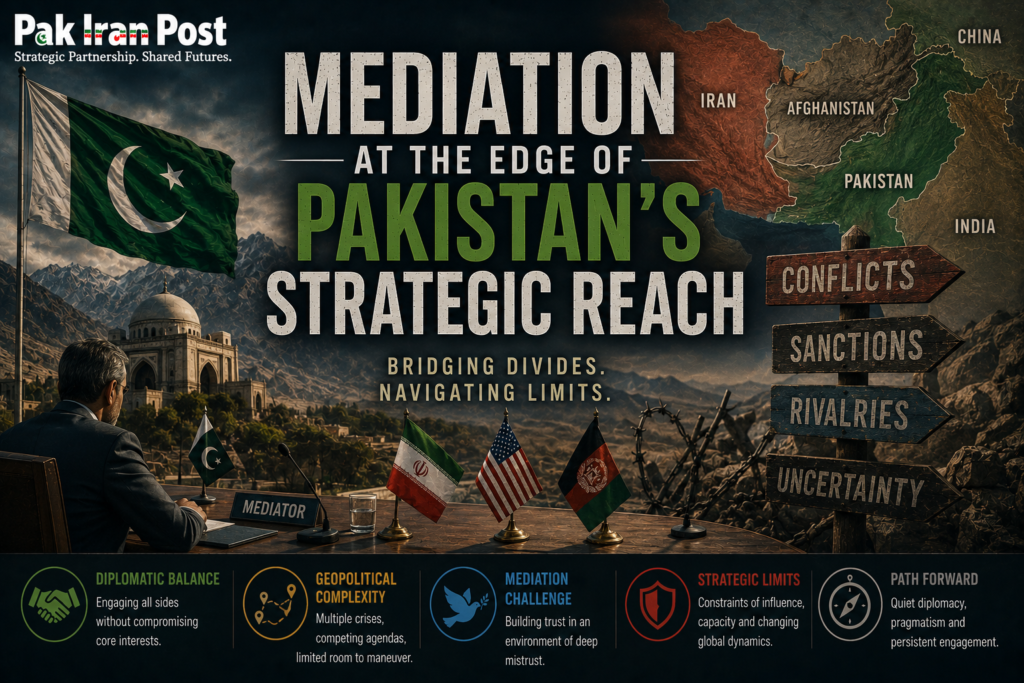
There are moments in diplomacy when a state appears to acquire sudden relevance not because it has become stronger, richer, or more coherent, but because geography, relationships, and timing briefly place it at the hinge of someone else’s crisis. Pakistan’s recent role in facilitating contact between the United States and Iran belongs to that category of moment. It has generated a familiar but serious question. Has Islamabad discovered a new strategic opening as a middle power capable of brokering communication between hostile states, or has it merely stumbled into a dangerous theatre in which larger actors temporarily require a messenger but have no intention of rewarding one?
That question matters because mediation is often romanticised in countries that are hungry for diplomatic validation. It is easy to mistake proximity to a negotiation for influence over its outcome, and easy to confuse being useful with being valued. Pakistan’s involvement in recent U.S.-Iran de-escalatory diplomacy has unquestionably altered perceptions of Islamabad in several capitals. It has reminded Washington that Pakistan still possesses channels into political and security circles that matter in Tehran. It has reassured parts of the Gulf that Islamabad, despite its own economic distress and domestic turbulence, remains capable of performing stabilising functions in a volatile neighbourhood. It has also offered Pakistan a rare opportunity to project itself not as a recipient of crisis management, but as a contributor to it. Yet the harder test is whether such mediation creates durable diplomatic capital or only a brief episode of tactical relevance in a region where strategic memory is short and coercive power still decides the terms of peace.
The temptation in Pakistan is to treat the very fact of mediation as proof of restored importance. That would be premature. Mediation becomes statecraft only when it is institutionalised, when it generates repeatable leverage, and when the state conducting it has enough internal coherence to absorb the risks that accompany external visibility. Otherwise, it remains a one-off performance, useful to others, flattering to domestic audiences, and ultimately difficult to convert into lasting gains. Pakistan now sits precisely at that threshold. It has demonstrated that it can act as a conduit between estranged powers. It has not yet demonstrated that it can transform that conduit role into a durable instrument of national strategy.
The argument for Pakistan’s usefulness is not difficult to understand. Few countries combine its mix of incentives and access. Pakistan shares a long and difficult border with Iran, making escalation in the Gulf and western Asia not a distant geopolitical spectacle but a direct national security problem. It has deep security concerns in Balochistan, where every regional convulsion threatens to spill into already fragile local conditions. It has long maintained a relationship with Tehran that is uneven and often constrained, but functional enough to preserve channels in moments of stress. At the same time, Pakistan has strong ties with Saudi Arabia and other Gulf monarchies, extensive labour and financial dependencies in the Gulf, and a history of security cooperation with Western powers, particularly the United States. That combination does not make Islamabad a neutral power in the classical sense. It does, however, make it one of the few states that can speak to all sides without being automatically disqualified by any one of them.
That is a strategic asset, but it is not self-executing. Channels alone do not produce mediation. What matters is whether a state can convert access into credibility. Credibility in this context does not mean moral authority or rhetorical balance. It means something much colder and more technical. Can a mediator keep messages secret, relay them accurately, and avoid freelancing? Can it reassure each side that sensitive communication will not be exploited for domestic grandstanding, leaked for short-term advantage, or distorted by institutional rivalry? Can it read the red lines of each capital, understand what is negotiable and what is theatre, and recognise when a proposal is designed for agreement and when it is designed for blame allocation? In crises involving the United States and Iran, these questions are not decorative. They are the architecture of trust.
Pakistan appears to have been useful because it could offer some of these things at a moment when direct communication was politically costly and strategically brittle. In Washington’s view, Islamabad can still reach Tehran through channels that are not entirely formal and not entirely civilian. In Tehran’s view, Pakistan is a neighbouring Muslim state with which it has disputes but not civilisational estrangement, and one whose military and political establishments can carry sensitive messages with seriousness. In Gulf capitals, Pakistan is not viewed as an adversary, and its stake in de-escalation is legible. That combination gave Islamabad a window. It allowed Pakistan to position itself not as an architect of settlement, which would have been implausible, but as a broker of controlled communication between actors who needed a mechanism to reduce the chance of miscalculation.
The distinction matters. Middle powers rarely mediate by imposing frameworks. They mediate by managing contact, sequencing messages, lowering ambiguity, and preserving space for larger actors to back away from escalation without public humiliation. That is often unglamorous work. It involves shuttle diplomacy, military-to-military reassurance, backchannel drafting, and the careful timing of signals that can calm markets and temper mobilisations even when no comprehensive agreement is yet in sight. If Pakistan’s recent diplomacy has value, it lies there. Not in the fantasy that Islamabad can reorder West Asian geopolitics, but in the more modest and more credible proposition that it can sometimes reduce the friction between estranged powers when those powers have reasons to avoid war but cannot yet admit that openly.
Yet usefulness can become a trap. Mediation does not only elevate a state’s profile; it also expands its exposure. The same position that grants access can generate retaliation, expectation, and strategic overreach. If Pakistan becomes known as a conduit between Washington and Tehran, it inherits not only prestige but also the burdens of being associated with failure. A mediator in a coercive theatre is often tolerated while talks are alive and forgotten when they collapse. Worse, it can be blamed by all sides for outcomes it never controlled. Iran may suspect bias if Pakistan appears too close to Gulf or American preferences. Washington may lose patience if Islamabad cannot deliver timely or sufficiently authoritative responses from Tehran. Gulf capitals may welcome Pakistani de-escalation only until they fear it is legitimising Iranian leverage. Israel, meanwhile, has its own view of regional diplomacy and its own thresholds for what counts as unacceptable accommodation. In such an environment, mediation is less like standing above the conflict than standing inside its line of fire without having command over its escalation ladder.
This is where Pakistan’s structural weaknesses become central. A country can perform a high-profile diplomatic role abroad while still being dangerously underprepared at home. Pakistan knows this pattern well. It has often cultivated an ambitious external posture while relying on fragmented internal machinery to execute it. The result is a recurring asymmetry in statecraft. The speech is strategic. The institution is improvisational. The ambition is regional. The administrative follow-through is thin. Mediation with Iran and the United States exposes that asymmetry with unusual clarity because the demands of credible brokerage are not merely diplomatic. They are bureaucratic, financial, legal, and political.
A serious mediator in a sanctions-heavy, militarised crisis requires sanctions literacy, inter-agency discipline, and a capacity for rapid policy synthesis. It must understand the legal architecture of U.S. and multilateral sanctions, the banking consequences of even indirect facilitation, the commercial risks to domestic firms, the insurance and shipping implications of maritime disruption, and the internal political calendars of all relevant capitals. It must coordinate civilian diplomats, military interlocutors, intelligence assessments, trade officials, financial regulators, and political leadership in real time. Pakistan has pockets of competence in several of these domains. What it does not yet have, at least not in visible and durable form, is an integrated crisis-diplomacy architecture capable of sustaining such mediation beyond the urgency of a single episode.
That gap matters because mediation generates second-order effects that a weakly coordinated state can struggle to absorb. If sanctions tighten, Pakistan’s border trade with Iran, already a mix of formal necessity and tolerated informality, could come under sharper scrutiny. If military incidents resume in the Gulf, Islamabad may be pressed to clarify positions it would prefer to keep ambiguous. If talks break down after Pakistan has invested prestige in them, domestic critics will ask whether the state overpromised abroad while neglecting fires at home. And if the process produces only a temporary pause rather than a durable settlement, Pakistan may find that it has attached its diplomatic credibility to a mechanism whose lifespan it cannot control.
The domestic political dimension is especially uncomfortable because it punctures the romance of mediation. Can a state wrestling with fiscal fragility, insurgent violence, and uneven institutional coordination sustainably play the role of regional broker? Pakistan’s western frontier is not calm. Balochistan remains vulnerable to insurgent attacks, illicit trade networks, and local grievances that are too often administered through force rather than governed through legitimacy. The economy remains structurally weak, dependent on external financing and recurrent rescue arrangements. Civil-military coordination in foreign and security policy may be stronger than in some periods, but strong coordination at the top does not automatically translate into coherent execution across ministries, regulators, customs, provincial authorities, and local administrations. The question is not whether Pakistan can mediate while imperfect. Most mediators are imperfect. The question is whether its internal fragilities are so pronounced that high-profile diplomacy risks becoming another elite performance detached from the state capacity needed to sustain it.
There is also a deeper strategic problem. Mediation can encourage a state to overestimate its room for manoeuvre. Once foreign capitals begin to treat Islamabad as a useful intermediary, Pakistan may be tempted to infer that it has recovered broader leverage in Washington, the Gulf, or multilateral forums. That would be a category error. A mediator is often valuable precisely because it is limited. It is acceptable because it is not a principal. Its access is tolerated because it does not threaten to dominate the process. The danger for Pakistan is to mistake this conditional usefulness for a wider strategic rehabilitation. The United States may appreciate Pakistan’s role in de-escalation without altering its long-term concerns about militancy, Chinese influence, nuclear risk, or democratic instability. Gulf states may praise Islamabad’s stabilising role while still treating it primarily as a labour exporter, security partner, and occasionally helpful Muslim-majority state, not as a co-equal architect of regional order. Iran may engage Pakistan as a conduit while remaining deeply suspicious of its military ties with Gulf monarchies and the West. Mediation can improve atmospherics. It does not erase structural hierarchies.
Still, dismissing the opening would be equally mistaken. The question is not whether mediation makes Pakistan a great power. It plainly does not. The question is whether it can be converted into a more disciplined form of middle-power statecraft, one grounded in selective brokerage, strategic restraint, and institutional repair. There are reasons to think it can, but only if Islamabad abandons the habit of treating diplomatic success as a press release rather than a systems test.
The first requirement is message discipline. In crises of this kind, a mediator’s greatest asset is not flamboyance but reliability. Pakistan must be able to assure all sides that messages transmitted through it will not become fodder for domestic political signalling. That requires a far tighter communications doctrine than Pakistan often displays. Civilian officials, military spokespersons, ministers, and party figures cannot all freelance around a sensitive diplomatic file. There has to be a single authorised line, a clear chain of custody for messages, and a disciplined separation between what is said privately, what is signalled publicly, and what is left unsaid. In a negotiation involving Iran and the United States, a careless sentence can carry operational consequences. Secrecy is not cosmetic. It is part of the diplomatic product.
The second requirement is institutionalising backchannel capacity rather than personalising it. Pakistan’s diplomacy has too often relied on a small number of powerful individuals whose personal relationships, military standing, or political access temporarily substitute for process. That can work in emergencies. It cannot serve as the foundation of a durable mediation posture. Islamabad needs a standing inter-agency crisis cell for western regional diplomacy, staffed not only by foreign service officers but by sanctions experts, financial analysts, military planners, energy officials, customs specialists, and legal advisers. Its task would not be to make grand strategy in the abstract but to produce rapid integrated assessments, map escalation scenarios, monitor sanctions exposure, and maintain structured lines of communication with relevant foreign capitals. The point is simple. If Pakistan wants to mediate recurrently, it must stop improvising every time a crisis erupts.
The third requirement is sanctions literacy. This may sound technical, but it is central. Any state mediating between Washington and Tehran will eventually collide with the practical realities of sanctions compliance, exemptions, humanitarian channels, insurance, shipping, and banking restrictions. Pakistan cannot afford to enter such diplomacy with a shallow understanding of the legal and financial terrain. It needs a specialised sanctions unit drawing expertise from the foreign ministry, finance ministry, State Bank, customs, and private-sector compliance professionals. That unit should be able to advise policymakers not only on what is politically desirable but on what is legally possible, commercially survivable, and reputationally defensible. Without that capacity, Pakistan risks becoming a diplomatic facilitator that cannot protect its own economy from the consequences of the process it is helping to manage.
The fourth requirement is to link external mediation to internal border resilience. Pakistan’s role in U.S.-Iran diplomacy is inseparable from the condition of its frontier with Iran. A state cannot credibly present itself as a stabilising broker in western Asia while treating its own western borderland as a permanently exceptional security zone governed through periodic closures, informal bargains, and underinvestment. If mediation is to become a genuine instrument of statecraft, Pakistan must reduce the volatility of Balochistan, formalise border commerce where possible, improve customs governance, and create more predictable local administrative mechanisms for cross-border movement. Otherwise, every regional crisis will continue to ricochet through a domestic space already primed for disruption.
The fifth requirement is strategic modesty. Pakistan should resist the urge to narrate mediation as proof that it can solve the region’s grand contradictions. The wiser course is to define its role narrowly and credibly. Islamabad cannot redesign the U.S.-Iran relationship, resolve the nuclear file, or adjudicate the wider balance between Iran, Israel, and the Gulf. What it can plausibly do is facilitate communication, reduce misunderstanding, carry proposals, and help sequence de-escalatory steps in moments when direct contact is politically blocked. That is not a small function. But it becomes dangerous when inflated into a mythology of indispensability. A mediator that believes its own publicity becomes less cautious, more visible, and easier for larger actors to manipulate.
There is also a political economy to this story that Pakistan should not ignore. Diplomatic capital is only partly about prestige. It is also about whether diplomatic usefulness can be translated into tangible gains without corrupting the neutrality required for mediation. Pakistan’s recent role has prompted talk of economic dividends, improved access in Western capitals, and renewed Gulf confidence. Some of that may materialise at the margins, especially in the form of goodwill, trade conversations, or a softer hearing in bilateral engagements. But Pakistan should be wary of overpricing those dividends. Great powers and rich regional states rarely reward middle-power mediation in proportion to the political risk assumed by the mediator. More often they offer gratitude, symbolic recognition, and perhaps selective concessions while keeping the underlying structural relationship unchanged.
That is why the most important dividend Pakistan can seek is not a vague diplomatic glow but a concrete strengthening of its own state capacity. If the mediation episode leads Islamabad to build better crisis-planning mechanisms, deepen sanctions expertise, formalise inter-agency coordination, improve strategic communications, and stabilise the Iran border economy, then it will have generated lasting value regardless of whether the U.S.-Iran track ultimately succeeds. If, by contrast, the episode ends in ceremonial self-congratulation, a handful of flattering headlines, and no institutional reform, then Pakistan will have confirmed the central weakness of its statecraft: a talent for episodic relevance without the administrative patience to convert relevance into capability.
The question, then, is not whether Pakistan should mediate. Given its geography, relationships, and stake in regional de-escalation, it would be strange if it did not try. The real question is what kind of mediator Pakistan wishes to become. One model is theatrical mediation, heavy on symbolism, vulnerable to leaks, dependent on personalities, and designed as much for domestic prestige as for diplomatic effect. The other is functional mediation, quiet, technical, disciplined, and rooted in the understanding that the state’s first obligation is not to appear important but to be useful in ways that also strengthen its own resilience. Pakistan has often preferred the first model because it is politically gratifying and institutionally easier. The present moment offers an opportunity to choose the second.
That choice will require an uncommon honesty about the limits of Pakistani power. Islamabad cannot control the strategic objectives of Washington, the internal politics of Tehran, the risk appetite of Israel, or the anxieties of Gulf monarchies. It cannot guarantee that ceasefires hold, that sanctions ease, or that regional militias remain contained. It cannot even guarantee that a negotiation it helps midwife will not collapse under the weight of mistrust, domestic politics, or battlefield shocks. But it can decide whether it will continue to approach such crises through ad hoc elite improvisation or through a more serious architecture of statecraft.
That architecture would be less glamorous than the rhetoric surrounding mediation. It would consist of trained teams, secure channels, legal mapping, customs coordination, financial risk assessment, energy contingency planning, and clear civilian-military protocols. It would require Pakistan to treat diplomacy not as an extension of political messaging but as a national capability requiring investment and discipline. It would also require a more mature political conversation at home, one in which foreign-policy episodes are not instantly converted into proof of national revival or ammunition for partisan competition. A state that wants to mediate effectively must learn to protect its diplomacy from its own appetite for spectacle.
In the end, Pakistan’s role in recent U.S.-Iran de-escalatory diplomacy has opened a door, but it has not yet built a room. The opening is real because it reflects something structurally true about Pakistan’s position. Islamabad sits at the intersection of Gulf security, Iranian instability, South Asian competition, and western strategic anxieties. It has reasons to prevent escalation, relationships that give it access, and a military-diplomatic apparatus that can still be useful in crisis. Yet the limits are equally real. Pakistan remains fiscally fragile, administratively uneven, and domestically strained. It is a country whose external ambitions still outpace the coherence of its internal machinery.
That does not invalidate mediation. It simply clarifies its terms. Pakistan can derive strategic value from acting as a broker of controlled communication, but only if it understands that mediation is not a trophy. It is a test. It tests whether a state can keep confidence, absorb pressure, manage ambiguity, and translate temporary relevance into institutional competence. It tests whether geography can be turned into leverage without becoming a trap. It tests whether a country accustomed to living inside other people’s conflicts can, at least occasionally, help prevent one without losing sight of its own vulnerabilities.
If Pakistan passes that test, mediation could become a modest but meaningful instrument of statecraft, not because it transforms the regional balance, but because it gives Islamabad a disciplined role in shaping moments of restraint. If it fails, the episode will join a familiar archive of Pakistani foreign policy, impressive in appearance, thin in institutional legacy, and quickly overtaken by the next emergency. The choice between those futures will not be made in summit photographs or congratulatory statements. It will be made in the unglamorous work of reforming how the Pakistani state plans, coordinates, communicates, and governs under pressure. Only then can a conduit become a strategy, and only then can tactical relevance harden into diplomatic capital.
A Public Service Message