
A Frontier That No Longer Behaves Like a Margin

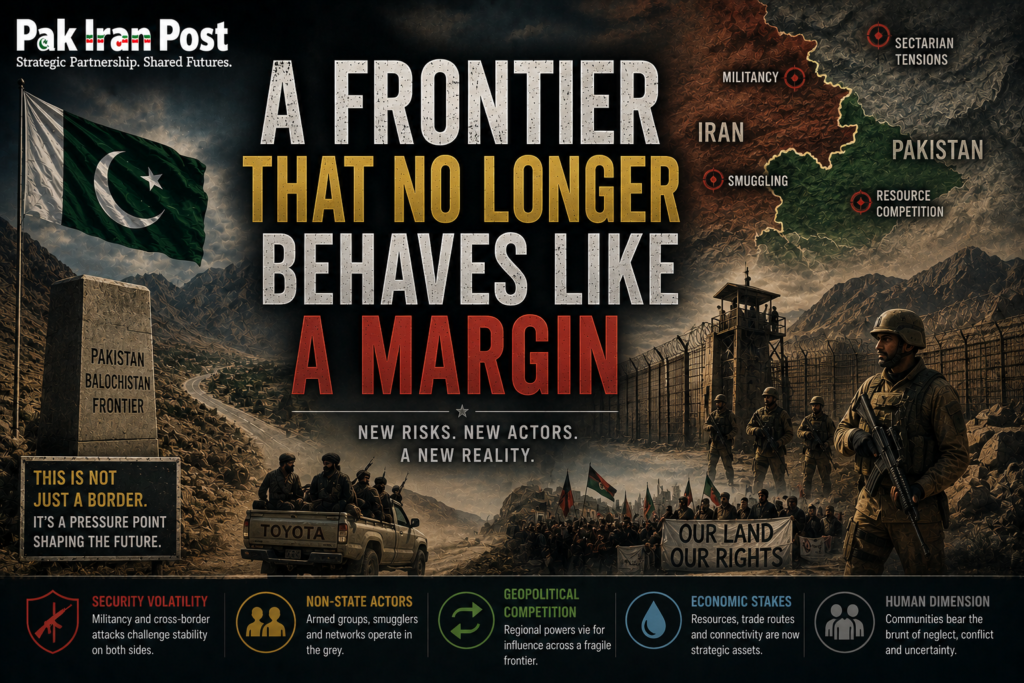
Borders become dangerous not only when armies cross them, but when states stop governing what the border has already become. The Pakistan-Iran frontier has long been described as a remote security belt, a rough edge of sovereignty where smugglers, insurgents, tribes, and underfunded officials coexist in uneasy improvisation. That description is now too small for the reality. The frontier between Pakistan’s Balochistan and Iran’s Sistan-Balochistan is no longer merely a peripheral problem of illicit fuel, occasional militant attacks, and periodic diplomatic complaint. It is becoming something more serious and more structurally revealing: a compression chamber in which insurgency, separatist violence, sectarian mistrust, refugee movement, economic desperation, and state neglect are colliding with regional geopolitics. The question is no longer whether the border is unstable. The question is whether Islamabad and Tehran can prevent that instability from hardening into a permanent military exception zone, one in which every crisis is managed through force and closure because neither state has built the political, administrative, or economic mechanisms required to govern the frontier in peacetime.
That shift in the nature of the problem matters because it changes what counts as strategy. For years, the Pakistan-Iran border was treated in official language as an irritating but containable challenge. Smuggling could be curbed through crackdowns. Militants could be chased through intelligence coordination. Cross-border tensions could be defused after the fact through hotline diplomacy, flag meetings, and ritual assurances that neither side would allow its territory to be used against the other. That framework now looks increasingly inadequate. Violence in Balochistan has intensified, militant organisations have shown greater sophistication, local economies remain deeply dependent on informal trade and Iranian fuel, and the region’s grievances have become more easily absorbed into larger contests involving Iran, Gulf rivalries, sanctions pressure, and Pakistan’s own internal insurgency problem. When the same frontier is at once a militant corridor, a sanctions loophole, a subsistence economy, a nationalist grievance zone, and a site of strategic mistrust between neighbouring states, it can no longer be managed through a narrow security lens alone.
Recent events have made that plain. Balochistan has witnessed repeated waves of coordinated separatist violence, including major attacks in early 2026 that killed civilians and security personnel and prompted large-scale military operations. Reuters and Al Jazeera reporting from this year has underscored both the scale of the insurgent threat and the persistence of structural grievances in the province, where underdevelopment, political alienation, and coercive state responses continue to feed cycles of violence. At the same time, the Iranian side of the frontier remains volatile, with Tehran still confronting militant activity in Sistan-Balochistan, including operations linked to Jaish al-Adl and other armed actors that exploit the geography and weak governance of the borderlands. The result is a frontier where both states believe the other is not doing enough, both security establishments reserve the right to interpret instability through the language of hostile sanctuary, and local populations pay the price for a crisis architecture they did not design.
The temptation in both capitals is to respond with familiar instruments: more fencing, more checkpoints, more closures, more kinetic operations, and more declarations that sovereignty will be defended at all costs. There are obvious reasons for that instinct. The border is porous, sparsely populated in large stretches, and traversed by communities whose social and economic ties predate the modern state. Armed groups can move through terrain that is difficult to monitor, and both Pakistan and Iran have faced attacks that make passivity politically impossible. Yet there is a difference between necessary security action and a governing philosophy built almost entirely around security action. The first can be justified. The second eventually becomes self-defeating. A frontier that is treated primarily as a military problem begins to generate the very conditions that perpetuate insecurity: disrupted livelihoods, predatory enforcement, corruption, informal taxation by armed actors, black-market dependence, and a widening gap between what the state says the border is and what borderland societies experience it to be.
That gap is central to understanding why the Pakistan-Iran frontier has become such a strategic liability. From Islamabad or Tehran, the border is often viewed through the language of national security and external threat. From Turbat, Panjgur, Gwadar, Kech, Washuk, Chagai, Taftan, or the adjoining districts across the Iranian side, the border is also an economy, a family network, a transport route, and a survival mechanism. The formal state sees fuel smuggling. Many local communities see affordable energy, employment, and one of the few functioning circuits of commerce available to them. The formal state sees unauthorised crossings. Border residents see kinship, seasonal movement, and access to markets, medical care, and goods that official channels have failed to provide. The formal state sees an illicit economy that undermines customs revenue. Border populations see a licit economy that was never built, and an illicit one that filled the vacuum because the state offered little else.
This does not romanticise smuggling. The informal fuel trade across the Pakistan-Iran border is entangled with patronage, rent-seeking, local strongmen, and corruption inside the state itself. It distorts markets, deprives the exchequer of revenue, and creates safety hazards as fuel is transported and stored through unregulated networks. It also blurs the line between subsistence commerce and organised criminality. But to describe it only as a law-and-order problem is to miss its political meaning. Informal fuel has become embedded in the social contract of neglect. It persists because it answers a material need in places where the formal economy is weak, infrastructure is poor, and state promises of development have too often arrived as rhetoric, extraction, or militarised control rather than sustained public goods. Crackdowns that ignore this context may produce temporary seizures and impressive headlines. They rarely produce lasting order.
That is one reason why the border’s volatility cannot be separated from the broader governance crisis in Balochistan. The province is Pakistan’s largest by area and among its poorest by human development. It is rich in minerals and strategically central to projects like Gwadar and the China-Pakistan Economic Corridor, yet much of its population continues to experience the state as distant, extractive, and securitised. The insurgency has its own internal dynamics, factions, and external narratives, but its persistence cannot be understood without acknowledging the political economy in which it operates. Militants do not create underdevelopment, but they thrive in spaces where the state’s legitimacy is already thin. They recruit not only through ideology or coercion but through grievance, humiliation, and the everyday knowledge that the benefits of strategic geography rarely reach those who live on it.
Iran’s Sistan-Balochistan presents a different but related version of the same problem. It is among Iran’s poorest provinces, home to a Sunni Baluch population that has long complained of discrimination, underinvestment, and heavy-handed security practices in a state defined by a Persian and Shia core. Tehran sees militant violence there through the lens of terrorism, separatism, and foreign interference, and there is no doubt that armed groups have mounted deadly attacks. Yet the province’s vulnerability is not explained by militancy alone. It is also shaped by economic marginalisation, weak trust in state institutions, and the fact that the border economy often functions as a substitute for development rather than a supplement to it. When both sides of a frontier are marked by poverty, ethnic alienation, and securitised governance, the border between them does not simply separate two problems. It fuses them.
That fusion is what makes the Pakistan-Iran frontier more dangerous than any single militant organisation operating across it. Jaish al-Adl, Baloch separatist factions, criminal syndicates, and sectarian networks matter. They can kill, intimidate, and provoke interstate crises. But the most combustible feature of the frontier may be the accumulation of governance vacuums that make each shock more difficult to contain. A militant attack on Iranian forces can quickly become a diplomatic accusation against Pakistan. A crackdown on smuggling can become an economic shock for Pakistani border districts already struggling with unemployment and inflation. A border closure imposed after a security incident can choke legal trade, increase prices, and push more commerce back into informal channels. A cross-border strike or hot pursuit can trigger nationalist escalation in both capitals, even if neither government wants a sustained confrontation. The problem is not only the presence of armed actors. It is the absence of a governing architecture robust enough to prevent every incident from cascading across security, diplomacy, and local livelihoods at once.
This is why the notion of the frontier as a “permanent military exception zone” is so important. An exception zone is a space where ordinary governance recedes and extraordinary security measures become normalised. Roads are shut at short notice. Communications are restricted. Markets are disrupted. Civilian movement is treated as suspect. Local intermediaries, smugglers, tribal brokers, and security officials negotiate the real terms of life more than formal institutions do. The state’s legitimacy is enforced rather than earned. Over time, the border is no longer governed as a social and economic region. It is administered as a recurring emergency. Pakistan and Iran are not fully there yet, but the danger is that the frontier is drifting in that direction through repetition. Each attack justifies another layer of militarisation. Each militarised response deepens local resentment or economic disruption. Each disruption widens the space for illicit actors. Each illicit network then strengthens the security rationale for the next crackdown. It is a circular system that produces motion without resolution.
The persistence of that system reflects a failure of institutional imagination in both Islamabad and Tehran. After violent episodes, officials from both sides routinely meet, exchange lists of concerns, reiterate commitments to deny sanctuary to hostile actors, and promise better coordination. These meetings are not meaningless. They can lower temperature and prevent immediate escalation. But they rarely amount to a strategy for governing the border as a shared problem rather than a bilateral complaint. The pattern is reactive. Violence happens. Security officials meet. Pledges are made. Patrols increase. The news cycle moves on. Then another attack, another closure, another accusation. What is missing is a binational framework that addresses the structural volatility of the frontier rather than only its episodic manifestations.
Such a framework would have to begin by accepting an uncomfortable truth. Neither Pakistan nor Iran can stabilise this border by force alone because the frontier’s disorder is not simply the product of insufficient force. It is the product of fragmented sovereignty, distorted local economies, weak administrative capacity, and political distrust on both sides. More troops may be necessary in a crisis. They are not a substitute for customs reform, local development, predictable legal trade, and institutionalised intelligence-sharing. Fencing may reduce some movement. It does not create employment for a border population dependent on cross-border commerce. Surveillance can help identify armed infiltration. It does not address why communities often prefer informal networks to formal state channels. Security cooperation matters. But if it is not paired with economic and administrative repair, it becomes a method of containment rather than a route to stability.
The policy case for a Pakistan-Iran border compact therefore deserves more serious attention than it usually receives. Such a compact should not be imagined as a grand treaty of friendship. It would be a pragmatic governance instrument built around four interlocking pillars: security coordination, licit border commerce, monitored fuel trade, and district-level development financing. The security component would include more systematic intelligence-sharing on named militant and criminal actors, agreed deconfliction mechanisms for border incidents, joint or synchronised patrol protocols in selected sectors, and direct communication links between local commanders rather than only central ministries. The commerce component would involve expanding and regularising border markets, simplifying customs procedures for small-scale traders, investing in scanning and tracking systems, and reducing the bureaucratic incentives that push ordinary commerce into smuggling channels. The fuel component would acknowledge a political reality both states already know: Iranian fuel will continue to move into Pakistan so long as price differentials, local demand, and weak formal supply persist. The choice is not between total prohibition and total permissiveness. It is between an unregulated trade captured by rent-seeking networks and a monitored, taxed, district-sensitive framework that brings some of that economy into legality. The development component would channel dedicated funds into border districts for roads, storage, transport safety, market infrastructure, vocational training, and local service delivery, thereby reducing the dependence of households on illicit commerce over time.
None of this is simple. Each pillar collides with entrenched interests. Security establishments are often reluctant to share operational information more deeply than necessary, especially with neighbours they do not fully trust. Customs reform threatens networks that profit from opacity. Formalising fuel imports would raise questions about sanctions, taxation, and domestic energy pricing. Development financing in Balochistan is vulnerable to leakage, politicisation, and the tendency of federal schemes to produce ribbon-cutting rather than durable governance. Iran’s own sanctions burden and internal economic crisis further complicate any effort to build more formal cross-border arrangements. Yet complexity is not an argument for passivity. It is an argument for moving from slogans to sequencing.
The sequencing matters because a border compact cannot begin with the most politically explosive issues. It must start where mutual incentives are strongest and symbolic costs are lowest. One obvious entry point is incident management. Pakistan and Iran need a more formal protocol for handling cross-border attacks and accusations before they escalate into public confrontation. That means agreed timelines for information exchange after a security incident, standard procedures for requesting action against named suspects, and protected channels through which local military and paramilitary commanders can communicate before central governments reach for retaliatory rhetoric. The goal is not to eliminate mistrust overnight. It is to make it harder for mistrust to become a trigger for escalation.
A second entry point is legal trade infrastructure. The border economy cannot be stabilised if lawful commerce remains cumbersome, underbuilt, and less profitable than smuggling. Both states should identify a small number of crossing points for phased upgrading, with transparent customs processes, warehousing, digital documentation, and dedicated lanes for small traders. This is not glamorous statecraft, but it is often more consequential than dramatic announcements about border security. A trader who can move goods through a predictable legal channel is one less participant in an informal system that funds middlemen, corrupt officials, and armed groups. The same logic applies to transport and market infrastructure in border districts. If a government wants communities to prefer the state’s rules, it must first offer them a state that functions.
The fuel question is harder because it sits at the intersection of local livelihood, national revenue, and international sanctions. Pakistan has for years tolerated, contested, and selectively exploited the inflow of Iranian fuel into Balochistan. The arrangement is unstable because it is neither fully legal nor fully suppressed. Local communities rely on it, enforcement agencies extract rents from it, and formal fuel suppliers resent it. A monitored fuel trade mechanism, perhaps under district quotas or licensed local cooperatives, would be politically controversial but strategically rational. It would not solve the sanctions problem, and Pakistan would have to navigate that carefully, especially in relation to U.S. restrictions on Iranian energy trade. But the current model, in which the state oscillates between tacit tolerance and performative crackdowns, serves neither revenue collection nor border stability. A frontier cannot be governed based on a fiction everyone knows to be false.
There is also a larger regional context pressing on the border from above. Pakistan’s relations with Afghanistan remain tense and militarised. Iran’s confrontation with Israel and its difficult relationship with the United States keep the western neighbourhood on edge. Gulf-Iran competition has not disappeared even when diplomacy temporarily lowers temperatures. China has strategic interests in Balochistan through Gwadar and CPEC, while India watches Chabahar and the wider Baloch question through its own lens of regional competition. In such an environment, the Pakistan-Iran frontier is vulnerable to becoming a proxy narrative even when the local drivers of instability are domestic and economic. That risk should make Islamabad especially careful about allowing the border to be defined solely through the language of external sabotage. Foreign interference is a real concern in many conflict zones, but it can also become an alibi that relieves the state of confronting its own governance failures. A frontier is easier to securitise when its disorder can be attributed entirely to hostile outsiders. It is harder, but more honest, to admit that under-governance, punitive administration, and economic exclusion are themselves strategic liabilities.
For Pakistan in particular, the border is also a test of whether it can reconcile national-security thinking with provincial governance. Balochistan is often discussed in Islamabad as a site of insurgency, connectivity, and geopolitical competition. It is less often governed as a place where citizens require predictable institutions, economic inclusion, and political dignity. That mismatch has consequences. When local communities believe the state notices them mainly through checkpoints, raids, or strategic projects designed elsewhere, they become less likely to trust the state’s narrative about why border restrictions are necessary or why crackdowns are in the public interest. A frontier where legitimacy is thin cannot be secured cheaply. It requires more coercion to produce less stability. That is not a sustainable model.
Iran faces a parallel challenge, though within its own ideological and political framework. Sistan-Balochistan has long occupied an ambiguous place in the Iranian state, important for security but peripheral in development and representation. Tehran’s instinct, like Islamabad’s, has often been to securitise first and reform later. The result is familiar. Militancy is treated as proof that the province needs harder control; harder control reinforces alienation; alienation sustains the environment in which militancy recruits. Neither state can afford to view the other side’s Baluch unrest as entirely external to its own domestic problem. The frontier’s volatility is cumulative. When Pakistan mishandles Balochistan, Iran inherits some of the risk. When Iran represses Sistan-Balochistan without addressing its deprivation, Pakistan inherits some of that instability too.
There is, then, a more difficult proposition that both states must confront. The most dangerous thing about the Pakistan-Iran border may not be any one organisation, route, or incident. It may be the fact that the frontier has become a repository for unresolved questions that neither state has wanted to answer honestly. What does sovereignty mean in a borderland where the formal economy does not sustain the population? What does security mean when the instruments used to produce it repeatedly disrupt the livelihoods that might otherwise anchor loyalty to the state? What does bilateral cooperation mean if it exists mainly as a post-crisis ritual rather than a system of shared governance? And what does development mean when strategic infrastructure is celebrated while the districts surrounding it remain trapped in fuel smuggling, underemployment, and administrative neglect?
Pakistan should answer those questions not with another round of rhetorical resolve but with a doctrine of border normalisation. That doctrine would not deny the need for force against armed groups. It would deny force the status of being the only serious language the state speaks in the borderlands. It would treat customs modernisation as national security, monitored fuel regulation as national security, district roads and warehouses as national security, local dispute resolution and lawful mobility as national security, and the political inclusion of border populations as national security. It would also recognise that not every irregularity at the frontier is a prelude to insurgency. Some are symptoms of an economy the state has failed to formalise. Others are consequences of a geography the state cannot wish away.
The alternative is grimly familiar. More closures, more patrols, more accusations after each attack, more economic pain for communities with few legal alternatives, more room for armed groups to tax and intimidate, and more occasions on which Pakistan and Iran discover that they have once again militarised the symptoms while neglecting the structure. That path does not merely keep the frontier unstable. It slowly teaches the state to live with instability as a permanent condition. And once a border becomes a permanent exception zone, reversing it is far harder than preventing it.
The Pakistan-Iran frontier no longer behaves like a margin. It behaves like a test. It tests whether two neighbouring states can govern complexity rather than merely punish it, whether they can build a border regime that distinguishes between militants and merchants without collapsing both into the same category of threat, and whether they can accept that durable security in Balochistan and Sistan-Balochistan will not be delivered by force alone. For Pakistan, especially, the border is a measure of strategic seriousness. A state that wants to act as a diplomatic player in regional crises cannot leave one of its most sensitive frontiers to the logic of improvisation, informal bargains, and recurring crackdowns.
If Islamabad wants the security burden on the Pakistan-Iran frontier to diminish over time, it should pursue a border compact with Tehran anchored in coordinated security, licit commerce, monitored fuel trade, and district-level development. That will not solve insurgency. It will not end mistrust. It will not remove the wider geopolitics pressing on the region. But it could begin to do something more realistic and more important: reduce the structural volatility that turns every shock into a crisis. In border policy, as in foreign policy, the choice is often not between order and disorder, but between governing disorder intelligently and allowing it to harden into the normal situation. The Pakistan-Iran frontier is approaching the point at which that choice can no longer be postponed.
A Public Service Message