
Can Pakistan Govern a Sanctions Border Responsibly

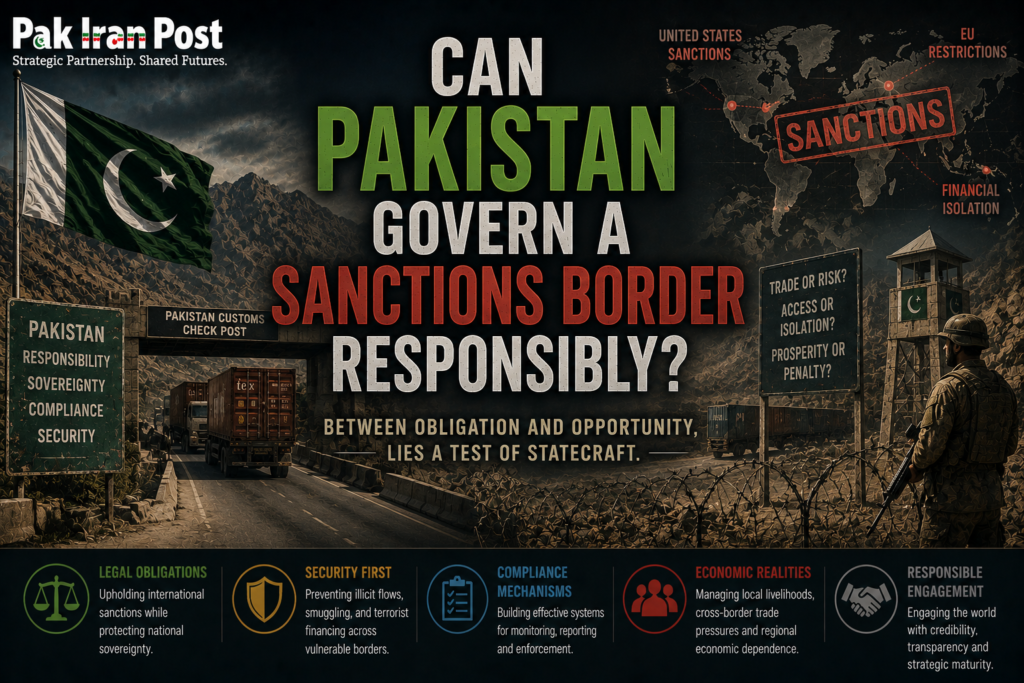
Pakistan’s debate over Iran is often staged as a question of foreign policy courage. Should Islamabad deepen trade with a neighbouring state under sanctions pressure. Should it revive the gas pipeline. Should it convert mediation into commercial advantage. Should it use geography more intelligently in a region being reorganised by war, shipping disruption, and corridor competition. Those questions matter, but they are not the first ones Pakistan should ask. The more uncomfortable question is administrative. Can the Pakistani state actually govern a sanctions adjacent border with the seriousness that a 2026 strategic environment demands, or is it still trying to manage a volatile frontier with habits better suited to a paper file, a district office ledger, and an emergency meeting called after the damage is done.
That distinction is no longer academic. Pakistan’s relationship with Iran now touches a far wider range of state functions than ceremonial diplomacy or periodic border management. It intersects with sanctions risk, fuel imports, local barter trade, customs surveillance, financial compliance, intelligence coordination, energy contingency planning, refugee flows, and the political economy of Balochistan’s border belt. It also increasingly intersects with third country cargo and rerouted commercial traffic as conflict, insurance premiums, and maritime insecurity reshape the economics of the wider region. A state that wants to operate in that environment cannot rely on fragmented authority, discretionary paperwork, and a border regime whose real logic is often negotiated informally between local traders, security actors, customs officials, transporters, and political intermediaries. It needs an operating system, not a slogan.
Pakistan’s Iran file has long been trapped between strategic temptation and bureaucratic timidity. Tehran is close, energy rich, commercially underused, and geographically relevant to western Pakistan, especially Balochistan. But Iran is also sanctioned, watched, politically combustible, and entangled in rivalries far larger than the bilateral relationship. Islamabad’s response has usually been to keep the relationship alive rhetorically while limiting the degree of formal integration that would force a hard confrontation with sanctions law, banking restrictions, or Western scrutiny. The result has been a familiar pattern. The state talks about connectivity, border markets, and regional trade, yet tolerates a large shadow economy at the frontier. It speaks of legal commerce, yet the institutional architecture needed to monitor, document, and de risk that commerce remains partial, uneven, and often reactive. It invokes national interest, yet frequently leaves implementation to agencies whose incentives are narrow, whose data systems do not fully talk to each other, and whose accountability is blurred by overlapping mandates.
The core problem is not that Pakistan lacks policy documents. It is that it lacks an integrated sanctions aware border governance model. Managing a frontier with Iran in 2026 requires more than customs posts and diplomatic talking points. It requires the ability to answer practical questions in real time. What goods are crossing. Who is financing them. Which entities are involved. What is the origin and final destination of sensitive cargo. Which consignments create exposure under sanctions regimes. Which goods fall into dual use categories. What emergency authorities exist if a war or shipping crisis suddenly diverts trade overland. Which agency has the lead if customs clearance, financial compliance, and intelligence concerns collide in the same transaction. Who speaks to traders. Who speaks to banks. Who speaks to provincial authorities. Who carries legal responsibility when a politically attractive transaction later turns into a sanctions embarrassment.
Pakistan’s current administrative culture does not inspire confidence that it can answer those questions cleanly. The state has made real progress in digitising customs and trade processing. The Pakistan Single Window project and the WeBOC system have modernised significant parts of cross border trade documentation, risk assessment, and agency integration. The customs bureaucracy is not where it was fifteen years ago. But the existence of digital architecture is not the same thing as an integrated frontier governance regime. A sanctions sensitive border is not governed by software alone. It is governed by how institutions share information, how exceptions are handled, how risk is escalated, how local political pressures are resisted, and whether the state can impose a common operating picture on agencies that often function as semi separate republics.
The most obvious weakness is fragmentation. Pakistan’s Iran facing border economy sits at the intersection of federal and provincial authorities, civilian and security institutions, formal trade and tolerated informality, revenue collection and political management. Customs sees one piece of the picture. The commerce ministry sees another. The petroleum bureaucracy sees energy supply pressures. Interior and intelligence agencies see security threats, militant flows, and smuggling networks. Provincial departments see livelihoods, district management, and local unrest. The State Bank and commercial banks see sanctions exposure and reputational risk. None of these perspectives is illegitimate. The problem is that they do not automatically combine into a coherent state posture. In practice, Pakistan often manages the frontier through parallel conversations rather than unified command. One arm of the state seeks facilitation, another seeks control, a third seeks deniability, and a fourth seeks short term political quiet. That is not governance. It is coexistence.
This fragmentation matters because the Iran border is no longer just a customs line. It is a strategic interface. If Gulf shipping disruptions intensify, overland commercial alternatives suddenly become more valuable. If energy shortages worsen, pressure to source fuel, LPG, or electricity through western channels rises. If sanctions enforcement tightens, routine trade can acquire legal and reputational consequences that far exceed its commercial value. If conflict inside Iran or on its periphery displaces people or reroutes cargo, Pakistan must decide whether it is merely a passive neighbour or an active regulator of frontier flows. Every one of those scenarios demands speed, data, and pre agreed protocols. Pakistan’s administrative instinct, by contrast, is often to improvise after the fact, distribute responsibility so that no single office owns the risk, and rely on verbal coordination between agencies that trust each other only selectively.
The border economy itself compounds the challenge. In much of the Pakistan Iran frontier, legality and illegality do not sit in neat categories. Formal trade, tolerated grey trade, petty smuggling, survival commerce, and politically protected rent extraction exist on a continuum. Fuel, food, consumer goods, and small consignments move through channels shaped as much by local necessity and patronage as by statute. For years the state has oscillated between crackdowns and accommodation, neither fully regularising the economy nor decisively suppressing it. That may have been administratively survivable when the main concern was revenue leakage or local law and order. It becomes far more dangerous when the same frontier sits adjacent to sanctions compliance, dual use scrutiny, and international monitoring. A system that cannot distinguish clearly between tolerated informality and regulated commerce is a system that can easily drift into inadvertent violation or selective enforcement.
That is why the real test of state capacity is not whether Pakistan can announce another border market or open another crossing point. It is whether it can construct a sanctions literate chain of custody for frontier trade. Can it digitise manifests comprehensively enough to know not only what is declared, but what is actually moving. Can it cross check consignments against risk profiles, end user concerns, and financial red flags. Can it monitor repeated patterns of under invoicing, misdeclaration, or route manipulation that often accompany sanctions evasion elsewhere. Can it ensure that emergency trade corridors do not become emergency loopholes. Can it create audit trails strong enough to defend legitimate trade while isolating suspect flows. Those are the questions that separate a state seeking strategic relevance from one merely hoping not to be noticed.
The financial dimension is even more revealing. Trade with Iran is not constrained only by border infrastructure. It is constrained by the fact that banks, insurers, shipping actors, and payment channels treat Iran related transactions as high risk terrain. Pakistan can talk about expanding commerce, but unless it can provide lawful, documented, and defensible mechanisms for settlement, traders will continue to rely on cash, barter, informal exchange networks, and third country workarounds. That may keep commerce alive at the margins, but it also keeps it opaque. Opaque trade is politically convenient because it allows the state to avoid decisive choices. Yet opacity is precisely what becomes untenable when sanctions sensitivity rises. A government that wants to avoid embarrassment must decide whether it is content with frontier survivalism or serious about formal commerce. It cannot indefinitely claim to support legal trade while leaving the financial plumbing either absent or too frightened to touch the transaction.
This is where Pakistan’s policy language often becomes evasive. Officials tend to speak as if the main obstacle to deeper economic engagement with Iran is geopolitical pressure from abroad. External pressure is real, but it is only half the story. The other obstacle is domestic incapacity. Pakistan does not yet appear to have a fully credible mechanism through which a trader, transporter, customs agent, bank, and regulator can know with confidence what is permissible, what documentation is required, what risk category applies, and which authority’s decision is final. In the absence of such clarity, business migrates either toward caution or toward informality. Legitimate firms step back because the compliance risk is too high. Less scrupulous networks step forward because opacity is their comparative advantage. The state then loses twice, first by failing to formalise trade and second by strengthening the very intermediaries who profit from institutional weakness.
The sanctions issue sharpens this dilemma because modern sanctions enforcement is not limited to dramatic headline violations. It increasingly operates through due diligence expectations, correspondent banking caution, vessel tracking, beneficial ownership scrutiny, and pressure on firms to avoid even indirect exposure. Pakistan does not need to become a major sanctions violator to suffer reputational damage. It only needs to appear administratively unserious, procedurally weak, or unable to explain how sensitive trade is screened. That is why a sanctions adjacent frontier cannot be governed by ad hocism. It requires a doctrine of lawful caution. The state must know what commercial activity it wishes to protect, what activity it wishes to prohibit, and what activity it wishes to monitor more aggressively. At present, those lines are too blurred.
Bureaucratic slowness is part of the problem, but not the whole of it. Pakistan’s deeper difficulty is that its administrative system still treats crisis as an interruption rather than a governing condition. In a relatively stable environment, a sluggish file can be tolerated. At a sanctions border in a war shaken region, slowness itself becomes a strategic liability. Traders reroute quickly. Smuggling adapts quickly. sanctions designations can change quickly. Insurance conditions can change quickly. Border closures can happen overnight. Fuel supply anxieties can trigger political pressure within days. If the state’s response mechanism depends on circulars, sequential approvals, and inter ministry correspondence that takes weeks to settle a question of jurisdiction, then policy is effectively being outsourced to circumstance. The frontier will be governed by whoever can move faster than the paperwork.
This is where the comparison with better functioning border administrations becomes uncomfortable. Serious frontier governance does not eliminate discretion, but it disciplines it. It builds risk based screening rather than blanket confusion. It creates unified data dashboards rather than scattered spreadsheets. It assigns lead responsibility for sanctions compliance and requires other agencies to plug into that chain rather than improvise around it. It subjects exceptions to audit. It maps local economic dependence so that enforcement does not trigger avoidable instability. It trains customs and commerce officials not merely to process goods but to understand the legal environment around them. It gives traders written guidance rather than whispered advice. It treats the border as a site of state capability, not merely a place where the state’s weaknesses are negotiated.
Pakistan is not starting from zero. It has the skeleton of a more serious system. Customs digitisation has progressed. Border infrastructure has expanded incrementally. The state has shown, at least episodically, that it can tighten control when security or diplomatic pressure becomes acute. But these are fragments, not yet a doctrine. The danger is that Pakistan mistakes partial digitisation for strategic preparedness. A new customs station is useful. A better crossing point is useful. A more integrated software platform is useful. None of those, by themselves, answers the larger governance question. A sanctions border fails not only when there is no infrastructure, but when infrastructure exists without unified accountability.
The most urgent reform, therefore, is institutional rather than rhetorical. Pakistan should establish a dedicated Pakistan Iran Economic and Border Coordination Cell with statutory authority, a permanent secretariat, and a sanctions aware mandate. That sounds technocratic, but it is in fact a question of state seriousness. The cell should bring together the commerce ministry, Federal Board of Revenue and customs, interior ministry, petroleum division, State Bank representation, intelligence liaison officers, and the Balochistan government under one operating framework. Its purpose would not be to centralise every transaction, but to create a single point where risk, legality, and strategy meet. If a border closure disrupts fuel imports, the cell should already know the fallback options. If a trader seeks clearance for a politically sensitive consignment, the state should not need a month of inter-agency confusion to determine whether it is lawful. If sanctions conditions change, the border regime should be updated through one command channel rather than multiple contradictory signals.
For such a body to matter, however, it must do more than hold meetings. It would need a live risk registry of Iran related trade categories, a sanctions advisory function for ministries and banks, a rapid response protocol for border disruptions, and a unified cargo visibility system linking customs declarations, transport records, licensing information, and enforcement alerts. It should produce written compliance guidance for traders and financial institutions, so that the burden of interpretation does not fall entirely on rumour and personal contacts. It should also maintain a confidential red team function, tasked with stress testing the border regime for evasion risks, patronage capture, and documentation loopholes. Pakistan does not merely need a coordinating table. It needs an administrative brain.
Just as important is the political protection of that brain. Any serious border governance reform will collide with entrenched interests. Informal fuel networks, transport cartels, politically connected importers, local power brokers, and rent seeking officials all benefit from ambiguity. A sanction aware, digitally monitored frontier threatens those rents. That means reform cannot be framed only as trade facilitation. It must be framed as state consolidation. Islamabad must decide whether it wants a border economy that produces measurable revenue, lawful commerce, and strategic credibility, or one that remains a hybrid of local dependency and deniable leakage. It cannot preserve both indefinitely.
There is also a provincial dimension that Islamabad ignores at its peril. Balochistan is not just the terrain through which the Iran file passes. It is the administrative condition that shapes whether the file can be governed at all. A frontier managed from Islamabad alone will fail, because implementation lives in district offices, crossing points, transport corridors, police arrangements, and local bargaining structures. If provincial authorities remain under resourced, politically mistrusted, and only selectively included in trade governance, then any federal sanctions compliance regime will be brittle. Traders and communities do not experience the state as an abstract coordination cell in the capital. They experience it as the local official who can process, delay, permit, harass, or ignore. If Pakistan wants a lawful border economy, it must professionalise the local state, not merely digitise the federal one.
This is where the conversation becomes politically awkward. Pakistan often approaches Balochistan through a security first lens, assuming that frontier stability can be produced by surveillance, checkpoints, and intermittent development packages while the deeper administrative weakness of the province remains unresolved. That logic is self-defeating. A sanctions sensitive frontier cannot be secured only by coercion because compliance, documentation, and trader trust are civilian functions. Customs officers, district administrators, provincial revenue officials, and legal trade facilitators are not decorative add ons to border security. They are the machinery through which security becomes governable rather than merely militarised. If they remain weak, the burden shifts back to informal actors and coercive agencies, which in turn deepens opacity.
The question, then, is whether Pakistan’s leadership is willing to treat the Iran border as a governance problem worthy of first tier institutional reform. Doing so would require a cultural change in how the state thinks about the frontier. It would require moving away from the comforting fiction that border trade can remain strategically useful precisely because it is somewhat opaque. It would require admitting that informality is not just a local livelihood mechanism but a national vulnerability when sanctions exposure rises. It would require bureaucracies to share information they often guard, and political actors to accept that some commercially attractive opportunities are not worth the compliance risk. It would also require discipline in public messaging. Pakistan cannot oscillate between grand claims of regional connectivity and quiet reliance on unformalised border practices. One posture undermines the credibility of the other.
The cost of not reforming is easy to underestimate because the frontier has survived for years in its current half governed form. But survival is not the same as adequacy. In a calmer era, Pakistan could muddle through, allowing small scale trade, tolerating leakage, and postponing hard choices. In the current era, muddling through becomes expensive. It exposes Pakistan to reputational shocks, legal uncertainty, revenue loss, and strategic embarrassment. It also weakens Islamabad’s bargaining position with everyone involved. With Iran, it cannot credibly promise scaled lawful commerce if it cannot govern the channel. With Western partners, it cannot convincingly argue that legitimate border trade can be insulated from sanctionable conduct if it lacks the audit trail. With traders, it cannot promise predictability if every sensitive transaction becomes a test of personal access rather than published procedure. With its own citizens, it cannot claim that border development will benefit the province if the gains are captured by informal networks and the risks socialised onto local communities.
The state’s defenders will argue that no country in Pakistan’s position can build a perfectly clean border under these geopolitical conditions. That is true, but it is also beside the point. The standard is not perfection. It is seriousness. Pakistan does not need an immaculate frontier to improve its position. It needs a governable one. It needs a border where the state knows more than it currently knows, records more than it currently records, coordinates faster than it currently coordinates, and explains rules more clearly than it currently explains them. It needs a frontier where sanctions risk is neither ignored nor theatrically exaggerated, but administered through a professional framework. Above all, it needs to stop treating the western border as a place where strategic ambition can coexist indefinitely with administrative improvisation.
In the end, Pakistan’s Iran question is less about whether it wants a bigger role in a changing region than whether it is willing to build the state machinery that a bigger role demands. Geography will continue to tempt Islamabad. Energy scarcity will continue to nudge it westward. Regional crises will continue to make overland routes, emergency supplies, and border trade politically salient. But none of that will translate into durable advantage if the governing apparatus remains slow, fragmented, and opaque. The frontier with Iran is no longer just a line on a map or a pressure valve for local commerce. It is a test of whether Pakistan can behave like a state that understands the administrative consequences of its own strategic rhetoric.
That is why the real policy question is not whether Pakistan should do business with Iran. It is whether Pakistan has the institutional discipline to do so responsibly. If the answer remains uncertain, then the danger is not simply that Pakistan will miss an economic opportunity. It is that it will continue to invite one of the worst outcomes available to a middle power at a sanctions border, strategic exposure without administrative control. In 2026, that is not a manageable inconvenience. It is a governing failure waiting to be formalised.
A Public Service Message