
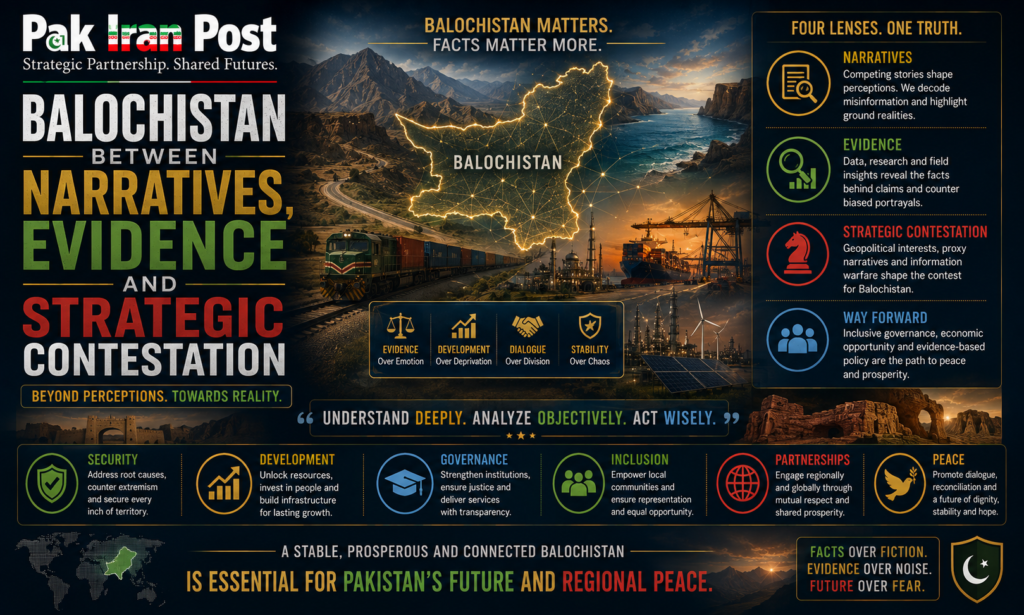
Balochistan Between Narratives, Evidence and Strategic Contestation

Pak Iran Post examines Balochistan not merely as a frontier but as an information environment in which local communities are increasingly converted into protagonists of geopolitical storytelling. Along the Pakistan Iran boundary, an isolated shooting, a disrupted convoy, a border closure, a smuggling allegation, a militant incident or a dispute over access to a crossing can rapidly acquire meanings far beyond its immediate circumstances. Pakistani security institutions may interpret an event through the prism of territorial integrity and counterterrorism. Iranian authorities may emphasise sovereignty, border security or alleged hostile activity. International media can frame the same episode through sanctions, regional rivalry, separatism or great power competition. Digital platforms then compress these competing interpretations into emotionally charged fragments, often detached from geography, chronology and evidentiary context. The consequence is not simply misinformation. It is the strategic manufacture of perception around communities whose actual priorities are frequently more prosaic: mobility, livelihoods, security, access to markets, water, healthcare, education and predictable administration.
The Pakistan Iran frontier traverses a social landscape that cannot be adequately represented through the vocabulary of national security alone. Communities on both sides possess historical, linguistic, familial and commercial connections that predate the contemporary territorial arrangements of the state. These affinities do not automatically constitute political allegiance, nor should cultural proximity be interpreted as evidence of separatist sentiment or foreign influence. Yet precisely because the frontier possesses these layered identities, it is vulnerable to external narrative simplification. A trader carrying goods across a recognised commercial route can become, in an inflammatory account, a smuggler. A community protest over an economic restriction can be depicted as subversion. A militant attack can be attributed collectively to an ethnic population. Conversely, legitimate security concerns can be dismissed by political actors as a pretext for repression. Such categorical framing is strategically hazardous because it eliminates the distinction between population, political grievance, criminal enterprise and organised violence.
The most consequential problem is therefore epistemic. Who establishes what happened before governments, broadcasters and digital audiences decide what it means? In many border incidents, the first available information originates from actors with an institutional, political or operational interest in shaping interpretation. A short video may circulate without a verifiable date or location. Old footage can be repackaged as evidence of a new confrontation. Images from another theatre of conflict may be presented as scenes from Balochistan. A local death toll can be inflated or minimised according to the narrative requirements of competing actors. Statements from unnamed officials may acquire greater authority than testimony from residents who actually witnessed the event. Once a claim achieves algorithmic velocity, subsequent corrections rarely recover equivalent reach.
This asymmetry has direct implications for Pakistan’s strategic communications architecture. The state cannot treat every contested narrative as a hostile information operation, because doing so would produce precisely the credibility deficit that adversarial actors seek to exploit. Nor can it remain passive while fabricated material acquires international circulation. What is required is a more discriminating doctrine that separates legitimate journalism, community testimony, political advocacy, deliberate deception and coordinated influence activity. The objective should not be narrative domination. It should be evidentiary superiority.
For policymakers, this distinction matters because Balochistan’s information environment increasingly intersects with conventional security calculations. An unverified allegation concerning militant movement can affect diplomatic signalling. A sensational report about border violence can influence public attitudes towards Iran. Claims of Iranian interference can become embedded in domestic political discourse before diplomatic channels establish the facts. Equally, allegations that Pakistan is systematically suppressing border populations can become part of international advocacy campaigns without adequate differentiation between genuine rights concerns and politically instrumentalised material. When such claims circulate simultaneously in Urdu, English, Persian and Balochi, each linguistic ecosystem can develop its own version of reality.
The solution requires a multilingual verification capability located close to the frontier rather than concentrated exclusively in Islamabad or major metropolitan newsrooms. Pakistan should establish a Border Information Verification Network linking accredited local journalists, independent fact checkers, universities, press clubs, district administrations and relevant federal information institutions. Its mandate should be narrowly defined: establish the location, date, source provenance, visual authenticity and institutional confirmation of significant border related claims. It should not function as a government propaganda mechanism. Its credibility would depend precisely upon its capacity to identify uncertainty, correct official statements when evidence contradicts them and publish verification records transparently.
A functioning verification system should maintain a digital incident ledger covering significant security, humanitarian and commercial developments along the frontier. Each entry should record the initial claim, time of emergence, geographical coordinates where safely available, originating source, corroborating evidence, contradictory accounts, official confirmation status and subsequent corrections. Satellite imagery, geolocation techniques, reverse image verification and metadata analysis can strengthen this architecture, but technology should remain subordinate to contextual journalism. A technically authentic image can still be misleading if its location or temporal context is falsified.
Local journalism requires corresponding investment. The disappearance of credible reporting capacity from peripheral districts creates an information vacuum that national broadcasters and international correspondents cannot consistently fill. Journalists based in Quetta, Chagai, Nushki, Washuk, Panjgur, Kech and other frontier districts possess a contextual advantage that cannot be replicated through remote monitoring. They understand local geography, tribal structures, commercial routes, linguistic distinctions and community sensitivities. Yet local reporters often operate with limited institutional protection, inadequate digital security, weak access to official data and considerable economic vulnerability. Strengthening this layer of journalism should therefore be regarded as part of national resilience rather than merely media development.
A specialised Border Journalism Protocol should be developed for sensitive reporting from Balochistan. It should require reporters and editors to distinguish verified facts from allegations, identify the provenance of user generated material, avoid collective attribution of criminal responsibility, refrain from publishing operational details that could compromise ongoing security activity and clearly identify when casualty figures remain provisional. The protocol should also discourage the publication of graphic imagery involving civilians when its principal effect is emotional mobilisation rather than public understanding. This is not censorship. It is professional discipline appropriate to a conflict sensitive environment.
International media organisations require similar standards. Foreign correspondents frequently enter Balochistan after an incident has already become internationally significant, meaning their reporting can inherit assumptions established by domestic political actors, diaspora networks or social media campaigns. International journalism should therefore invest in local verification partnerships rather than treating local voices merely as quotations. A resident should not appear in an article only as an anonymous victim or symbolic representative of an entire ethnic community. Local actors possess political diversity, economic interests and competing interpretations. Their testimony requires contextualisation, not romanticisation.
The Pakistani state also needs to reform its own information behaviour. Delayed statements, contradictory casualty figures, inaccessible officials and excessive reliance on anonymous briefings create conditions in which speculation becomes structurally more attractive than fact. A crisis communication protocol for the Pakistan Iran frontier should establish predetermined timelines for preliminary statements, verification updates and corrections. District level information officers should be trained to communicate uncertainty without appearing evasive. If authorities do not yet know whether a claim is accurate, saying so is more credible than issuing an absolute denial that may later prove unsustainable.
Iranian information activity presents a parallel challenge. Pakistani institutions should distinguish between legitimate Iranian state communication, Iranian media narratives, unofficial ideological messaging and demonstrably coordinated influence campaigns. Treating all Iranian originated information as hostile would undermine analytical precision. Tehran itself operates within a complex media ecosystem in which official agencies, broadcasters, religious networks, political organisations and independent users produce materially different narratives. Pakistan’s intelligence and diplomatic assessments should therefore employ source classification rather than nationality based assumptions.
The same principle should apply to separatist and diaspora communication networks. The existence of a political narrative does not by itself establish an operational security threat. Policymakers need a taxonomy distinguishing peaceful political advocacy, documentation of grievances, ideological mobilisation, disinformation, incitement and direct facilitation of violence. Without such distinctions, security institutions risk converting a broad information environment into a single category of threat. That approach may produce short term administrative convenience while generating long term strategic liabilities.
Commercial narratives deserve greater attention. Border communities often experience the frontier through commodity prices, fuel availability, transportation restrictions and access to Iranian markets rather than through diplomatic communiqués. When authorities tighten trade controls, a livelihood crisis can rapidly become a political narrative. When illicit networks exploit price differentials, legitimate traders can be collectively stigmatised. A sophisticated policy framework must therefore separate organised smuggling economies from subsistence and small scale border commerce. Reliable data on traders, commodity flows, crossing frequency and household dependence would allow the state to regulate risk without unnecessarily criminalising economic communities.
This is where border governance and information governance converge. A transparent trader registration system, digitised cargo documentation, verified crossing records and publicly available aggregate trade statistics would reduce the informational ambiguity that fuels competing allegations. If authorities can demonstrate how much lawful trade occurs, which commodities are restricted, where enforcement interventions are concentrated and what proportion of detected violations involves organised networks, narrative space for exaggerated claims narrows considerably. Data, properly governed, becomes a strategic communications instrument without becoming propaganda.
There is also a requirement for institutional separation between evidence collection and narrative advocacy. Security agencies should collect intelligence according to operational mandates. Civilian institutions should provide administrative data. Journalists should independently verify information. Academic institutions should conduct empirical research. Diplomatic channels should interpret implications for bilateral relations. A mature national information architecture does not collapse these functions into one centralised narrative machine. It allows different institutions to generate distinct forms of evidence and then establishes mechanisms through which inconsistencies can be reconciled.
For the strategic community, the principal warning is that narrative escalation can precede physical escalation. A fabricated account of an attack may provoke public demands for retaliation before the underlying event has been verified. A video depicting alleged Iranian activity can generate diplomatic pressure within hours. Conversely, an authentic report of civilian suffering can be dismissed as foreign manipulation, damaging Pakistan’s credibility when evidence later emerges. Information latency has therefore become a security variable. The state needs mechanisms capable of reducing the interval between incident occurrence, factual verification and authoritative public communication.
An interagency Frontier Information Cell could provide that function, provided it is designed as an analytical and verification mechanism rather than a publicity office. It should integrate information from border administration, customs, immigration, police, emergency services, diplomatic reporting and verified media sources. Its analytical products should classify incidents according to confidence levels and distinguish confirmed events from uncorroborated claims. Sensitive intelligence should remain protected, while non sensitive factual material should be released rapidly enough to prevent an information vacuum.
The wider objective should be to restore agency to the communities themselves. Border populations should not remain passive objects through which Islamabad, Tehran, foreign correspondents, militant organisations, political movements and digital influencers project competing geopolitical meanings. Local residents should have institutional channels to document economic disruption, humanitarian needs, security concerns and administrative failures. Community radio, bilingual digital platforms and district level public information forums can create an evidentiary layer between lived experience and national political interpretation.
Balochistan’s frontier cannot be stabilised through security policy alone, because perceptions of insecurity are partly produced by the information conditions surrounding actual events. Nor can communication policy substitute for effective governance. Roads, markets, crossings, policing, judicial access, healthcare and lawful commerce remain the material foundations upon which credible narratives are built. Where governance is visibly functional, sensational claims encounter institutional evidence. Where governance is opaque, every vacuum becomes an invitation to competing storytellers.
Pakistan’s strategic interest is therefore not to win every narrative contest but to make factual distortion progressively harder to sustain. That requires local reporting capacity, multilingual verification, disciplined official communication, interoperable incident data, source attribution, independent media standards and calibrated intelligence assessment. It also requires resisting the temptation to treat disagreement as deception and criticism as subversion. A state confident in its evidence does not need to manufacture unanimity.
The Pakistan Iran border will remain exposed to competing narratives because its geography, identity networks, security pressures and commercial interdependence make it inherently newsworthy. The appropriate response is not informational insulation. It is institutional resilience. If Pakistan can build an environment in which a claim is rapidly traceable, a photograph is geographically testable, a casualty figure is attributable, a local reporter is professionally protected and an official statement is promptly corrigible, geopolitical storytelling will lose some of its capacity to overwhelm reality. For the communities of Balochistan, that would mean something more consequential than improved media coverage. It would mean that their lives are no longer routinely reduced to evidence in someone else’s strategic argument.
A Public Service Message