Escorted Stability Architecture: How Pakistan Can Embed Itself in a Regional Maritime Security Regime Around the Strait of Hormuz

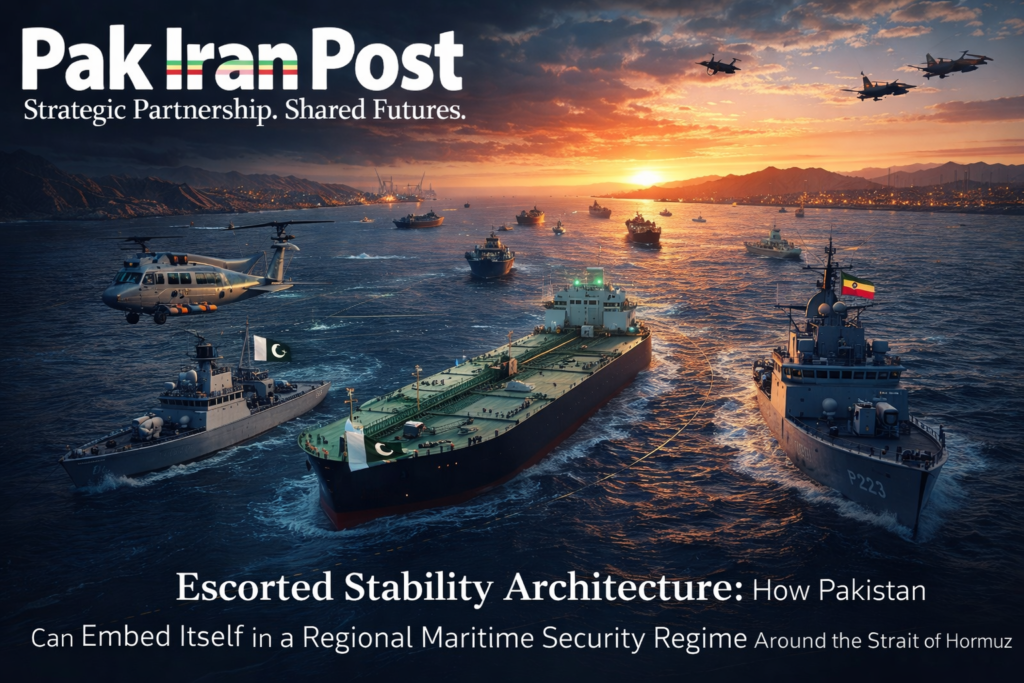
The evolving security dynamics of the Strait of Hormuz are no longer defined by episodic crises or symbolic shows of force but by a gradual institutionalization of managed risk. What is emerging is not a battlefield but a system, one in which maritime insecurity is not eliminated but structured, priced, and controlled through layered security arrangements. At the center of this transformation lies the concept of escorted stability, where naval presence, convoy systems, and coordinated surveillance mechanisms redefine how global energy flows are protected. This shift marks the transition from reactive militarization to proactive security governance, and it opens a strategic window for states like Pakistan to move from peripheral observation to embedded participation.
Historically, the security of Hormuz has been underwritten by external powers, particularly the United States and its allied naval coalitions. However, the credibility and sustainability of this model are increasingly under strain. Regional actors are asserting greater control over their immediate environments, while global powers are recalibrating their commitments amid competing priorities. In this vacuum, a hybrid model is taking shape, combining elements of state sovereignty, regional cooperation, and market-driven security services. Escort operations, once ad hoc responses to specific threats, are becoming normalized as part of routine maritime management.
Iran’s role in this architecture is pivotal. Rather than relying solely on deterrence through disruption, Tehran is exploring ways to convert its geographic leverage into a structured security offering. This does not imply alignment with Western models of maritime governance but rather the development of a parallel system that reflects its strategic interests. Controlled escort regimes, selective coordination, and localized surveillance networks form the backbone of this approach. For states willing to engage, this creates an opportunity to participate in a system that blends security with economic logic.
For Pakistan, the emergence of an escorted stability architecture presents a multidimensional opportunity. Its geographic proximity to the Gulf, combined with its naval capabilities and longstanding relationships across the region, positions it as a natural candidate for participation. The challenge lies in translating this potential into a concrete role that enhances both national security and economic resilience without triggering strategic backlash from competing stakeholders.
At the operational level, Pakistan can seek integration into escort and convoy frameworks that facilitate safe passage through high-risk zones. This does not require full alignment with any single actor but rather the ability to coordinate across multiple systems. Joint patrols, information sharing, and synchronized transit schedules can create a layered security environment in which Pakistan becomes an indispensable node. Such participation would not only enhance the safety of its own maritime traffic but also generate credibility as a provider of regional stability.
The economic implications of this role are significant. Escort services are not merely a security function but a revenue-generating activity embedded within the broader logistics chain. By participating in these mechanisms, Pakistan can capture value through service provision, operational coordination, and ancillary support. Over time, this can evolve into a specialized sector within the national economy, attracting investment and expertise. The integration of security and commerce reflects a broader trend in which risk management becomes a tradable commodity.
However, the pursuit of such a role requires careful calibration of capabilities. Pakistan’s naval forces must be equipped and trained to operate within complex, multinational environments. This includes not only traditional maritime operations but also advanced domains such as electronic surveillance, cyber coordination, and real-time data integration. Investments in these areas are not optional but essential to maintaining relevance in an increasingly sophisticated security landscape.
Equally important is the development of institutional frameworks that support sustained engagement. Maritime security is not a one-off intervention but a continuous process that requires coordination across agencies and jurisdictions. Pakistan must establish dedicated structures for maritime policy, integrating defense, foreign affairs, and economic planning. This will ensure that participation in escorted stability regimes is aligned with broader national objectives and executed with consistency.
Diplomatically, the integration into a regional security architecture demands a nuanced approach. Pakistan must navigate a complex web of relationships, balancing its engagement with Iran against its ties to Gulf states and the United States. This requires a posture of strategic flexibility, where cooperation is framed in terms of shared interests rather than exclusive alignment. Transparency and communication will be critical in managing perceptions and avoiding misinterpretation of intent.
One avenue for managing these sensitivities is through multilateral engagement. By participating in broader regional forums focused on maritime security, Pakistan can position its involvement as part of a collective effort rather than a bilateral alignment. This reduces the risk of political backlash and enhances legitimacy. At the same time, it provides a platform for influencing the evolution of the security architecture in ways that reflect Pakistan’s interests.
The role of technology in this transformation cannot be overstated. Modern escort operations rely heavily on data, from vessel tracking and threat assessment to route optimization and incident response. Pakistan must invest in the digital infrastructure اللازمة to support these functions, including satellite connectivity, integrated command systems, and data analytics capabilities. This will not only enhance operational effectiveness but also create opportunities for innovation and collaboration with private sector partners.
From a strategic perspective, participation in an escorted stability architecture enhances Pakistan’s leverage in regional affairs. By contributing to the امنیت of a critical global chokepoint, Pakistan elevates its status as a stakeholder in international trade and energy flows. This, in turn, can translate into greater influence in diplomatic negotiations and economic partnerships. The ability to offer security as a service becomes a powerful tool in a world where stability is increasingly scarce.
At the same time, risks must be carefully managed. The security environment in Hormuz is inherently volatile, and participation in escort operations exposes Pakistan to potential escalation. Clear rules of engagement, robust contingency planning, and continuous risk assessment are essential to mitigating these dangers. Pakistan must ensure that its involvement enhances security without entangling it in conflicts that exceed its strategic objectives.
The economic benefits of this strategy extend beyond direct revenue. By reducing transit risk and enhancing reliability, Pakistan can improve the competitiveness of its trade routes and logistics networks. This can attract shipping traffic and investment, reinforcing the country’s position as a regional hub. The integration of maritime security with economic development creates a virtuous cycle in which stability drives growth and growth reinforces stability.
Energy security is another critical dimension. By embedding itself in the mechanisms that govern transit through Hormuz, Pakistan can gain greater control over the flow of its energy imports. This reduces vulnerability to disruptions and price volatility, providing a more stable foundation for economic planning. In a context of global uncertainty, such stability is a strategic asset.
Policy coherence will be key to realizing these benefits. Pakistan must develop a clear roadmap for its engagement in maritime security, outlining objectives, capabilities, and partnerships. This roadmap should be supported by targeted investments and institutional reforms that enable effective criticism. Coordination across government agencies and alignment with private sector stakeholders will ensure that efforts are mutually reinforcing.
International partnerships will also play a crucial role. Engagement with China, for example, can provide access to resources and expertise that enhance Pakistan’s capabilities. At the same time, maintaining constructive relations with Western powers will ensure that participation in regional security frameworks does not lead to isolation. A balanced approach that leverages multiple partnerships will maximize flexibility and resilience.
The transition to an escorted stability architecture reflects a broader shift in the nature of global security. Traditional notions of dominance and control are giving way to more distributed and cooperative models. In this environment, states that can integrate security with economic logic will have a distinct advantage. Pakistan has the potential to be one of these states, provided it acts with clarity and purpose.
Timing is critical. The architecture is still evolving, and early engagement will allow Pakistan to shape its development. Delayed entry risks relegation to a marginal role, as established players consolidate their positions. Decisive action, informed by strategic insight, will be essential to capturing the available opportunities.
Ultimately, the question is not whether Pakistan can participate in this emerging system but how effectively it can do so. Success will depend on the ability to align national capabilities with regional dynamics, to balance competing relationships, and to integrate security with economic strategy. The rewards are substantial, offering enhanced stability, economic growth, and geopolitical relevance.
In a world where uncertainty is becoming the norm, the ability to provide stability is a valuable currency. By embedding itself in the escorted stability architecture of the Strait of Hormuz, Pakistan can position itself as both a beneficiary and a provider of this stability. This dual role will not only strengthen its national position but also contribute to the broader goal of maintaining the flow of global trade and energy. The opportunity is significant, and the time to act is now.
A Public Service Message