
Cultural Diplomacy Soft Power Gaps and Civilizational Connectivity Pakistan Iran

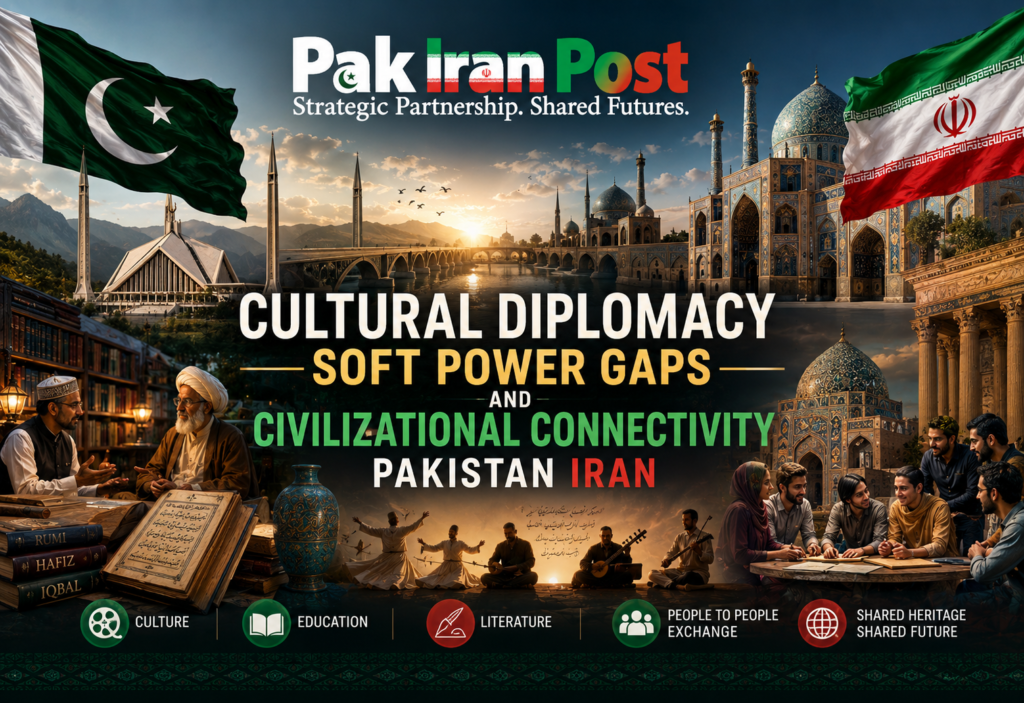
The cultural and intellectual relationship between Pakistan and Iran is often rhetorically elevated as one of civilizational proximity, yet operationally it remains structurally underdeveloped, episodic, and largely deprived of institutional depth. This contradiction between historical density and contemporary underperformance constitutes one of the most persistent yet under-analysed dimensions of bilateral relations. While political discourse frequently invokes shared religion, linguistic affinities, and overlapping historical trajectories, these symbolic references have not been translated into sustained architectures of cultural diplomacy capable of shaping durable soft power interdependence.
At a structural level, cultural diplomacy between Pakistan and Iran remains trapped within a ceremonial paradigm. Exchanges tend to be event-driven rather than system-driven, relying on periodic festivals, official visits, or symbolic commemorations that generate visibility but not continuity. These activities, while politically useful for signaling goodwill, do not accumulate into an enduring framework of mutual cultural literacy or interpretive convergence. The absence of institutional continuity means that each cultural initiative often begins from epistemic zero, without building upon prior engagements in a cumulative manner.
This fragmentation is particularly striking given the deep historical entanglement between the two societies. Persian literary influence on South Asian intellectual traditions is profound, shaping not only classical poetry and philosophy but also administrative and aesthetic vocabularies. Similarly, the intellectual currents of South Asia have historically interacted with Iranian religious, political, and philosophical developments. Yet in contemporary policy imagination, this dense civilizational interweaving has been reduced to symbolic invocation rather than operational strategy.
One of the central deficits lies in the limited integration of academic ecosystems. Universities and research institutions in both countries remain largely inward-facing, with minimal structural incentives for sustained collaboration. Joint research initiatives are rare, and when they do occur, they are often confined to short-term academic conferences rather than long-term research consortia. This results in a significant gap in mutual scholarly interpretation, where each country continues to study the other through external secondary sources rather than co-produced knowledge frameworks.
The consequences of this academic isolation are not merely intellectual but geopolitical. In the absence of sustained scholarly exchange, policy elites and media commentators often rely on fragmented or outdated interpretive frameworks when analysing the other country. This epistemic distance contributes to the persistence of stereotypes, analytical simplifications, and reactive policy assumptions that fail to reflect the complexity of contemporary realities.
Media diplomacy, which could potentially serve as a corrective mechanism, is similarly underdeveloped. There is a striking absence of co-produced media content between Pakistan and Iran, whether in the form of documentaries, investigative journalism, or narrative storytelling. Journalistic exchange programs exist but remain limited in scope and frequency, often lacking the institutional continuity required to generate long-term professional familiarity. As a result, media systems in both countries continue to operate within nationally bounded narrative ecosystems that rarely intersect in sustained or structured ways.
In the contemporary global environment, where soft power is increasingly mediated through narrative industries, this gap represents a significant strategic underutilization. Cultural production—whether through film, television, digital media, or literature—functions not merely as entertainment but as a vehicle of geopolitical imagination. The absence of co-produced cultural content between Pakistan and Iran therefore limits the capacity of both states to shape each other’s public perceptions beyond episodic diplomatic messaging.
Language, as a foundational medium of cultural diplomacy, also reflects this structural disconnect. Despite historical linguistic interpenetration, there is limited contemporary investment in systematic language exchange programs. Persian language studies in Pakistan and Urdu studies in Iran remain institutionally present but not strategically prioritized. This results in a narrowing of interpretive access between the two societies, where linguistic familiarity is insufficiently developed to support deep cultural comprehension at scale.
The soft power deficit is further exacerbated by the absence of institutionalized cultural infrastructures dedicated specifically to bilateral engagement. While both countries possess cultural institutions, museums, and arts councils, these bodies largely operate within national frameworks without sustained bilateral integration. The lack of joint cultural institutes or permanent cultural liaison bodies means that cultural diplomacy remains reactive rather than anticipatory, responding to political developments rather than shaping cultural continuity.
This underdevelopment is particularly paradoxical when viewed against the backdrop of shared civilizational resources. Few bilateral relationships possess such a dense reservoir of historical, literary, and religious interconnectedness. Yet this reservoir remains largely untapped in contemporary strategic planning. The gap between cultural potential and institutional realization is therefore not a matter of absence but of underutilization.
From a strategic perspective, this represents a missed opportunity in the broader architecture of regional stability. Cultural diplomacy, when properly institutionalized, functions as a form of low-intensity geopolitical stabilization. It reduces misperception, enhances interpretive familiarity, and creates informal channels of communication that can persist even during periods of political tension. In this sense, cultural infrastructure operates as a parallel diplomatic system, often more resilient than formal political channels.
The current absence of such infrastructure between Pakistan and Iran contributes to a condition in which political fluctuations are not buffered by cultural continuity. When diplomatic tensions arise, there are limited institutional or societal mechanisms capable of absorbing or moderating perceptual shocks. This increases the vulnerability of bilateral relations to episodic volatility, particularly in the informational and media domains discussed earlier.
A reimagined framework for cultural diplomacy would require a shift from symbolic exchange to structural integration. This would involve the creation of permanent bilateral cultural institutions with dedicated funding, governance structures, and long-term mandates. Such institutions could coordinate joint research, curate shared cultural archives, support artistic collaboration, and facilitate sustained academic exchange.
In parallel, media co-production frameworks could be developed to institutionalize collaborative storytelling. Joint documentary projects, co-produced news features, and shared digital content platforms would allow both countries to construct narratives that are not merely parallel but interwoven. This would help reduce the interpretive distance that currently characterizes media representations in both directions.
Higher education institutions could also play a transformative role if integrated into a structured bilateral academic network. Joint degree programs, shared research funding mechanisms, and cross-border faculty exchanges would help cultivate a generation of scholars and professionals with embedded familiarity in both contexts. Over time, this would contribute to the emergence of a more coherent epistemic space in which Pakistan–Iran relations are analysed through shared rather than fragmented frameworks.
Digital platforms further expand the possibilities for cultural diplomacy beyond traditional institutional boundaries. Online cultural archives, virtual exhibitions, and transnational educational platforms can serve as scalable tools for enhancing mutual cultural literacy. However, without strategic coordination, these digital opportunities risk remaining fragmented and underutilized.
It is also necessary to recognize that cultural diplomacy today operates within a broader attention economy in which visibility is unevenly distributed. Competing global narratives often overshadow regional cultural exchanges, making it essential for Pakistan and Iran to develop more sophisticated cultural communication strategies that can operate effectively within global digital ecosystems.
The strategic importance of addressing these deficits lies not only in cultural enrichment but in geopolitical resilience. In an era where perception increasingly shapes policy outcomes, cultural familiarity becomes a form of strategic insulation against misinterpretation and escalation. States that possess deeper cultural understanding of each other are better equipped to manage crises without allowing them to escalate into systemic ruptures.
Ultimately, the Pakistan–Iran cultural relationship stands at a critical juncture. It possesses exceptional latent potential grounded in centuries of shared intellectual, linguistic, and spiritual exchange. Yet this potential remains insufficiently institutionalized in the present. Without deliberate policy intervention, the relationship risks remaining trapped in a cycle of symbolic affirmation without structural consolidation.
The task for policymakers, therefore, is not to invent cultural proximity but to operationalize it. This requires moving beyond episodic gestures toward the construction of durable institutional architectures capable of sustaining cultural engagement across political cycles. In doing so, cultural diplomacy can evolve from a peripheral complement to foreign policy into a central pillar of bilateral stability, capable of anchoring Pakistan–Iran relations in a deeper and more resilient form of civilizational connectivity.
A Public Service Message