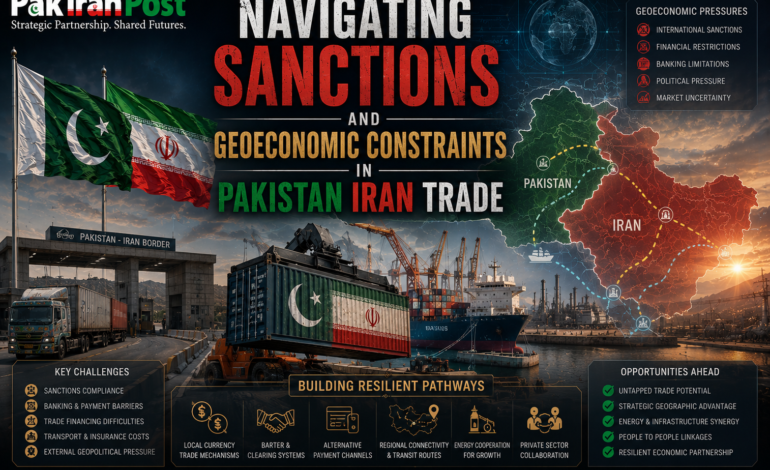
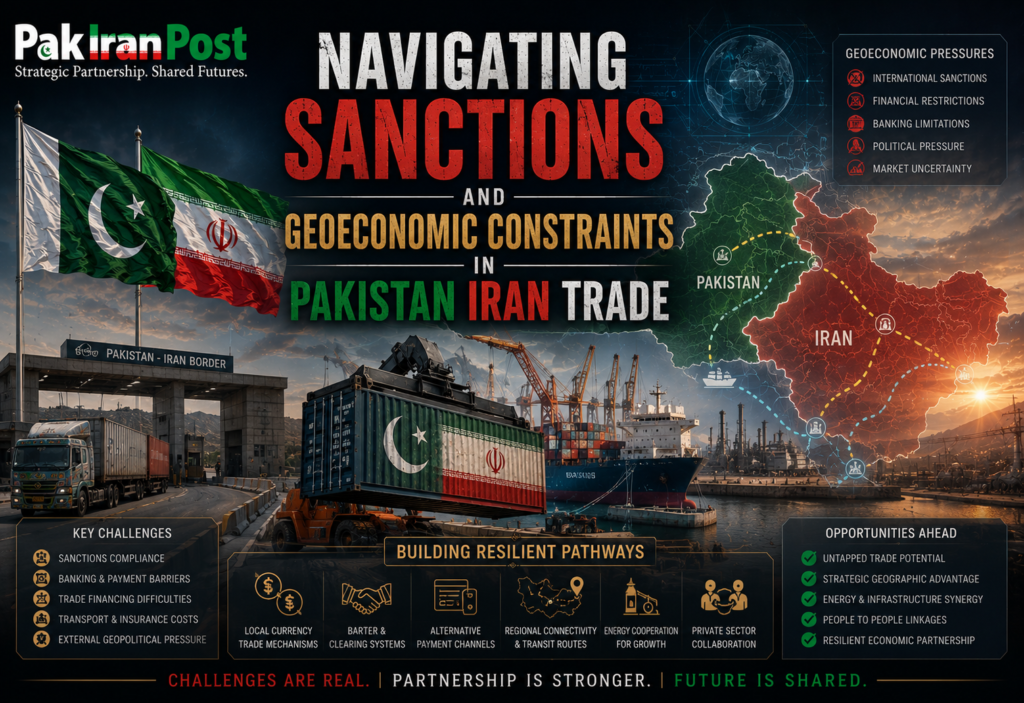
Navigating Sanctions and Geoeconomic Constraints in Pakistan Iran Trade

The evolving economic relationship between Pakistan and Iran is increasingly shaped not only by bilateral considerations but by the tightening architecture of global sanctions regimes, fragmented financial systems, and intensifying geoeconomic competition among major powers. In this constrained environment, economic engagement is no longer a straightforward matter of trade facilitation or geographic proximity; it has become a complex exercise in strategic calibration, institutional creativity, and risk-managed diplomacy. The question confronting policymakers in Islamabad and Tehran is not whether to engage economically, but how to do so within a global system that actively penalizes certain forms of connectivity while incentivizing others under shifting political alignments.
At the heart of this dilemma lies the structural asymmetry of the international financial order. The dominance of dollar denominated transactions, the extraterritorial reach of secondary sanctions, and the centrality of Western controlled financial messaging systems have collectively transformed economic interdependence into a domain of strategic vulnerability. For countries operating on the periphery of this system, including Pakistan and Iran, economic engagement is continuously filtered through layers of compliance risk, reputational exposure, and institutional constraint. This produces a paradoxical condition in which geographic proximity and economic complementarity exist alongside financial friction and regulatory uncertainty.
Iran, subject to prolonged sanctions pressure and restricted access to global capital markets, has increasingly turned toward regional economic partnerships as a mechanism of strategic resilience. Pakistan, meanwhile, faces its own set of macroeconomic constraints, including balance of payments pressures, dependency on external financing, and recurring engagement with multilateral financial institutions that impose stringent compliance requirements. The intersection of these two constrained economies creates both opportunity and limitation, producing a space of partial economic alignment that is simultaneously promising and precarious.
Recent developments in regional logistics and energy demand have further intensified the relevance of this relationship. The growing instability of maritime routes in the broader Gulf region, combined with periodic disruptions in shipping corridors, has underscored the strategic value of overland connectivity. For Pakistan, access to Iranian energy resources and transit routes offers a potential buffer against global energy volatility. For Iran, Pakistan represents a critical gateway to South Asian markets and a partial outlet for economic diversification under conditions of financial restriction. Yet the realization of this potential is consistently mediated by the constraints of sanctions compliance and international financial scrutiny.
In this context, the concept of sanctions navigation emerges not as a tactical evasion strategy but as a structural framework for managing economic engagement under constraint. It involves the development of layered mechanisms that allow states to maintain formal adherence to international obligations while simultaneously constructing alternative channels for regional economic activity. This dual track approach is neither purely legal nor purely informal; it exists in a grey zone of institutional innovation where economic necessity intersects with regulatory ambiguity.
One of the most frequently discussed mechanisms in this regard is the expansion of local currency settlement systems. By reducing reliance on external reserve currencies, such arrangements can partially insulate bilateral trade from the volatility of global financial markets and the reach of external sanctions enforcement. However, the effectiveness of such systems depends heavily on macroeconomic stability, currency convertibility, and mutual trust in financial governance structures. Without these conditions, local currency arrangements risk becoming symbolic rather than functional.
Another emerging modality is barter based trade, which allows for the direct exchange of goods and services without reliance on conventional financial intermediaries. While such systems can provide short term flexibility, they are inherently limited in scale and efficiency. They also introduce significant challenges in valuation, standardization, and long term economic planning. Nonetheless, in environments of acute financial restriction, barter systems can serve as transitional mechanisms that sustain economic flows in the absence of full financial integration.
Energy swap arrangements represent a further layer of potential engagement. Given the geographical proximity and complementary energy profiles of Pakistan and Iran, structured energy exchanges could play a stabilizing role in regional energy security. However, such arrangements are highly sensitive to external political pressure and require sophisticated contractual frameworks capable of insulating transactions from secondary sanctions exposure. This necessitates the development of legally robust yet diplomatically flexible institutional architectures.
In parallel, the role of third party mediation channels has gained increasing relevance. Regional financial intermediaries, trade facilitation hubs, and neutral logistical platforms can provide indirect pathways for sustaining economic engagement without triggering direct sanctions violations. However, reliance on intermediary systems introduces additional layers of cost, complexity, and dependency, potentially diluting the benefits of bilateral cooperation. It also raises questions about transparency, accountability, and long term strategic autonomy.
The broader macroeconomic implications of Pakistan Iran economic engagement extend beyond bilateral trade flows. Increased connectivity has the potential to reshape regional energy markets, alter trade route hierarchies, and influence the distribution of economic influence across South and West Asia. However, these outcomes are contingent upon the stability of underlying institutional arrangements and the ability of both states to manage external pressure without destabilizing their domestic financial systems.
For Pakistan, the challenge lies in balancing its engagement with Iran against its commitments to international financial institutions and its need to maintain access to global capital markets. Any perceived deviation from established compliance frameworks risks triggering reputational costs that could exacerbate existing economic vulnerabilities. This creates a policy environment characterized by continuous risk assessment and strategic ambiguity, where economic decisions are evaluated not only on their intrinsic value but on their external political implications.
For Iran, the challenge is one of economic diversification under constraint. The pursuit of alternative trade partners is not merely an economic strategy but a structural necessity in the face of prolonged sanctions pressure. However, the effectiveness of such diversification depends on the ability to construct stable and predictable trade relationships that can withstand external shocks and regulatory uncertainty. Pakistan, in this context, represents both an opportunity and a limitation, offering geographic access but also exposing engagement to external scrutiny.
Within this constrained environment, the concept of a hybrid compliance navigation regime becomes particularly relevant. Such a regime would seek to reconcile formal adherence to international financial obligations with the practical need for regional economic continuity. It would involve the creation of institutional mechanisms that allow for segmented financial flows, controlled transparency, and adaptive regulatory practices. However, the implementation of such a regime would require careful calibration to avoid triggering systemic financial risks or diplomatic backlash.
The feasibility of such arrangements is further complicated by the evolving nature of global power competition. The increasing rivalry between major economic blocs has led to the fragmentation of global trade governance into competing networks of influence. In this context, sanctions are no longer merely punitive instruments but components of broader geoeconomic strategies aimed at shaping regional alignments and controlling strategic corridors. Pakistan and Iran, positioned at the intersection of these competing systems, must therefore navigate a highly fluid and contested economic landscape.
China’s expanding infrastructure footprint in the region, Russia’s efforts to reassert economic influence across Eurasia, and the persistent role of Western financial institutions collectively create a multipolar economic environment in which traditional binary distinctions between sanctioned and non sanctioned systems are increasingly blurred. This fragmentation creates both constraints and openings for regional actors seeking to expand economic cooperation outside conventional frameworks.
For policymakers, the central challenge is to construct economic engagement strategies that are resilient to external shocks while remaining compliant with essential international obligations. This requires a shift from reactive policy making to anticipatory institutional design, where potential sanctions risks are integrated into the architecture of economic planning from the outset. It also requires enhanced coordination between financial regulators, trade ministries, and diplomatic institutions to ensure policy coherence across multiple domains.
Ultimately, the Pakistan Iran economic relationship under sanctions pressure is not simply a bilateral issue but a microcosm of broader transformations in the global economic order. It reflects the increasing politicization of financial systems, the fragmentation of trade governance, and the emergence of alternative economic networks operating alongside traditional structures. In this environment, economic engagement becomes an exercise in strategic navigation, requiring continuous adaptation, institutional innovation, and geopolitical awareness.
The future trajectory of this relationship will depend on the ability of both states to develop flexible yet resilient frameworks capable of sustaining economic interaction under constraint. Whether through localized financial mechanisms, infrastructure-based connectivity, or hybrid compliance systems, the success of this engagement will ultimately be determined by institutional capacity rather than geographic proximity alone. In a world where economic flows are increasingly shaped by political boundaries and financial restrictions, the ability to navigate complexity becomes the defining feature of effective statecraft.
In this sense, Pakistan Iran economic engagement under sanctions is not merely a policy challenge but a test case for the adaptability of regional economic systems in a fragmented global order. It reveals both the limitations of existing structures and the potential for innovative institutional responses that can partially reconcile the tensions between sovereignty, interdependence, and external constraint.
A Public Service Message