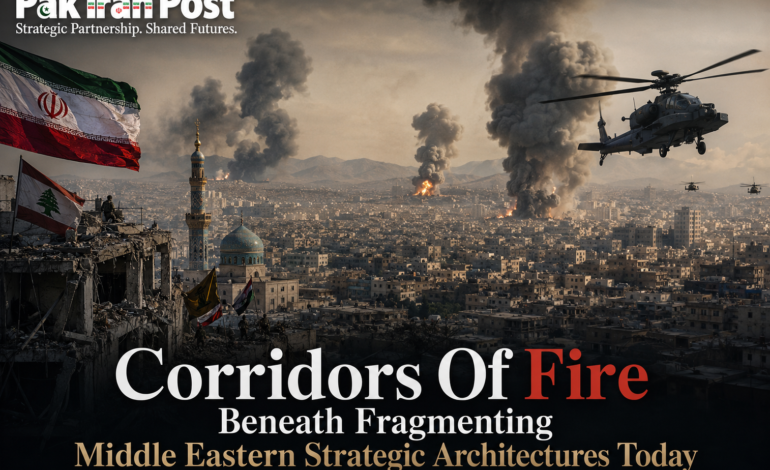

Civilizational Realism and Pakistan Iran Post Westphalian Diplomatic Thought Framework


Civilizational realism emerges as an intellectual attempt to rethink the architecture of international relations beyond the rigid epistemic boundaries that have historically defined classical realism and liberal internationalism. In the case of Pakistan and Iran, this theoretical proposition gains resonance because both polities exist at the intersection of territorial sovereignty and deeper civilizational sedimentation. Their diplomatic engagement cannot be adequately interpreted through the narrow calculus of power maximization alone, nor through the normative optimism of institutional liberalism. Instead, it must be understood as an evolving synthesis where material interests and civilizational consciousness are not opposing forces but mutually constitutive dimensions of political reality. Civilizational realism therefore does not reject realism but expands its ontological depth, situating power within a thicker historical and cultural continuum.
At the heart of this conceptual reorientation lies the recognition that the modern state, as inherited from the Westphalian imagination, is an incomplete vessel for the expression of political identity in regions where historical consciousness predates the emergence of the nation state. Pakistan and Iran both inhabit such a space. Their territorial configurations are modern, but their symbolic geographies extend into pre modern civilizational terrains shaped by Islamic epistemology, Persian literary cosmology, and South Asian spiritual pluralism. Civilizational realism begins by acknowledging that these layers are not ornamental residues of history but active forces that shape strategic perception, diplomatic language, and security imagination. In this sense, foreign policy becomes not merely the management of external constraints but the negotiation of inherited meanings.
Classical realism, from the tradition of thinkers such as Hans Morgenthau, privileges the logic of power, interest defined in terms of power, and the perpetual condition of anarchy as the structuring principle of international politics. While this framework captures important dimensions of Pakistan Iran relations, particularly in terms of border security, regional alignments, and energy interdependence, it remains insufficient to explain the deeper continuity of engagement between the two states even during periods of geopolitical divergence. The endurance of diplomatic channels, the recurrence of cultural affinity, and the symbolic invocation of shared religious identity indicate that power is always already embedded within meaning. Civilizational realism therefore modifies classical realism by asserting that interests are never purely material but are shaped by interpretive horizons rooted in civilizational memory.
Liberal internationalism, on the other hand, assumes that cooperation emerges primarily through institutions, economic interdependence, and normative convergence. It envisions a progressive harmonization of interests through legal frameworks and multilateral platforms. Yet the Pakistan Iran relationship demonstrates that institutional cooperation alone cannot exhaust the depth of bilateral relations. Even when formal mechanisms exist, their effectiveness is filtered through historical perception and cultural resonance. Liberal assumptions of universal rationality encounter limits in contexts where identity is not merely individual or civic but civilizational. Civilizational realism thus challenges liberalism by suggesting that institutions do not float above history but are anchored within it, and their efficacy depends on alignment with deeper symbolic structures.
The conceptual innovation of civilizational realism lies in its refusal to treat identity and interest as separate analytical domains. Instead, it proposes that identity is itself a form of strategic infrastructure. In the Pakistan Iran context, Islamic memory operates not only as a spiritual category but also as a diplomatic resource that enables communication even in moments of geopolitical tension. Persianate cultural influence, deeply embedded in poetry, philosophy, and linguistic exchange, provides an additional layer of continuity that softens the edges of strategic competition. Regional continuity, shaped by geography and shared security environments, further reinforces the interdependence of the two states. These elements together form what may be described as a civilizational substratum upon which formal diplomacy is constructed.
To articulate civilizational realism more precisely, one must move beyond the binary opposition of materialism and idealism. The framework proposes that material structures such as borders, trade routes, and military capabilities are always interpreted through civilizational lenses. A border is not merely a line of separation but a historical memory of movement, exchange, and contestation. Energy corridors are not only economic instruments but also symbolic pathways of connectivity that evoke older patterns of regional interaction. Security concerns are not purely reactive but are shaped by inherited narratives of trust and suspicion. Thus, materiality itself becomes semiotically charged, and power becomes inseparable from interpretation.
In the case of Pakistan and Iran, civilizational realism reveals a complex dialectic between convergence and divergence. On one hand, both states share a foundational commitment to Islamic identity, though expressed through different doctrinal and institutional frameworks. This shared identity provides a reservoir of symbolic capital that can be activated during periods of diplomatic engagement. On the other hand, geopolitical alignments, regional pressures, and internal political dynamics often pull the two states in different strategic directions. Civilizational realism does not resolve this tension but conceptualizes it as constitutive of the relationship itself. The coexistence of unity and difference is not an anomaly but the defining structure of their interaction.
One of the most significant implications of civilizational realism is its redefinition of sovereignty. In classical Westphalian terms, sovereignty is absolute, territorially bounded, and legally indivisible. However, in the Pakistan Iran context, sovereignty is continuously negotiated through overlapping civilizational affiliations. Religious identity introduces a supra territorial dimension that complicates the exclusivity of state authority. Cultural memory connects populations across borders in ways that exceed administrative control. Economic interdependence creates functional linkages that transcend jurisdictional boundaries. Civilizational realism thus proposes that sovereignty is not a fixed attribute but a layered condition in which multiple registers of belonging coexist.
This does not imply the dissolution of the state. Rather, it suggests a transformation in the meaning of statehood. The state becomes a mediator between different layers of identity rather than the sole repository of political legitimacy. In Pakistan Iran relations, this mediatory role is particularly visible in the way diplomatic discourse often oscillates between strategic calculation and civilizational invocation. Statements of cooperation are frequently framed in both material and symbolic terms, reflecting an underlying recognition that neither dimension alone is sufficient. Civilizational realism interprets this oscillation not as inconsistency but as structural hybridity.
Another critical dimension of this framework is its temporal orientation. Classical realism tends to operate within a cyclical understanding of history dominated by recurring patterns of conflict and balance of power. Liberal internationalism, by contrast, assumes a linear progression toward greater integration and institutional density. Civilizational realism introduces a more layered temporality in which past, present, and future coexist within the same political moment. The past is not dead history but active memory. The present is not a purely rational calculation but a site of historical condensation. The future is not predetermined but shaped by the reinterpretation of inherited narratives. In Pakistan Iran relations, this temporal complexity is evident in the continuous reactivation of historical references in contemporary diplomatic language.
The epistemological contribution of civilizational realism lies in its challenge to methodological reductionism. It refuses to isolate variables such as security, economy, or identity into separate analytical compartments. Instead, it insists on their entanglement. Security decisions are influenced by cultural perceptions. Economic choices are shaped by historical memory. Identity formations are conditioned by material constraints. This entanglement produces a form of complexity that cannot be adequately captured by linear models of causality. Civilizational realism therefore demands a more interpretive approach to international relations, one that is sensitive to symbolism, narrative, and historical depth.
Critically, civilizational realism is not a normative idealization of cultural harmony. It does not assume that shared civilization automatically produces cooperation. Rather, it recognizes that civilizational proximity can generate both affinity and tension. The same historical and religious connections that facilitate understanding can also intensify competition over leadership, interpretation, and influence. In the Pakistan Iran context, this duality is evident in the simultaneous presence of cooperation and strategic divergence. Civilizational realism thus avoids romanticism and instead offers a nuanced account of how deep historical ties interact with contemporary geopolitical pressures.
From a broader theoretical perspective, civilizational realism can be understood as part of a wider intellectual movement that seeks to de provincialize international relations theory. Much of classical IR theory emerged from European historical experience and carries within it assumptions about state formation, secularization, and rationality that may not fully apply to other civilizational contexts. By foregrounding the Pakistan Iran relationship, civilizational realism contributes to a more pluralistic understanding of global politics, one that acknowledges multiple genealogies of political thought. It suggests that different regions may generate distinct forms of realism shaped by their own historical experiences.
In practical diplomatic terms, civilizational realism offers a framework for interpreting the durability of Pakistan Iran relations despite external pressures. It explains why the relationship does not collapse under the weight of geopolitical divergence, and why it repeatedly reconstitutes itself through cultural and symbolic channels. It also highlights the potential for deeper integration if civilizational resources are consciously mobilized in support of strategic cooperation. Energy projects, trade corridors, and security arrangements may acquire greater stability when embedded within a narrative of shared historical destiny.
However, civilizational realism also carries cautionary implications. The invocation of civilizational identity can become exclusionary if not carefully managed. It can generate boundaries as well as bridges. Therefore, the framework emphasizes interpretive responsibility. Civilizational narratives must be engaged critically rather than accepted unreflectively. In the Pakistan Iran context, this means recognizing both the unifying and differentiating potentials of shared heritage. It requires a diplomatic sensibility that is capable of navigating ambiguity without forcing premature resolution.
Ultimately, civilizational realism does not seek to replace existing theories of international relations but to expand their horizon. It introduces a thicker ontology of global politics in which meaning and materiality are inseparable. Pakistan and Iran serve as a particularly illuminating case study because their relationship cannot be fully understood without reference to both strategic calculation and civilizational memory. In their interaction, we observe the emergence of a diplomatic form that is neither purely Westphalian nor entirely post Westphalian but suspended between multiple historical logics.
In conclusion, civilizational realism offers a philosophical synthesis that reimagines the foundations of international relations theory. It challenges the sufficiency of both classical realism and liberal internationalism by demonstrating that neither power nor institutions alone can account for the complexity of Pakistan Iran relations. Instead, it proposes a model in which civilizational identity, historical memory, and material interest are co constitutive dimensions of political reality. This framework does not dissolve the state but situates it within a broader civilizational field. It does not eliminate conflict but contextualizes it within deeper patterns of continuity. And it does not promise harmony but offers a more adequate language for understanding the layered reality of diplomacy in a historically dense and culturally intertwined region.
A Public Service Message