
Public Perception of Pakistan Foreign Policy Neutrality Dilemma Explained

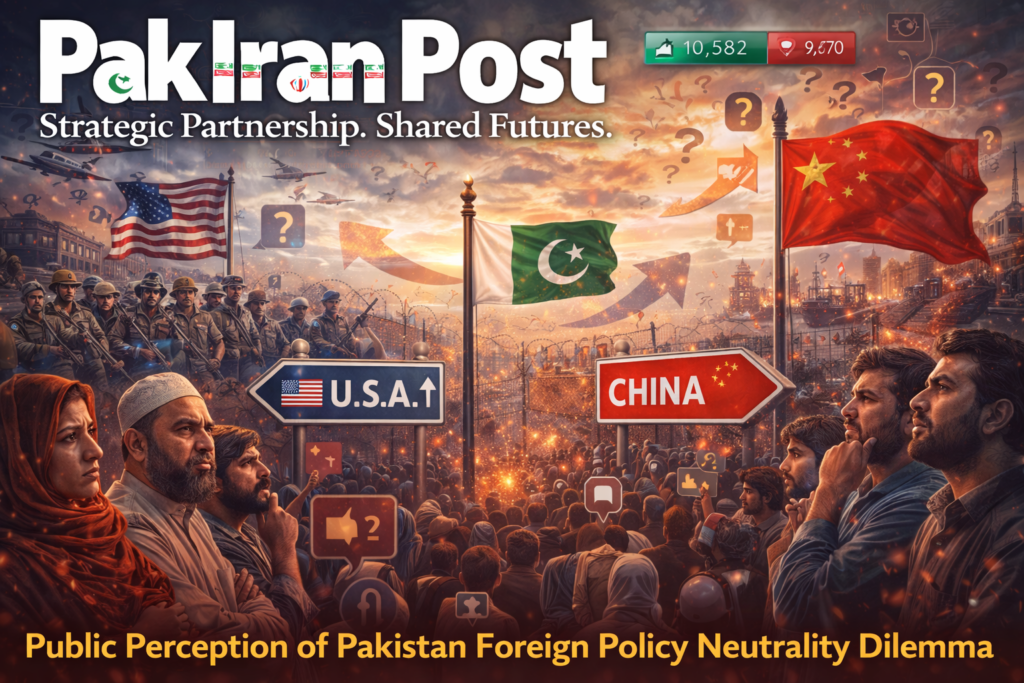
Pakistan’s claim to foreign policy neutrality amid intensifying Iran–Gulf tensions has become less a coherent diplomatic doctrine and more a contested narrative field in which public perception, strategic necessity, and ideological inheritance collide. What is officially presented as balanced engagement between rival regional blocs is increasingly interpreted through fragmented domestic lenses shaped by religious identity, economic vulnerability, and a historically conditioned sensitivity to Muslim world geopolitics. The result is a perception gap between state articulation and societal interpretation that exposes the limits of neutrality as both a policy framework and a communicative strategy in a highly polarized informational environment.
At the level of official discourse, Pakistan’s foreign policy posture is routinely framed in terms of equilibrium, restraint, and non-alignment with competing regional blocs. This language reflects both structural compulsion and strategic calculation. Geographically positioned at the crossroads of South Asia, the Middle East, and Central Asia, Pakistan cannot afford rigid alignment in a region characterized by fluid alliances, proxy conflicts, and overlapping security architectures. Its economic dependence on Gulf remittances, energy imports, and financial assistance further constrains its diplomatic flexibility, while its long-standing border with Iran introduces security and energy interdependencies that cannot be ignored.
Yet public perception does not always operate within the same rationalist parameters that inform elite diplomatic reasoning. Instead, it is filtered through a complex interplay of historical memory, ideological identity, and mediated narratives. For a significant segment of the population, particularly those influenced by religiously inflected political discourse, neutrality is not perceived as strategic prudence but as moral hesitation. Iran is often symbolically embedded within broader narratives of Muslim resistance and solidarity, and any perceived distancing from Tehran is interpreted through this moralized framework. Conversely, strong ties with Gulf states, especially Saudi Arabia, are frequently viewed as economically necessary but ideologically compromising.
This tension reveals a deeper structural contradiction in Pakistan’s foreign policy communication. The state’s attempt to maintain diplomatic flexibility requires narrative ambiguity, yet domestic political culture often demands moral clarity. Neutrality, in this sense, becomes inherently unstable as a communicative category. It is simultaneously presented as pragmatic necessity and interpreted as ideological positioning, depending on the audience and the interpretive frame applied.
Economic dependence plays a central role in shaping both policy and perception. Pakistan’s reliance on Gulf Cooperation Council countries for remittances, employment opportunities, and external financing has created a structural asymmetry that constrains policy autonomy. Millions of Pakistani workers in Saudi Arabia, the United Arab Emirates, and other Gulf states form a transnational economic lifeline that directly influences domestic stability. This material dependency inevitably shapes public awareness, even if it does not always translate into coherent political consensus. For many households, Gulf relations are not abstract geopolitical considerations but immediate economic realities tied to livelihood and survival.
At the same time, Iran represents a different kind of economic imagination. Despite sanctions-related constraints and underdeveloped bilateral trade infrastructure, Iran is frequently invoked in public discourse as a potential energy partner and alternative corridor for regional connectivity. The long-stalled pipeline project between the two countries continues to serve as a symbolic reference point in debates about energy security and economic diversification. In this context, Iran is not only a neighboring state but also a projection surface for unrealized economic possibilities, particularly in relation to Pakistan’s chronic energy deficits.
These dual economic imaginaries produce a form of cognitive dissonance within public perception. On one hand, Gulf states are associated with immediate financial stability and employment opportunities. On the other hand, Iran is associated with long-term strategic energy cooperation and regional connectivity potential. The state’s neutrality doctrine attempts to navigate between these two economic poles, but public interpretation often reduces this balancing act to perceived inconsistency or opportunism.
Media ecosystems further complicate this perception landscape. Television talk shows, digital news platforms, and social media networks frequently present foreign policy issues through polarized and personality-driven narratives. Complex diplomatic strategies are distilled into binary framings that emphasize alignment, betrayal, or ideological authenticity. Within such a media environment, neutrality is difficult to communicate as a nuanced policy position. It is instead refracted through emotionally charged debates that prioritize immediacy over analytical depth.
Digital platforms intensify this distortion by accelerating the circulation of fragmented narratives. Social media users encounter foreign policy developments in real time, often stripped of context and embedded within competing interpretive frames. Algorithmic amplification further reinforces this fragmentation by prioritizing content that generates engagement, often at the expense of nuance or accuracy. As a result, public perception of neutrality is not formed through structured information but through a continuous stream of partial, and often contradictory, narrative inputs.
Religious identity remains a significant but uneven factor in shaping perception. Pakistan’s historical self-conception as a Muslim-majority state has long influenced its foreign policy discourse, particularly in relation to issues involving the wider Islamic world. Iran’s symbolic association with Islamic resistance narratives and Palestine solidarity movements contributes to its positive reception in certain segments of public opinion. However, this religious affinity is not uniform and is often moderated by sectarian sensitivities, geopolitical awareness, and economic pragmatism.
The state’s diplomatic language of neutrality is therefore received through multiple interpretive filters. For some, it aligns with Islamic ideals of unity and non-confrontation among Muslim states. For others, it appears as strategic hedging driven by economic necessity rather than ideological commitment. For yet others, particularly within policy-aware urban constituencies, neutrality is understood as a rational response to structural constraints in an increasingly fragmented global order.
This multiplicity of interpretations underscores the absence of a singular epistemic framework through which foreign policy is understood in Pakistan. Instead, there exists a plurality of competing rationalities that coexist without full convergence. Religious rationality emphasizes moral solidarity, economic rationality prioritizes material survival, and strategic rationality focuses on geopolitical stability. Neutrality is interpreted differently within each of these frameworks, producing a persistent gap between state intention and public perception.
Institutional communication strategies have struggled to bridge this gap. Official statements often rely on diplomatic language that prioritizes ambiguity and flexibility, yet this very ambiguity becomes a source of interpretive divergence. In the absence of sustained public diplomacy efforts capable of translating strategic objectives into accessible narratives, foreign policy communication remains vulnerable to misinterpretation and politicization.
Educational and media literacy constraints further exacerbate this challenge. A significant portion of the population relies on simplified or secondary sources of information for understanding complex international issues. In such contexts, nuanced policy positions are often collapsed into simplified narratives that emphasize alignment or opposition rather than strategic balance. This structural limitation contributes to the persistence of polarized interpretations of neutrality.
Pakistan’s emerging role as a potential intermediary in regional diplomacy adds another layer of complexity to public perception. Occasional diplomatic engagements aimed at facilitating dialogue between Iran and Western actors are often interpreted domestically through divergent lenses. Some view such initiatives as evidence of diplomatic maturity and international relevance, while others perceive them as exposure to external pressures without corresponding strategic gains. The absence of visible and tangible outcomes from such efforts further complicates their reception within domestic discourse.
The geopolitical environment itself is undergoing rapid transformation, further destabilizing traditional categories of alignment and neutrality. The fragmentation of regional orders, intensification of proxy conflicts, and increasing role of non-state actors have made rigid bloc-based alignments less viable. In this context, Pakistan’s neutrality is not an exception but part of a broader pattern of hedging behavior among middle and peripheral states navigating uncertain global structures.
However, the domestic interpretation of this global trend remains uneven. While policy elites may view neutrality as adaptive strategy, public discourse often lacks the comparative framework necessary to situate Pakistan’s behavior within broader international patterns. As a result, what is structurally normal in international relations is frequently perceived domestically as inconsistency or indecision.
The long-term sustainability of Pakistan’s neutrality doctrine will depend not only on diplomatic execution but also on narrative coherence. Without a more integrated approach to foreign policy communication, the gap between state strategy and public perception is likely to persist. This gap carries implications not only for external diplomacy but also for internal political cohesion, as foreign policy issues increasingly intersect with domestic ideological contestation.
Ultimately, Pakistan’s neutrality dilemma is not simply a matter of choosing between Iran and Gulf allies. It is a reflection of deeper structural tensions within the country’s political economy, media environment, and identity formation processes. Neutrality, in this sense, is less a fixed position than a continuously negotiated space shaped by competing pressures and interpretations.
The persistence of this dilemma suggests that Pakistan’s foreign policy will continue to operate within a field of managed ambiguity, where clarity is often sacrificed for flexibility, and coherence is constantly negotiated rather than fully achieved. In such a context, public perception will remain fragmented, not because of misinformation alone, but because the underlying structural conditions of ambiguity are themselves integral to the strategy of balancing competing regional imperatives.
A Public Service Message