Reconfiguring Pakistan Iran Relations Beyond Security Paradigms

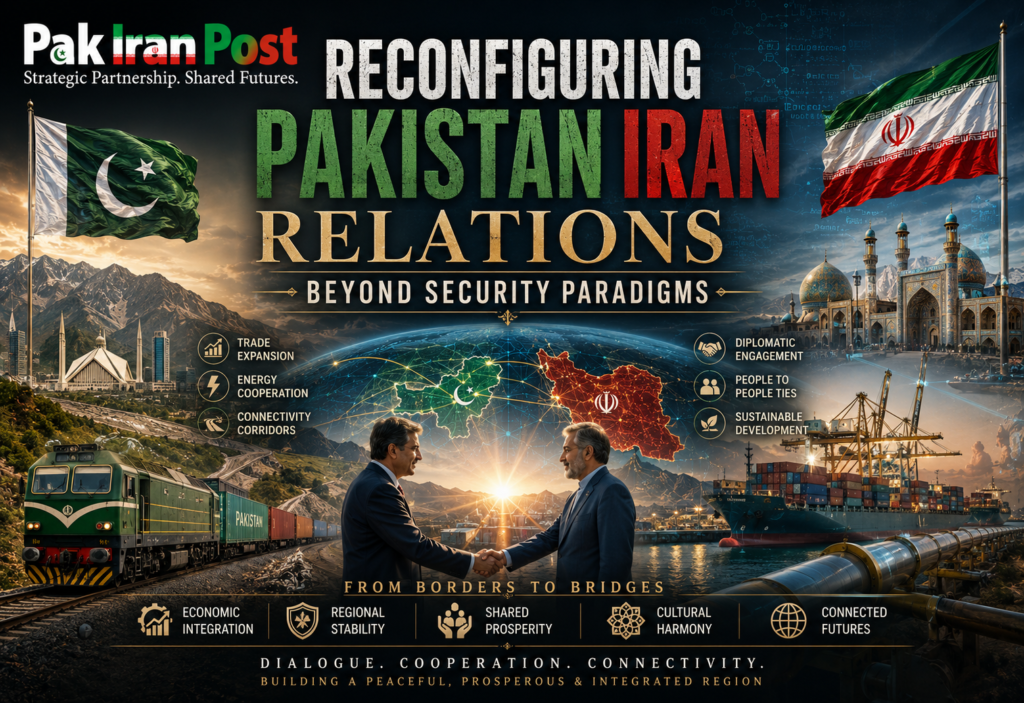
In the evolving geometry of South and West Asian geopolitics, the relationship between Pakistan and Iran is undergoing a subtle but structurally consequential transformation that defies traditional diplomatic grammar. What was once largely interpreted through the narrow prism of border insecurity, sectarian anxieties, and episodic crisis containment is increasingly being rearticulated within a wider matrix of geoeconomic necessity, infrastructural interdependence, and strategic hedging in a fragmented global order. The shift is not merely rhetorical. It reflects a deeper recalibration in how both states perceive proximity, vulnerability, and opportunity at a time when the architecture of global governance itself is being contested by sanctions regimes, maritime disruptions, and competing corridors of influence stretching from the Gulf to Central Asia.
Recent developments across the Strait of Hormuz and adjoining trade arteries underscore the fragility of maritime dependency in the region. The partial disruption of shipping flows and the accumulation of stranded cargo at Pakistani ports, including thousands of containers originally destined for Iranian markets, has exposed a structural vulnerability in regional logistics that neither state can ignore indefinitely. In response, Pakistan’s activation of overland transit routes linking Karachi, Gwadar, and Port Qasim to Iranian border crossings represents more than a technical adjustment. It signals the emergence of a parallel economic geography in which land corridors begin to compensate for maritime uncertainty, thereby quietly altering the strategic calculus of regional connectivity.
This infrastructural pivot is occurring alongside an unprecedented intensification of diplomatic mediation, where Pakistan has positioned itself not merely as a neighboring stakeholder but as a provisional intermediary in broader US Iran negotiations. While such mediation remains fluid and contingent, it reflects a significant evolution in Pakistan’s diplomatic identity, from reactive security actor to provisional convenor of regional stabilization frameworks. The implications of this shift extend beyond bilateral relations and into the architecture of regional order itself, where middle powers increasingly occupy intermediary spaces between great power confrontations and regional fragmentation.
Yet, to interpret this transformation as linear progress would be analytically misleading. The Pakistan Iran relationship remains embedded within deeply sedimented historical anxieties and structural asymmetries that continue to constrain its institutional evolution. Border governance, for instance, remains characterized by a hybrid order of formal regulation and informal economies, where trade, migration, and security are continuously negotiated through ad hoc mechanisms rather than stable institutional frameworks. This hybridity is not accidental. It is the product of decades of uneven state capacity, fluctuating sanctions regimes, and the strategic ambiguity that both states have historically employed to manage external pressure without fully institutionalizing bilateral integration.
At the same time, the global context in which this relationship is unfolding has undergone a profound transformation. The resurgence of sanctions as an instrument of geopolitical coercion, combined with the fragmentation of global payment systems and the increasing weaponization of maritime chokepoints, has fundamentally altered the cost structure of regional connectivity. Iran’s constrained access to global financial networks, juxtaposed with Pakistan’s dependence on external capital inflows and multilateral financing, creates a paradoxical interdependence in which both states are simultaneously constrained by and drawn toward each other’s economic spaces. This condition produces what can be described as constrained proximity, a form of regional adjacency in which geography becomes both opportunity and liability.
Within this framework, the question of institutional redesign becomes central. The absence of a durable bilateral economic architecture has historically limited the capacity of Pakistan and Iran to translate geographic contiguity into sustained economic integration. Trade remains episodic, border management remains reactive, and energy cooperation remains underdeveloped despite clear complementarities in demand and supply structures. The persistence of this under institutionalization is not merely a bureaucratic failure. It reflects deeper epistemological constraints in how both states have conceptualized their mutual relationship, often subordinating economic logic to security reflexes and external alignments.
However, the current conjuncture presents an opening for reconfiguration. The emergence of overland trade corridors as partial substitutes for maritime routes introduces the possibility of a distributed logistics system in which economic flows are no longer singularly dependent on vulnerable sea lanes. This shift, while still nascent, has the potential to reorient regional trade imaginaries away from oceanic dependency toward continental connectivity. In such a scenario, Pakistan’s western frontier ceases to function solely as a security perimeter and begins to operate as a logistical interface between South Asia and the Iranian plateau, with implications that extend into Central Asia and the broader Eurasian corridor system.
Nevertheless, the realization of such a transformation requires a fundamental rethinking of institutional design. Existing bilateral mechanisms are insufficiently equipped to manage the complexity of emerging interdependencies. A fragmented array of border committees, customs arrangements, and security dialogues cannot substitute for a coherent governance architecture capable of integrating trade facilitation, intelligence coordination, and economic planning within a unified framework. Without such institutional consolidation, the system will remain vulnerable to periodic shocks, policy discontinuities, and external disruptions that can rapidly reverse incremental gains.
Moreover, the political economy of border communities must be placed at the center of any sustainable policy framework. For decades, these regions have operated within a liminal economic space where formal state structures coexist uneasily with informal trade networks, smuggling economies, and kinship-based commercial systems. Any attempt at formalization must therefore grapple with the risk of displacing established livelihood structures without providing viable alternatives. The challenge is not simply one of enforcement but of economic transition, requiring calibrated policies that gradually integrate informal economies into formal supply chains without triggering abrupt socioeconomic dislocation.
In parallel, the broader geopolitical environment continues to exert significant pressure on the evolution of Pakistan Iran relations. The intensification of US China strategic competition, the reconfiguration of Russian economic outreach, and the fragmentation of global trade governance have collectively produced a system in which regional alignments are increasingly fluid and contingent. Within this environment, Pakistan and Iran are not merely bilateral actors but nodes within overlapping networks of influence, infrastructure, and financial dependency. Their relationship is therefore continuously shaped by external vectors that both enable and constrain the scope of bilateral autonomy.
The intersection of these dynamics produces a complex strategic environment in which policy choices cannot be evaluated in isolation. Engagement with Iran, for instance, cannot be understood solely as a bilateral economic decision. It carries implications for Pakistan’s relations with Gulf states, its access to Western financial systems, and its positioning within emerging Eurasian connectivity frameworks. Conversely, Iran’s engagement with Pakistan reflects its broader search for economic diversification and strategic insulation from sanctions pressure, particularly as it seeks alternative routes for trade and energy circulation.
Within this context, policy innovation becomes both necessary and unavoidable. A purely reactive approach to border management and economic engagement is no longer sufficient. Instead, what is required is a forward looking institutional strategy that recognizes the structural nature of interdependence and seeks to manage it through anticipatory governance mechanisms. This includes the development of integrated border management systems, harmonized customs protocols, and joint infrastructure planning bodies capable of coordinating long term economic development across the frontier zone.
At the same time, any such institutional evolution must be grounded in a realistic appraisal of geopolitical constraints. The persistence of sanctions regimes, the volatility of regional security environments, and the fragility of maritime trade routes impose clear limits on the speed and scale of integration. Policy therefore must operate within a framework of calibrated ambition, balancing long term structural goals with short term risk mitigation strategies.
Ultimately, the reconfiguration of Pakistan Iran relations beyond security paradigms represents not a discrete policy choice but an ongoing structural transition. It reflects the gradual erosion of older strategic certainties and the emergence of a more fragmented, interdependent, and contested regional order. In this order, geography is no longer destiny in a deterministic sense, but neither is it irrelevant. Instead, it becomes a field of negotiation, where states continuously recalibrate their positions in response to shifting economic, political, and technological pressures.
The challenge for policymakers is not merely to manage this transition but to shape it. This requires moving beyond reactive diplomacy toward a more sophisticated understanding of regional political economy, one that recognizes the deep entanglement of infrastructure, security, and economic governance. It also requires acknowledging that the future of Pakistan Iran relations will not be determined solely by bilateral intent but by the broader evolution of the global system within which both states are embedded.
In this sense, the current moment should be understood less as a crisis and more as a threshold, a transitional phase in which the parameters of regional engagement are being renegotiated under conditions of uncertainty. Whether this transition leads to fragmentation or integration will depend not only on external pressures but on the capacity of both states to construct institutional frameworks capable of sustaining cooperation beyond episodic necessity and into the domain of structural permanence.
A Public Service Message