
Cognitive Security Resilience Trust And Climate National Security Shift

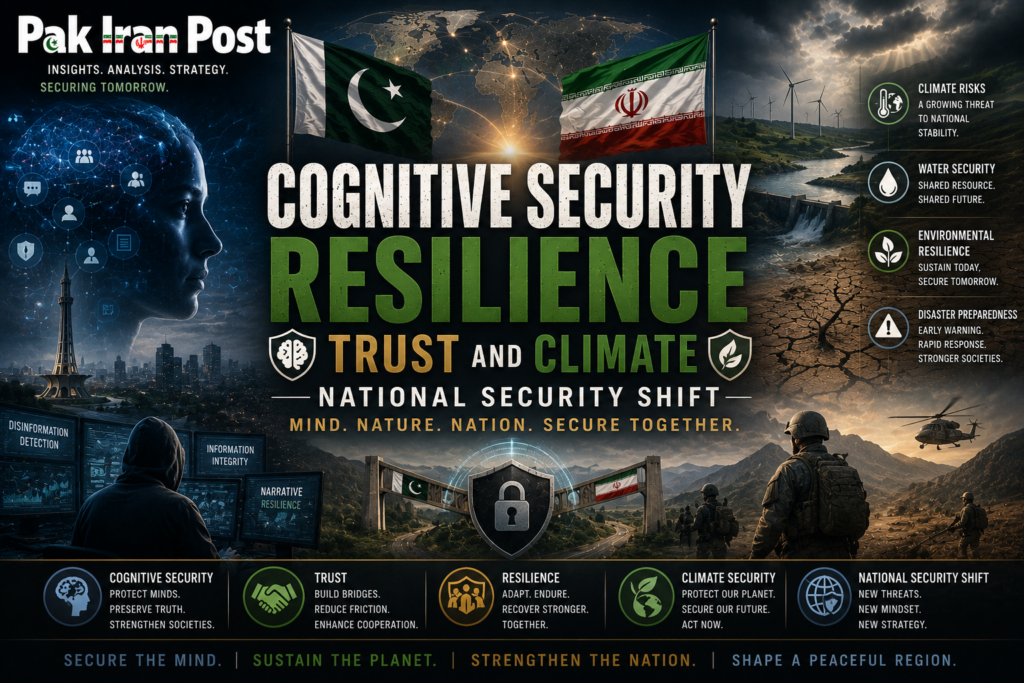
The evolving security environment across the Pakistan Iran post regional continuum is increasingly defined by a structural reordering of what constitutes national stability. Traditional security paradigms anchored in territorial defense, kinetic deterrence, and diplomatic balancing are gradually being supplemented, and in certain dimensions displaced, by a more complex architecture of non traditional security determinants. These include psychological resilience, cognitive coherence, institutional trust, climate exposure, and resource predictability, which together form an emerging matrix of systemic survivability.
At the heart of this transformation lies a fundamental shift in the ontology of security itself. Security is no longer exclusively about protection from external aggression; it is increasingly about internal coherence under sustained stress. In this sense, the decisive question for states like Pakistan and Iran is not merely whether they can deter threats, but whether they can maintain functional continuity under conditions of persistent economic, environmental, and informational strain.
One of the most significant but under examined dimensions of this shift is cognitive security. This refers to the stability of collective perception, interpretive frameworks, and narrative coherence within society. In environments characterized by economic volatility, political contestation, and digital information fragmentation, societies begin to experience divergence in how reality itself is interpreted. Inflation, unemployment, and policy reforms are no longer universally understood phenomena but contested narratives shaped by competing informational ecosystems.
This fragmentation of cognitive space produces a subtle but profound security challenge. When societies no longer share a stable understanding of economic or political reality, policy transmission becomes unreliable. Even technically sound interventions are filtered through divergent interpretive lenses, producing inconsistent behavioral responses. In such conditions, governance becomes not only a matter of implementation but of perception management, where narrative alignment becomes as critical as fiscal discipline.
Closely linked to cognitive security is the erosion of institutional trust. Trust functions as the invisible infrastructure of governance, enabling compliance, reducing transaction costs, and facilitating policy absorption. However, prolonged exposure to economic stress, inconsistent policy signaling, and uneven distribution of burden has begun to erode this foundational asset. The decline of trust does not manifest as sudden collapse but as gradual substitution of formal authority with informal negotiation, selective compliance, and localized rule interpretation.
In both Pakistan and Iran, this dynamic is further complicated by external economic pressures. Engagement with international financial systems, including conditional lending frameworks and macroeconomic stabilization programs, introduces necessary fiscal discipline but also generates domestic legitimacy challenges. Energy pricing reforms, tax broadening measures, and subsidy rationalization policies, while structurally essential, often arrive in politically saturated environments where public tolerance for adjustment is already limited.
The result is a recurring tension between macroeconomic necessity and microeconomic survivability. Households operate under constrained consumption thresholds, meaning that even marginal price adjustments in energy or essential commodities can trigger disproportionate welfare effects. This sensitivity transforms economic policy into a high impact political instrument, where technical decisions carry immediate social consequences.
Overlaying these fiscal and cognitive dimensions is the accelerating relevance of climate and environmental security. Water scarcity, glacial melt variability, extreme heat events, and agricultural unpredictability are no longer peripheral environmental concerns; they are central determinants of economic stability. In agrarian dependent economies, climate variability directly translates into income volatility, food price inflation, and rural migration pressures.
This environmental stress does not operate in isolation. It interacts with energy shortages, demographic pressures, and infrastructural limitations to produce compound risk clusters. For example, rising temperatures increase electricity demand for cooling, while simultaneously reducing hydrological availability for hydroelectric generation. This creates a structural imbalance between energy supply capacity and consumption demand, intensifying fiscal strain and public dissatisfaction.
Demographically, both Pakistan and Iran face the challenge of youthful population structures that, in the absence of sufficient employment generation, risk transforming demographic advantage into structural pressure. Youth cohorts, when confronted with constrained economic mobility and declining trust in institutional pathways, become more susceptible to informal economies, migration aspirations, and episodic political mobilization. The long term implication is not immediate instability but gradual system strain through unmet expectations.
Within this multi layered environment, psychological resilience emerges as a critical but often neglected component of national security. Societies under prolonged stress conditions exhibit measurable changes in behavioral patterns, including reduced risk tolerance, shorter planning horizons, and increased sensitivity to economic shocks. These behavioral shifts have macroeconomic consequences, as they influence savings rates, investment behavior, and labor market participation.
In strategic terms, psychological resilience should therefore be conceptualized not as a soft social indicator but as a hard security variable. States that fail to maintain collective psychological stability risk experiencing policy fatigue, reduced compliance, and heightened volatility in response to minor shocks. Conversely, societies with higher resilience thresholds are better able to absorb reform shocks, adapt to structural transitions, and maintain institutional continuity.
From an establishment perspective, this necessitates a recalibration of national security frameworks. Military preparedness remains essential, but it must now be integrated with cognitive stability management, climate adaptation strategy, and economic resilience planning. Security institutions are increasingly required to operate in domains traditionally associated with civilian governance, including information integrity, disaster preparedness, and socio economic stabilization.
Energy and water systems, in this context, are no longer merely infrastructural sectors but strategic security assets. Energy insecurity translates directly into industrial disruption, inflationary cycles, and political dissatisfaction. Water insecurity translates into agricultural instability, rural displacement, and urban pressure accumulation. Both function as latent triggers for broader systemic stress.
The IMF and similar multilateral institutions occupy a complex position within this architecture. Their policy frameworks provide necessary macroeconomic discipline but often operate on temporal horizons that are misaligned with domestic political cycles. Energy tax reforms, for example, may be economically justified in medium term stabilization models, but politically destabilizing in short term social contexts. This temporal mismatch is one of the central governance challenges facing states under external financial supervision.
The strategic implication is that resilience must be designed, not assumed. This requires the development of integrated national frameworks that combine fiscal policy, climate adaptation, demographic planning, and cognitive governance. Fragmented policy approaches are insufficient in an environment where shocks are cross sectoral and mutually reinforcing.
Pakistan and Iran, given their geographic proximity and overlapping vulnerability profiles, have an opportunity to conceptualize a shared resilience corridor. Such a framework would not eliminate structural constraints but could mitigate their intensity through coordinated energy strategies, migration management protocols, and climate response alignment. More importantly, it could establish a basis for stabilizing cross border economic expectations in an otherwise volatile regional environment.
Ultimately, the emerging security paradigm is defined by the convergence of four critical variables: cognitive coherence, institutional trust, climate stability, and psychological resilience. These are not auxiliary considerations but central pillars of state durability in the contemporary era. Their erosion does not produce immediate collapse but gradual systemic weakening, which is often more difficult to detect and more challenging to reverse.
The policy imperative is therefore clear. States must move from reactive crisis management toward anticipatory resilience engineering, where security is understood as a continuous process of maintaining systemic balance under conditions of persistent uncertainty.
A Public Service Message