Silent Faultlines Governance Fatigue Economic Drift Regional Trust Crisis

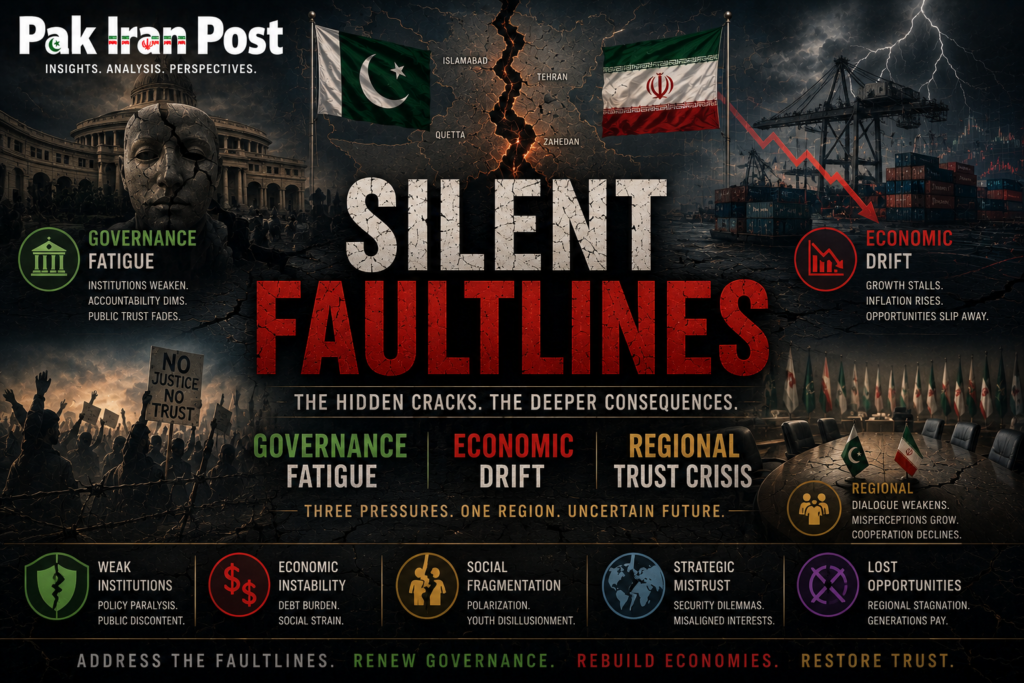
The Pakistan Iran post regional architecture is increasingly defined by a quiet accumulation of structural pressures that rarely manifest as sudden rupture yet continuously erode the internal coherence of state systems. What is emerging is not conventional instability but a more insidious condition of governance fatigue, where institutional capacity, fiscal space, and epistemic authority decline in parallel, producing a prolonged state of adaptive exhaustion across policy ecosystems.
At the core of this transformation lies a gradual decoupling between governance intent and governance delivery. Both Pakistan and Iran are operating under conditions where policy ambition exceeds implementation bandwidth, not due to absence of planning frameworks but due to overstretched administrative systems, fragmented authority chains, and persistent fiscal compression. The result is a widening gap between formal state rationality and functional state performance, a gap increasingly filled by informal mechanisms of survival, parallel economies, and non institutional coping structures.
This condition is further intensified by prolonged economic fatigue. Inflationary persistence, currency instability, and constrained external financing channels have shifted public expectations from developmental progress to minimal stability preservation. In such an environment, economic policy loses its forward looking character and becomes predominantly reactive, oriented toward crisis containment rather than structural transformation. The psychological consequence of this shift is significant, as societies begin to internalize a lowered threshold of expectation, which in turn reshapes political legitimacy dynamics.
Public trust, once anchored in institutional predictability, is undergoing a slow erosion. This erosion is not necessarily dramatic or visible in moments of crisis but accumulates through repeated experiences of policy inconsistency, delayed relief mechanisms, and perceived inequities in burden distribution. As trust declines, compliance becomes increasingly conditional rather than normative. Citizens begin to interpret policy not as collective necessity but as negotiated imposition, which weakens the cohesion required for effective governance transmission.
Simultaneously, both states are confronting a growing complexity in information environments. The proliferation of digital narratives, fragmented media ecosystems, and unverified economic interpretations has generated a condition of informational asymmetry between state institutions and the public sphere. In such environments, perception often acquires equal or greater weight than material reality. Inflation expectations, for instance, are shaped not only by supply side dynamics but also by narrative velocity, rumor propagation, and social amplification effects.
This informational volatility introduces a second order governance challenge: even well designed policy interventions risk being undermined by interpretive distortion. Energy tariff adjustments, subsidy rationalisation, or taxation reforms may achieve technical coherence while simultaneously triggering public resistance rooted in perceived inequity or mistrust. The governance challenge is therefore no longer limited to policy formulation but extends to narrative stabilisation and cognitive alignment between state intent and societal understanding.
Within this context, establishment level concerns increasingly revolve around systemic overstretch. Administrative systems are required to respond simultaneously to fiscal tightening, social protection demands, security obligations, and external diplomatic pressures. This multi vector burden reduces institutional depth, forcing reliance on short term expedients rather than sustained reform trajectories. Over time, this creates a pattern of policy oscillation, where reforms are announced, partially implemented, and subsequently adjusted under political or social pressure, further weakening credibility.
In Pakistan’s case, energy sector reform remains a central node of this tension. IMF driven restructuring of tariffs and taxation frameworks is essential for macroeconomic stabilization, yet it directly intersects with already fragile household consumption patterns. The political economy of energy pricing thus becomes a high sensitivity domain, where technical necessity collides with social acceptability. In Iran’s context, external sanctions constraints amplify internal fiscal rigidity, narrowing policy maneuverability and increasing dependence on non conventional economic channels, which themselves introduce opacity into the system.
Cross border dynamics between Pakistan and Iran add another layer of complexity. While both states share certain structural vulnerabilities, including external economic pressure and demographic stress, their policy responses are shaped by differing institutional architectures and external alignments. This creates a situation of asymmetric synchronization, where cooperation potential exists but is constrained by divergent constraints and external dependencies. The result is a relationship characterized by strategic necessity but operational limitation.
A less visible but increasingly critical dimension of this evolving landscape is the rise of governance exhaustion as a systemic condition. This refers not only to resource scarcity but to the diminishing capacity of institutions to continuously absorb shocks without degradation in performance quality. When administrative systems operate under prolonged stress, their adaptive flexibility declines, leading to slower decision cycles, reduced policy experimentation, and increased risk aversion. This, in turn, reinforces stagnation and limits reform velocity.
At the societal level, this governance fatigue translates into what can be described as normalization of dysfunction. Irregular service delivery, intermittent economic instability, and partial policy implementation become expected conditions rather than exceptional failures. This normalization reduces pressure for systemic correction while simultaneously lowering institutional accountability thresholds. Over time, the distinction between crisis and normality becomes blurred.
The financial dimension of this process is closely linked to external conditionality regimes. Engagement with international financial institutions introduces structured reform pathways, yet these pathways often operate on macroeconomic assumptions that do not fully account for domestic absorptive capacity. Energy tax reforms and subsidy reductions, while aligned with fiscal consolidation objectives, can generate disproportionate distributive shocks if not calibrated with social buffering mechanisms. The resulting tension between external compliance and internal stability becomes a recurring policy dilemma.
In parallel, climate related stressors are increasingly intersecting with governance fatigue. Water scarcity, agricultural volatility, and energy demand fluctuations introduce additional layers of unpredictability into already constrained administrative systems. These environmental variables do not operate in isolation; they amplify existing governance limitations by increasing the frequency and intensity of demand for state intervention. The cumulative effect is a rising load on systems already operating near capacity thresholds.
Demographic pressures further compound this dynamic. Youth population expansion, combined with limited employment generation capacity, creates a structural mismatch between aspiration and opportunity. This mismatch has long term implications for social cohesion, particularly when combined with declining trust in institutional responsiveness. The risk is not immediate instability but gradual disengagement from formal systems, manifested in migration pressures, informal economic participation, and reduced civic participation.
In strategic terms, the convergence of these factors suggests a transition from episodic crisis management to chronic fragility governance. States are increasingly required to manage not discrete emergencies but continuous stress environments. This requires a fundamental reorientation of governance philosophy, from control based models to resilience based frameworks that prioritise adaptability, redundancy, and systemic flexibility.
Policy recommendations emerging from this analysis point toward several critical interventions. First, institutional capacity must be strengthened not only in terms of resources but in terms of decision making velocity and coordination efficiency. Second, fiscal reforms, particularly in the energy sector, must be accompanied by targeted social protection architectures capable of absorbing distributive shocks without eroding legitimacy. Third, information governance mechanisms must be enhanced to reduce the gap between policy intent and public perception, thereby stabilizing the epistemic environment in which economic decisions are received.
Finally, Pakistan and Iran must consider the development of a shared regional resilience framework that acknowledges common vulnerabilities while respecting sovereign constraints. Such a framework would not replace existing bilateral mechanisms but would complement them by introducing coordinated approaches to migration management, energy stability, and climate adaptation.
The central insight is that governance fatigue is not a temporary phase but an emergent structural condition. Addressing it requires moving beyond reactive policy cycles toward anticipatory governance architectures capable of sustaining institutional coherence under prolonged stress.
A Public Service Message