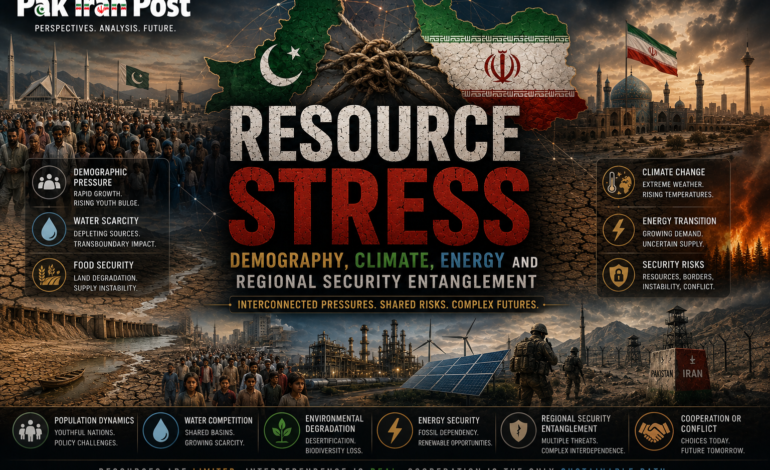
Resource Stress Demography Climate Energy And Regional Security Entanglement

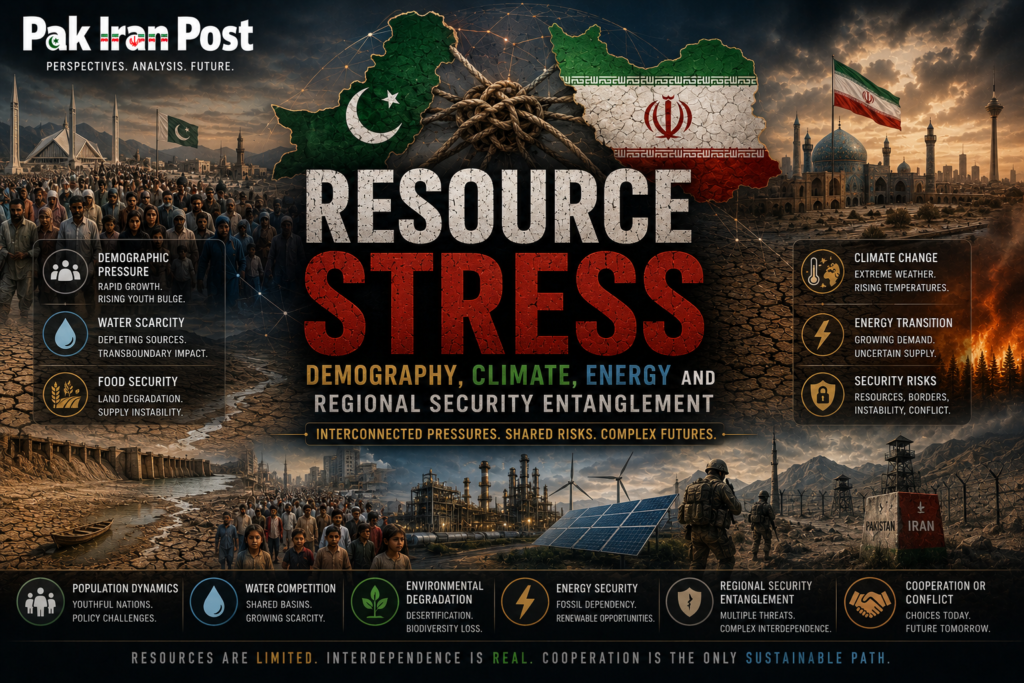
The Pakistan Iran post regional security environment is increasingly shaped by an underlying convergence of resource constraints, demographic pressures, climate volatility, and energy insecurity, which together form a complex and interdependent system of structural stress. Unlike conventional security paradigms that prioritize military balance or diplomatic alignment, this emerging configuration operates through slow moving but persistent pressures that gradually reshape state capacity, social stability, and economic endurance.
At the core of this transformation is the reclassification of natural resources from developmental inputs into strategic security determinants. Water, energy, arable land, and climatic stability are no longer peripheral variables within economic planning; they are central pillars of national continuity. Their scarcity, unpredictability, and uneven distribution are increasingly generating systemic effects that extend far beyond their immediate sectors, influencing migration patterns, fiscal stability, and political legitimacy.
Water stress, in particular, has emerged as a critical fault line in both Pakistan and Iran. Hydrological variability, declining per capita water availability, and increasing agricultural demand are converging to produce a structural imbalance between supply and consumption. This imbalance is further exacerbated by climate induced shifts in precipitation patterns and glacial melt dynamics, which undermine long term predictability in water resource planning. As a result, water is no longer merely a resource management issue; it is becoming a latent trigger for inter provincial tension, rural economic fragility, and urban dependency escalation.
Energy insecurity operates in parallel, reinforcing and amplifying these vulnerabilities. Both Pakistan and Iran face structural challenges in energy generation, transmission efficiency, and pricing stability. Dependence on imported fuels, inefficiencies in distribution networks, and fiscal constraints on subsidy regimes create a persistent gap between demand and supply. This gap manifests not only as periodic load shedding or price adjustments but as a chronic constraint on industrial productivity, household welfare, and investor confidence.
The intersection of energy and climate systems introduces an additional layer of complexity. Rising temperatures increase peak electricity demand, particularly for cooling, while simultaneously affecting hydrological flows that support hydroelectric generation. This creates a counter cyclical stress pattern, where demand increases precisely when supply becomes more uncertain. Such structural misalignment intensifies fiscal pressure on governments already constrained by external debt obligations and conditional reform frameworks.
Demographic dynamics further complicate this resource stress architecture. Both states are characterized by youthful population structures, which theoretically offer long term demographic dividends but in practice generate immediate pressures when employment absorption capacity is insufficient. High youth dependency ratios, combined with limited formal sector expansion, create structural unemployment or underemployment conditions that feed into informal economic growth, migration aspirations, and periodic social volatility.
The demographic transition is not merely quantitative but qualitative. Urbanization is accelerating at a pace that outstrips infrastructural development, resulting in expanding informal settlements, strained public services, and uneven access to essential utilities. This urban concentration of demographic pressure transforms cities into focal points of systemic stress, where energy shortages, water scarcity, and employment competition converge in highly visible forms of socio economic strain.
Climate change acts as a force multiplier across all these dimensions. Increased frequency of extreme weather events, shifting agricultural zones, and rising baseline temperatures are not isolated environmental phenomena; they are systemic disruptors of economic planning and social stability. Agricultural productivity, which remains a significant component of rural livelihoods in both Pakistan and Iran, is increasingly exposed to climatic unpredictability, resulting in income volatility and food price inflation.
This climatic uncertainty feeds directly into migration dynamics. Rural populations, facing declining agricultural viability, are increasingly moving toward urban centers or seeking cross border opportunities. This migration is not always linear or formalized; it often occurs through informal channels that expose migrants to legal, economic, and physical vulnerabilities. Over time, these movements reshape labor markets, urban demographics, and cross border socio economic linkages.
Within this evolving environment, energy, water, and climate systems cannot be treated as separate policy domains. They are increasingly interlocked, forming a composite risk architecture in which stress in one domain amplifies vulnerabilities in others. For example, water scarcity reduces agricultural output, which increases food prices, which in turn intensifies inflationary pressure, which then constrains energy affordability, creating a cascading cycle of systemic strain.
From an establishment perspective, this interdependence represents a strategic challenge that transcends traditional sectoral governance. Security frameworks must now incorporate resource stability as a core component of national resilience. This includes not only infrastructure investment but also predictive modeling of climate impacts, demographic shifts, and energy demand trajectories. Failure to integrate these variables risks policy fragmentation and reactive governance cycles.
The international dimension further complicates this architecture. External financial frameworks, including those associated with multilateral lending institutions, often prioritize macroeconomic stabilization, fiscal consolidation, and energy pricing reform. While these objectives are economically rational, they can produce short term distributive shocks when implemented in resource constrained and climate sensitive environments. Energy tariff rationalization, for instance, may improve fiscal balance sheets but simultaneously reduce household consumption capacity, thereby amplifying social pressure.
In such contexts, the sequencing of reforms becomes as important as their design. Abrupt fiscal adjustments in energy or water pricing can trigger systemic stress responses that undermine long term stabilization objectives. This highlights the importance of adaptive policy calibration, where reform pathways are adjusted in accordance with social absorption capacity and environmental conditions.
At the regional level, Pakistan and Iran occupy a shared vulnerability space, despite differences in economic structure and external alignments. Both are exposed to climate stress, energy constraints, demographic pressures, and external financial dependencies, albeit in varying configurations. This shared exposure creates a latent opportunity for coordinated resilience strategies, particularly in areas such as cross border energy trade, water management diplomacy, and climate adaptation cooperation.
However, such coordination is constrained by geopolitical sensitivities, institutional asymmetries, and external strategic pressures. As a result, regional cooperation remains episodic rather than systemic, limiting its potential stabilizing effect. The absence of a structured resilience framework means that both states continue to manage similar challenges in largely parallel but uncoordinated ways, reducing overall efficiency in stress mitigation.
The long term implication of this trajectory is the gradual normalization of resource constrained governance. States adapt not by resolving underlying shortages but by continuously adjusting to them through incremental policy shifts. While this may ensure short term stability, it risks locking economies into low growth, high vulnerability equilibria, where structural constraints persist over extended periods.
The strategic imperative is therefore to reframe resource governance as a core component of national security architecture. This involves integrating water security, energy planning, and climate adaptation into a unified policy framework that recognizes their interdependence. It also requires strengthening institutional capacity for long term forecasting and cross sectoral coordination.
Ultimately, the convergence of demographic pressure, climate instability, energy insecurity, and water scarcity represents not a series of isolated challenges but a unified systemic condition. Addressing it requires moving beyond sector specific interventions toward holistic resilience engineering, where the objective is not merely to manage scarcity but to stabilize the systemic interactions that produce it.
A Public Service Message