
Fragile Corridors Economic Shockwaves Across Pakistan Iran Human Security Matrix

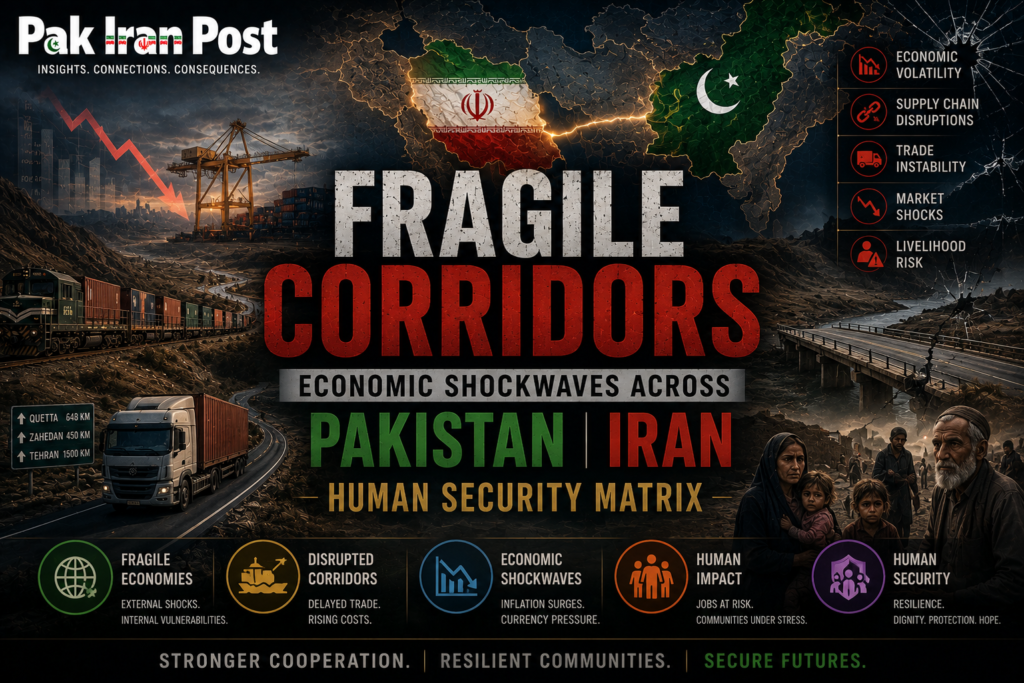
The contemporary geopolitical economy linking Pakistan and Iran is entering a phase of quiet but structurally consequential transformation, in which visible diplomacy increasingly obscures an underlying architecture of systemic fragility. Beneath the formal rhetoric of regional cooperation, energy connectivity, and border stability, a more volatile set of economic and human security dynamics is unfolding, shaped by external financial conditionalities, shifting labour geographies, and an intensifying competition for fiscal survival within constrained state systems.
In analytical terms, the region is no longer primarily exposed to episodic shocks; it is increasingly embedded in a condition of chronic stress transmission. The most immediate vector of this transmission is the remittance corridor, historically functioning as a stabilising artery for household consumption, currency liquidity, and informal social protection across both Pakistan and Iran’s wider labour-exporting ecosystems. Yet this corridor is now subject to compounding pressures emanating from tightening Gulf labour localisation policies, intensified regulatory scrutiny of migrant labour, and a broader recalibration of energy-dependent Gulf economies under post-oil diversification strategies.
Within this shifting matrix, ordinary households are becoming the primary absorbers of macroeconomic volatility. The contraction or delay of remittance inflows is no longer a cyclical inconvenience but a structural shock amplifier. It transmits directly into food inflation sensitivity, education discontinuity, and healthcare affordability thresholds, thereby converting external financial tightening into domestic social stress. The effect is not linear; it is recursive, as household coping mechanisms, including informal debt accumulation and asset liquidation, further erode long-term resilience.
Simultaneously, both Pakistan and Iran are operating under a converging set of fiscal constraints shaped by international financial governance frameworks. The International Monetary Fund conditionality regime, particularly its emphasis on energy pricing rationalisation, tax base expansion, and subsidy reduction, has introduced a technocratic discipline into domestic policy design. However, the political economy of implementation remains fraught. Energy tax restructuring, while economically rational in orthodox fiscal terms, generates immediate distributive shocks in societies already experiencing inflationary fatigue. The result is a tension between macroeconomic stabilisation objectives and micro-level survival economies.
In Pakistan’s case, energy sector reform under IMF pressure intersects with structural inefficiencies in circular debt accumulation, transmission losses, and tariff misalignment. In Iran’s context, external sanctions architecture compounds internal fiscal rigidity, narrowing the state’s capacity to absorb reform-induced social discontent. In both cases, energy pricing is no longer merely an economic variable; it has become a proxy indicator of state legitimacy and governance capacity.
Overlaying this fiscal compression is a labour market transformation that is subtly but decisively altering the socio-economic fabric of cross-border mobility. Migration, once a relatively predictable lifecycle strategy for surplus labour absorption, is becoming increasingly contingent, politicised, and securitised. Visa regimes are tightening not only in Gulf economies but also in transit jurisdictions, creating friction in mobility chains that historically functioned as pressure-release valves for domestic unemployment.
The implication is a gradual narrowing of economic escape routes for lower-income populations. As formal migration channels contract, informal and irregular pathways expand, exposing migrants to heightened vulnerability, exploitation, and legal precarity. This shift introduces a new category of risk: migration insecurity, where labour mobility itself becomes a volatile asset rather than a stable economic strategy.
Within this evolving landscape, the role of information systems and narrative construction becomes increasingly central. Information disorder, amplified through fragmented digital ecosystems, is reshaping public perception of economic conditions in real time. Inflation expectations, labour anxieties, and political trust are now partially mediated through unregulated narrative flows that often outpace institutional communication capacity. The consequence is a decoupling between lived economic reality and perceived economic trajectory, generating volatility in both markets and governance legitimacy.
From an establishment perspective, this represents a strategic concern of increasing magnitude. The erosion of epistemic coherence, where citizens no longer share a stable understanding of economic facts, undermines policy transmission mechanisms. Fiscal measures, energy reforms, and labour regulations lose efficacy not only due to implementation gaps but due to interpretive fragmentation within society. In such conditions, governance becomes reactive, relying on ad hoc stabilisation measures rather than coherent long-term planning.
The security implications of these dynamics are often underestimated. Economic stress, when sustained over prolonged periods, does not remain confined to financial indicators; it migrates into the domain of social cohesion and psychological resilience. In both Pakistan and Iran, there is growing evidence that economic uncertainty is contributing to a form of anticipatory stress behaviour, where households and communities adjust expectations downward, reduce long-term investment in human capital, and prioritise immediate consumption survival strategies over developmental planning.
This behavioural shift carries long-term structural consequences. Education discontinuity, health expenditure compression, and reduced entrepreneurial risk-taking collectively erode the productive base of the economy. Over time, this produces a low-growth equilibrium trap, in which states remain operational but structurally underperforming in terms of developmental acceleration.
Compounding these internal pressures is the external dimension of regional instability. Broader Middle Eastern volatility continues to influence energy pricing trajectories, insurance costs for trade routes, and investment risk premiums across adjacent economies. Even when direct conflict does not materialise, risk perception alone is sufficient to elevate transaction costs and reduce capital inflows. This phenomenon is particularly acute in energy-dependent economies, where imported fuel pricing volatility transmits directly into domestic inflation indices.
At the environmental frontier, climate stressors are increasingly converging with economic fragility to produce hybrid vulnerabilities. Water scarcity, particularly in transboundary river systems, is no longer solely an environmental management issue but a strategic stability concern. Agricultural output variability induced by hydrological unpredictability feeds directly into rural income instability, which in turn accelerates urban migration pressures. Urban centres, already strained by demographic expansion, face infrastructural saturation, resulting in service delivery deficits and informal settlement expansion.
Energy scarcity further intensifies this convergence. Power generation constraints, whether due to fuel import dependency or infrastructure inefficiency, create periodic disruptions that ripple through industrial productivity and household welfare. When combined with climate-induced demand variability, the result is a structural mismatch between supply capacity and consumption demand, reinforcing cycles of inflation and public dissatisfaction.
Demographic pressures add another layer of complexity. A youthful population structure, while theoretically advantageous, becomes a liability in the absence of adequate employment absorption capacity. Youth unemployment or underemployment generates latent socio-political tension, particularly when coupled with declining mobility prospects and rising cost of living. The result is not immediate instability but a gradual accumulation of systemic frustration.
Within this context, the notion of national security itself requires conceptual recalibration. Traditional security paradigms centred on territorial defence and military capability are increasingly insufficient to capture the full spectrum of contemporary vulnerabilities. Security must now be understood as a multi-dimensional construct encompassing economic stability, informational coherence, resource sustainability, and psychological resilience.
Policy responses, therefore, must move beyond compartmentalised interventions. Energy taxation reforms, while fiscally necessary under IMF frameworks, must be sequenced with targeted social protection mechanisms to prevent distributive shock amplification. Labour migration policy must be restructured through bilateral or multilateral frameworks that recognise mobility as a stabilising economic asset rather than a discretionary privilege. Remittance systems require formalisation and digital integration to reduce transaction friction and enhance macroeconomic predictability.
From an establishment standpoint, there is also a need to institutionalise strategic foresight mechanisms capable of identifying second and third order effects of policy decisions. Short-term fiscal consolidation cannot be pursued in isolation from long-term social stability considerations. Similarly, information governance must be strengthened to ensure coherence between state messaging and economic reality, thereby reducing the gap between perception and policy.
At the international level, engagement with multilateral financial institutions such as the IMF must increasingly incorporate geopolitical sensitivity clauses that recognise the asymmetric social impact of standardised reform packages. Energy pricing rationalisation, while economically justified, requires adaptive calibration in fragile socio-economic environments to avoid triggering disproportionate welfare shocks.
The broader strategic implication is that Pakistan and Iran are entering a shared condition of systemic exposure, where external economic pressures and internal structural constraints converge in increasingly unpredictable ways. Stability, in this context, is no longer a static condition but a continuously negotiated equilibrium.
Ultimately, the emerging reality is one in which human security and economic architecture are inseparably intertwined. The fragility of remittance corridors, the volatility of energy pricing regimes, the tightening of labour mobility pathways, and the erosion of institutional trust collectively define a new strategic environment. In this environment, resilience is not derived from insulation against shocks, but from the capacity to absorb, adapt, and reconfigure in response to them.
The policy challenge is therefore not merely technical but civilisational in scope: to construct governance systems capable of managing fragility without normalising collapse, and to transform vulnerability into a structured framework of anticipatory stability rather than reactive crisis management.
A Public Service Message