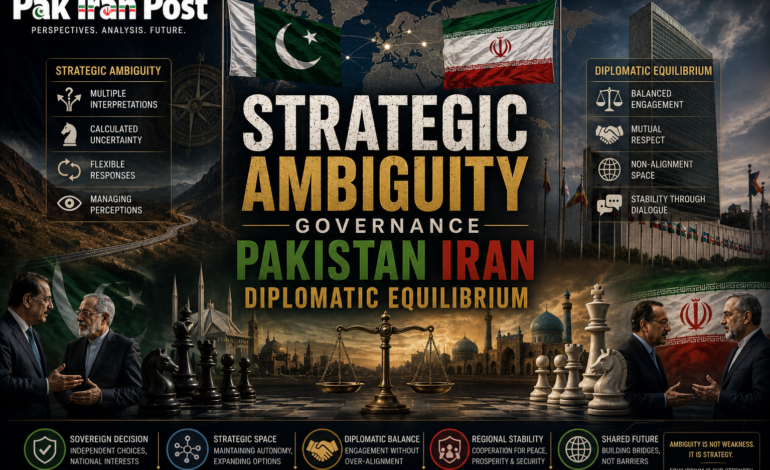
Strategic Ambiguity Governance Pakistan Iran Diplomatic Equilibrium


By : Shafqat Ali Qureshi
The contemporary architecture of regional diplomacy is increasingly defined by the deliberate cultivation of strategic ambiguity, a condition in which states maintain calculated indeterminacy across ideological alignment, economic orientation, and security partnerships. Within this evolving diplomatic grammar, Pakistan and Iran exemplify a broader middle power tendency to navigate an increasingly fragmented international order through controlled non alignment, selective signaling, and calibrated opacity. Strategic ambiguity, once an incidental feature of transitional diplomacy, has now matured into a structural instrument of statecraft, embedded within the operational logic of survival under conditions of geopolitical compression.
This transformation is occurring against a backdrop of intensified global polarization, where major power competition has reduced the availability of neutral diplomatic space and increased the cost of explicit alignment. As competing blocs demand clearer positional commitments, states with limited economic elasticity and heightened security exposure are incentivized to preserve maneuverability through ambiguity rather than clarity. In this context, ambiguity is not an absence of strategy but a form of strategic density, allowing multiple interpretations of policy intent to coexist without immediate resolution.
For Pakistan, strategic ambiguity has historically functioned as a balancing mechanism between competing security imperatives and economic dependencies. Its geopolitical positioning requires continuous calibration between regional connectivity aspirations, security partnerships, and multilateral financial engagements. The increasing conditionality associated with global financial institutions, particularly in the domains of energy taxation, fiscal consolidation, and governance reform, further constrains the scope of explicit alignment. Consequently, ambiguity becomes a functional necessity, enabling Pakistan to engage diverse actors without prematurely foreclosing strategic options.
Iran, operating under a different but equally complex set of constraints, utilizes ambiguity as a mechanism to mitigate the effects of prolonged sanctions regimes and limited financial integration. Its regional posture is shaped by the need to maintain deterrence credibility while simultaneously preserving avenues for economic interaction and diplomatic recalibration. In this context, ambiguity serves as a protective buffer against systemic isolation, allowing Iran to signal resilience while retaining flexibility in its external engagements.
However, the increasing centrality of strategic ambiguity introduces its own structural contradictions. While ambiguity enhances flexibility, it simultaneously generates interpretive uncertainty among external partners, which can erode trust capital over time. Diplomatic systems, particularly those linked to investment flows, security cooperation, and infrastructure development, rely on a minimum threshold of predictability. Excessive ambiguity risks undermining this threshold, thereby limiting the scope of long term cooperation.
The contemporary international environment, characterized by rapid information diffusion and heightened narrative sensitivity, further complicates the utility of ambiguity. In earlier diplomatic eras, ambiguity could be sustained over extended periods without significant interpretive penalty. In contrast, the current informational ecosystem reduces the lifespan of ambiguity by rapidly subjecting it to competing narrative interpretations. This accelerates the transition from ambiguity to forced clarification, thereby compressing the strategic utility window.
Within this constrained environment, Pakistan and Iran face the challenge of converting strategic ambiguity from a passive condition into an actively managed governance instrument. This requires institutionalization of ambiguity management, where the boundaries of interpretive flexibility are clearly defined even if specific policy outcomes remain intentionally fluid. Such an approach allows states to preserve adaptability while minimizing the risk of reputational erosion or strategic misalignment.
A key dimension of this process involves the differentiation between tactical ambiguity and structural ambiguity. Tactical ambiguity operates at the level of specific policy initiatives, allowing temporary flexibility in diplomatic signaling or economic engagement. Structural ambiguity, by contrast, pertains to foundational questions of alignment and identity, which, if left unresolved, can generate long term strategic uncertainty. For both Pakistan and Iran, maintaining equilibrium requires ensuring that ambiguity remains primarily tactical rather than structural.
Energy diplomacy represents a critical arena in which strategic ambiguity is both necessary and risky. Energy corridors, pricing regimes, and cross border infrastructure projects require long term commitments, yet are simultaneously exposed to geopolitical volatility and external regulatory scrutiny. In such contexts, ambiguity can facilitate exploratory engagement but may also deter large scale investment if perceived as institutionalized uncertainty. The challenge lies in distinguishing between flexible negotiation space and credible commitment frameworks.
Similarly, in the domain of security cooperation, ambiguity functions as both deterrent and constraint. It allows states to avoid premature escalation while retaining signaling capacity, yet it also complicates alliance predictability. For Pakistan and Iran, maintaining deterrence credibility while avoiding unnecessary escalation requires a finely tuned balance between explicit signaling and controlled opacity. Mismanagement of this balance can lead to misinterpretation by external actors, thereby increasing systemic risk.
From a governance perspective, the institutionalization of strategic ambiguity necessitates the development of sophisticated policy coordination mechanisms. Foreign policy, economic planning, and security apparatuses must operate in synchrony to ensure that ambiguity is strategically coherent rather than administratively fragmented. Without such coordination, ambiguity risks devolving into inconsistency, undermining both domestic policy effectiveness and external credibility.
The role of international institutions further complicates this dynamic. Multilateral frameworks such as the United Nations system, global financial institutions, and regional development organizations operate on the basis of transparency expectations and reporting standards that are structurally resistant to prolonged ambiguity. Engagement with these institutions therefore requires a dual track approach, wherein states maintain internal flexibility while presenting externally coherent policy narratives.
For Pakistan, compliance with multilateral financial frameworks introduces an additional layer of interpretive discipline, as policy ambiguity must be reconciled with formal reporting requirements and reform benchmarks. For Iran, partial engagement with international systems requires even more careful calibration, as ambiguity must be sustained without triggering additional sanctions exposure or diplomatic isolation. In both cases, the institutional environment acts as a moderating force on the extent and duration of ambiguity.
The broader Muslim world context adds another layer of complexity. Fragmented regional alignments, competing ideological narratives, and uneven economic integration have produced a diplomatic environment in which collective positioning is difficult to sustain. Within this fragmented landscape, Pakistan and Iran occupy a potentially stabilizing role, yet their ability to do so depends on their capacity to manage ambiguity without undermining regional trust architectures.
Strategically, the future of ambiguity in Pakistan Iran diplomacy will depend on the evolution of global power structures. If geopolitical polarization intensifies further, the demand for clarity may increase, thereby reducing the operational space for ambiguity. Conversely, if multipolarity deepens in a more fluid form, ambiguity may retain or even expand its strategic utility as states navigate a more complex constellation of alignments.
Policy recommendations arising from this analysis emphasize the need for deliberate ambiguity governance frameworks. These frameworks should define the permissible scope of flexibility, establish clear red lines in critical sectors, and ensure that ambiguity does not extend into areas requiring long term investment certainty. Additionally, strategic communication systems must be strengthened to manage external interpretations and reduce the risk of narrative distortion.
Ultimately, strategic ambiguity is neither inherently stabilizing nor destabilizing. Its impact depends on the institutional capacity of states to manage it, the clarity of their underlying strategic objectives, and the coherence of their external signaling. For Pakistan and Iran, the challenge is to transform ambiguity from a reactive adaptation into a structured instrument of diplomacy, capable of preserving flexibility without sacrificing credibility. In an international system increasingly defined by uncertainty, the ability to govern ambiguity may itself become a core determinant of strategic success and regional relevance.
A Public Service Message