
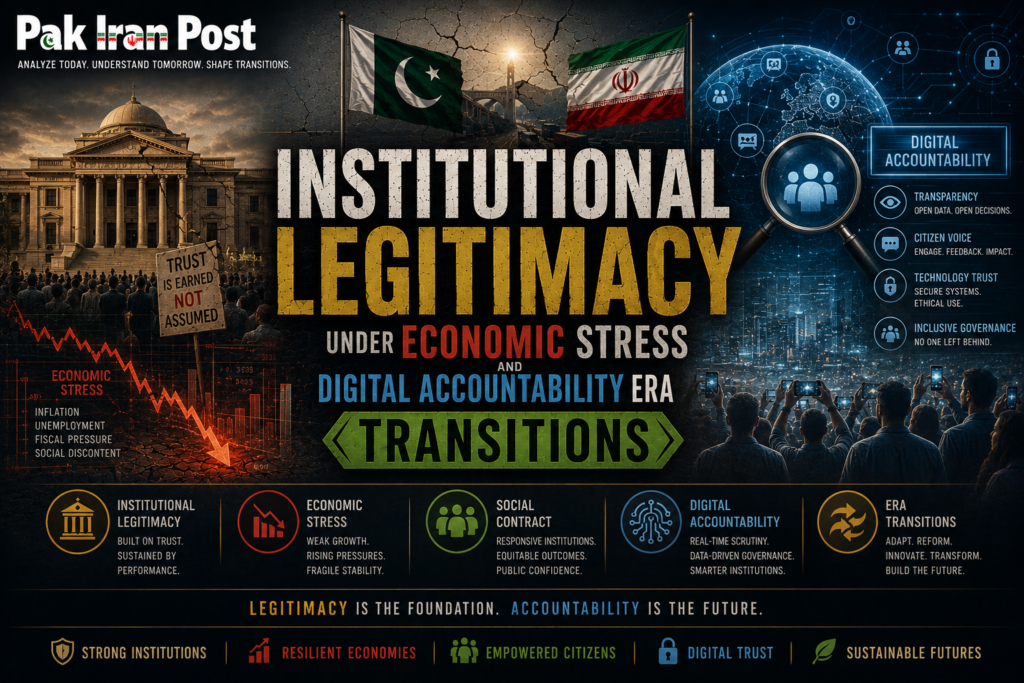
Institutional Legitimacy Under Economic Stress and Digital Accountability Era Transitions

In an international policy environment increasingly defined by macroeconomic compression, accelerated digital transparency, and the intensification of public expectation regimes, the question of institutional legitimacy has shifted from a constitutional abstraction into a continuously stress-tested operational variable. For states situated at the intersection of geopolitical volatility and structural economic dependency, including Pakistan and Iran, legitimacy is no longer derived solely from electoral cycles, ideological coherence, or administrative inheritance. It is now produced, eroded, and recalibrated in real time through the interaction of fiscal credibility, information ecosystems, and the perceived capacity of the state to respond to cascading crises without institutional fatigue or normative fragmentation.
Across policy corridors in Washington, Beijing, Brussels, and multilateral financial institutions such as the International Monetary Fund and the United Nations development architecture, a quiet but persistent analytical convergence is emerging. It suggests that legitimacy in the coming decade will be less a question of political authority and more a function of governance performance under constraint. This includes the ability to manage inflationary pressures while simultaneously implementing tax reforms, particularly in the energy sector, which has become a focal point of IMF conditionality frameworks. In several developing economies, energy taxation is no longer a purely fiscal instrument; it is a politically sensitive stress point that exposes the limits of administrative resilience, social consent, and elite cohesion.
Within this environment, Pakistan’s fiscal restructuring debates and Iran’s sanction-mediated economic adaptation strategies illustrate parallel but distinct manifestations of the same underlying structural challenge. External financial pressures, including IMF conditionalities tied to energy subsidy rationalisation and revenue mobilisation, intersect with domestic political economies that are increasingly sensitive to cost-of-living shocks. The resulting tension does not merely generate policy friction; it produces a legitimacy gap between state narrative and citizen experience, a gap that is amplified by digital media ecosystems where economic distress is rapidly converted into political discourse, often without institutional mediation.
The digital transformation of public accountability has fundamentally altered the temporal rhythm of governance. Where once policy legitimacy could be accumulated over annual budgets or electoral cycles, it is now subject to instantaneous validation or rejection within information networks that operate beyond traditional state control. Social media platforms, transnational news flows, and diaspora communication channels have collectively produced what analysts describe as “continuous scrutiny governance,” a condition in which state decisions are evaluated not only by outcomes but by perception velocity. This shift imposes a structural constraint on policy sequencing, particularly in areas such as taxation, subsidy reform, and public expenditure rationalisation.
For regional states operating under economic constraint regimes, the challenge is compounded by what can be termed compressed policy space. IMF programmes, bilateral financing conditions, and global commodity volatility restrict discretionary fiscal manoeuvre, while domestic political expectations demand immediate relief from inflationary pressures. In such contexts, governance legitimacy becomes contingent upon the state’s ability to construct persuasive narratives around austerity, reform, and structural adjustment without triggering systemic distrust. However, narrative construction alone is increasingly insufficient. The modern legitimacy environment demands demonstrable administrative coherence and measurable delivery outcomes.
Establishment-level policy institutions, particularly those embedded within security-administrative frameworks in South Asia and the Middle East, are therefore confronted with a dual-pressure architecture. On one side lies the requirement to maintain macro-stability under external financial supervision; on the other lies the necessity to preserve internal cohesion in the face of rising socio-economic stress. This duality creates what strategic analysts often describe as “governance under constrained sovereignty,” where formal policy autonomy exists but operational flexibility is significantly narrowed by external and internal binding constraints.
In Pakistan’s case, repeated engagement with IMF stabilisation frameworks has placed energy sector reform at the centre of fiscal restructuring. The rationalisation of energy subsidies, adjustment of tariff structures, and introduction of new energy taxes are not merely technical adjustments; they are politically consequential interventions that directly affect household consumption patterns and industrial competitiveness. While such reforms are often framed as necessary for macroeconomic stabilisation, their distributive consequences create political friction that can rapidly translate into legitimacy stress, particularly in an environment of high inflation and currency volatility.
Iran presents a parallel but structurally distinct case, where sanctions architecture has produced a long-term adaptation economy characterised by internal substitution, parallel trade networks, and state-mediated resource allocation. While this has enabled a degree of systemic resilience, it has also generated inefficiencies that complicate fiscal transparency and limit integration with global financial systems. In both cases, legitimacy is shaped not only by domestic governance performance but by the external economic architecture within which these states operate.
The central analytical question is therefore not whether governance reforms are necessary, but whether existing institutional configurations are capable of sustaining legitimacy under conditions of permanent economic stress. Traditional governance models, which rely on hierarchical decision-making and slow bureaucratic calibration, are increasingly mismatched with the speed and complexity of contemporary crisis environments. Economic volatility, cyber-intrusions targeting financial infrastructure, and media-driven political amplification cycles collectively produce a governance environment in which delays are interpreted as failures and adjustments are interpreted as instability.
In response, some policy systems have attempted incremental digitisation of administrative processes, introducing data-driven decision support systems, integrated financial monitoring dashboards, and real-time policy feedback mechanisms. However, the adoption of digital governance tools alone does not resolve the underlying institutional challenge. Without corresponding reforms in bureaucratic culture, inter-agency coordination, and policy continuity frameworks, digitisation risks becoming a layer of technical sophistication over structurally rigid governance systems.
A deeper structural issue lies in the fragmentation of institutional memory. In many developing governance systems, policy discontinuity across political cycles leads to repeated recalibration of economic strategies, undermining long-term credibility. This is particularly significant in IMF-supported programmes, where consistency of reform implementation is a key determinant of financial confidence. When policy reversals occur, whether due to political transition or administrative resistance, the resulting signal to external markets is one of reduced institutional reliability, which in turn increases borrowing costs and constrains fiscal space further.
The establishment concern in such environments is not merely economic stability but systemic predictability. Security and administrative institutions increasingly view economic volatility as a potential vector for broader socio-political instability, particularly when inflationary pressures intersect with unemployment and urban stress dynamics. In this context, governance legitimacy becomes intertwined with perceptions of state capacity to prevent disorder, not only to manage economic indicators.
A further dimension is the evolving role of public expectation inflation. As populations become more digitally connected and exposed to global consumption standards, the gap between expectation and delivery widens. This expectation gap is particularly acute in energy markets, where subsidies, pricing, and availability are directly experienced by households. When reforms are introduced under external conditionality frameworks, such as IMF energy tax adjustments or tariff rationalisation measures, they are often interpreted domestically through a lens of external imposition rather than internal necessity, complicating legitimacy narratives.
In parallel, media ecosystems play an increasingly constitutive role in shaping policy perception. The framing of economic reform as either structural necessity or elite-driven austerity determines the degree of public compliance or resistance. In this sense, governance is no longer solely about policy design but about narrative architecture. However, narrative alone cannot substitute for material relief. Where economic hardship is acute, communication strategies have limited absorptive capacity.
The policy implication for regional states is that governance reform must operate on multiple simultaneous levels. First, fiscal reforms must be sequenced in a manner that minimises immediate distributive shock while preserving long-term macroeconomic objectives. Second, institutional frameworks must be strengthened to ensure continuity of policy direction across political transitions. Third, digital governance systems must be integrated not as cosmetic reforms but as core infrastructural components of decision-making processes. Fourth, communication strategies must be aligned with demonstrable improvements in service delivery to maintain narrative credibility.
At a more strategic level, Pakistan and Iran face a converging challenge of institutional adaptation under external constraint regimes. While their geopolitical orientations differ, both operate within environments where economic sovereignty is partially mediated by external financial, sanction, or commodity systems. In such contexts, governance legitimacy becomes a function of adaptive capacity rather than absolute autonomy. The ability to negotiate external constraints while maintaining internal stability is emerging as the defining metric of state effectiveness.
There is also an emerging structural shift in how policy success is evaluated by international actors. Beyond macroeconomic indicators, there is increasing attention to governance resilience indicators, including institutional coordination efficiency, crisis response speed, and policy implementation consistency. These metrics, while less visible than GDP growth or inflation rates, are increasingly central to investment decisions and multilateral engagement frameworks.
The hidden risk within this evolving architecture is that legitimacy erosion may occur not through dramatic political rupture but through gradual institutional fatigue. As economic pressures persist and reform cycles intensify, the cumulative strain on administrative systems may reduce their absorptive capacity, leading to slower response times, reduced policy coherence, and increasing public dissatisfaction. This form of slow governance erosion is particularly difficult to detect in real time but has significant long-term implications for state stability.
In conclusion, institutional legitimacy in the contemporary era is no longer a static attribute derived from constitutional order or historical authority. It is a dynamic outcome produced at the intersection of economic performance, digital scrutiny, institutional coherence, and narrative credibility. For states operating under IMF programmes, energy taxation reforms, and external constraint environments, legitimacy is increasingly conditional upon the ability to deliver measurable outcomes under conditions of structural limitation.
The strategic challenge for policymakers is therefore not merely to implement reform, but to redesign governance systems capable of sustaining legitimacy under continuous stress. This requires a shift from reactive policy-making to anticipatory governance, from fragmented institutional structures to coordinated state capacity frameworks, and from narrative-driven legitimacy to performance-based institutional credibility. In the absence of such transformation, the gap between state capacity and societal expectation is likely to widen, producing systemic vulnerabilities that may not manifest immediately but will accumulate over time into structural governance stress.
A Public Service Message