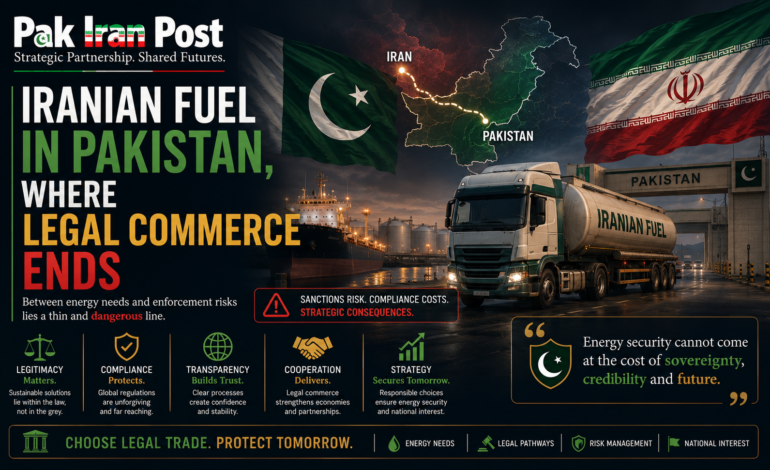
Iranian Fuel in Pakistan, Where Legal Commerce Ends


Pak Iran Post approaches Iranian petroleum entering Pakistan not as a binary contest between legality and illegality, but as a border governance problem in which fiscal architecture, local subsistence, enforcement discretion, national security and bilateral relations have become entangled. The distinction matters because a jerrycan carried by a border resident, a registered Zamyad operating under a provincial token arrangement, a commercial tanker avoiding customs controls and a distribution network supplying distant urban markets may involve the same commodity while representing radically different degrees of economic harm and security risk. Treating all of them as one category called smuggling produces poor intelligence, indiscriminate enforcement and an incentive structure in which legitimate border commerce is driven underground alongside genuinely organised criminal activity.
The scale of the price distortion makes the problem politically resilient. Domestic petrol stood at Rs334.18 per litre in late July 2026, while high speed diesel stood at Rs386.83, with approximately Rs110 per litre in taxes and duties embedded in petrol and Rs96 in diesel. In parts of Balochistan, Iranian fuel has consequently remained sufficiently cheaper to sustain a parallel market despite repeated enforcement operations. Provincial authorities themselves have intervened in the retail market: Balochistan fixed Iranian petrol at Rs280 per litre in April, while Hub administration later fixed it at Rs250, illustrating an uncomfortable administrative reality. The state has sometimes attempted to regulate the price of a commodity whose formal entry into the national fuel system remains legally problematic.
That contradiction should no longer be managed through episodic raids. Pakistan requires a differentiated border petroleum regime in which the legal status of the transaction, the scale of the consignment, the identity of the operator, the destination of the fuel, the tax exposure and the provenance of the product are separately recorded. Enforcement agencies need an operational taxonomy that distinguishes subsistence trade from commercial evasion and commercial evasion from organised smuggling. Without such classification, the smallest participant becomes the easiest arrest while the financier, transporter, warehouse operator and distribution intermediary remain structurally insulated.
The first category should comprise subsistence scale informal trade conducted by residents of designated border districts whose household income depends materially upon cross border commerce. This activity may be undocumented or only partially documented, but its economic character is fundamentally different from an enterprise designed to defeat the national revenue system. PIDE research has demonstrated the depth of this dependency. In Washuk, around 31 per cent of the population was estimated to participate directly in petroleum imports from Iran, compared with 21 per cent in Gwadar, 16 per cent in Panjgur, 13 per cent in Chaghi and around 8 per cent in Kech. The same research identifies border trade as a principal livelihood mechanism in communities where employment alternatives are exceptionally thin.
The policy implication is not that subsistence trade should be declared immune from regulation. Rather, it should be brought into a controlled framework whose compliance requirements are proportionate to the operator’s economic capacity and the risk represented by the transaction. A resident licensed for a defined quantity should not face the same enforcement treatment as an operator using concealed storage, fabricated vehicle compartments, multiple identities or a fleet of nominally independent vehicles. A biometric registration system linked to CNIC, vehicle registration, designated border crossing, permitted quantity and transaction history could convert an opaque population into a visible economic constituency.
Pakistan already possesses a partial institutional foundation for such a model. The Zamyad token mechanism in several Balochistan districts records information including the token holder’s CNIC, vehicle engine and chassis numbers, address, barcode and driver details. PIDE research notes that the system was introduced in 2020 and permits designated residents to import Iranian petroleum under a controlled arrangement. The problem is not simply the existence of the mechanism. It is the absence of a technologically integrated national architecture capable of verifying whether a token is genuinely used by its registered beneficiary, whether the same vehicle repeatedly exceeds its permitted allocation, whether fuel subsequently moves outside the authorised district and whether the recorded transaction corresponds to a taxable commercial activity.
The second category should be commercial evasion. This begins where the transaction exceeds an approved livelihood allocation or deliberately exploits a concession intended for border residents. Its defining feature is not necessarily criminal sophistication but fiscal intent. A trader who acquires fuel through a concessionary channel and then sells substantial quantities outside the authorised area is no longer conducting merely subsistence commerce. The correct response should be assessment, licensing sanctions, recovery of unpaid duties and graduated penalties rather than an indiscriminate security operation.
This distinction is particularly important because concessions can themselves become instruments of arbitrage. A policy designed to provide livelihood access may unintentionally create a transferable entitlement. Tokens, permits, vehicle registrations and local identities can become commodities. Once that occurs, the state is no longer regulating trade; it is subsidising an informal distribution chain. The appropriate response is therefore to make permits non transferable, electronically authenticated and transaction bound. Every authorised fuel movement should generate a digital record containing origin, vehicle, quantity, time, destination and declared purchaser. Repeated deviations should automatically elevate the operator’s risk rating.
The third category is organised smuggling, which should command the principal attention of Pakistan’s security and enforcement architecture. Its indicators are identifiable. Large volume movement, concealed storage, fabricated vehicle compartments, multiple transport assets, coordinated routes, systematic bribery, fraudulent documentation, wholesale distribution, cross provincial movement and links to other illicit economies should constitute risk markers. The objective should be to identify the network rather than merely confiscate its commodity.
Recent Customs operations demonstrate why this approach is necessary. In November 2025, Customs Enforcement Karachi seized more than 42,200 litres of Iranian diesel from concealed tanks and makeshift facilities at the Northern Bypass, with the consignment valued at more than Rs12 million. In another operation, Customs recovered 64,578 litres of Iranian diesel and petrol from illegal dumping points operating under the guise of petrol pumps, including a vehicle specially modified to transport petroleum products. Such cases bear little resemblance to a border resident transporting a limited quantity for household income. They should therefore generate intelligence exploitation, financial investigation, asset tracing and network disruption, not simply seizure statistics.
The fiscal dimension is equally consequential. Every litre entering outside the regulated supply chain can represent foregone customs revenue, petroleum levy, sales tax or other fiscal receipts, depending on the legal structure governing the product. Yet the fiscal loss cannot be calculated merely by multiplying an assumed smuggled volume by the domestic tax rate. Such calculations risk exaggeration because the counterfactual is not necessarily a fully taxed domestic sale. Some border consumers would reduce consumption, substitute other fuels or purchase at lower prices if the informal product disappeared. A credible fiscal model should therefore estimate the revenue actually recoverable through formalisation, not an imaginary tax windfall based on complete displacement.
The state should commission a joint fiscal model involving the Federal Board of Revenue, Petroleum Division, Oil and Gas Regulatory Authority, provincial authorities and independent economists. It should map fuel volumes at every principal crossing, estimate retail demand within designated border districts, calculate transport costs, identify the incidence of existing taxes and determine what portion of the price differential is attributable to taxation, subsidy structures, logistics and Iranian domestic pricing. The result should be a transparent policy band indicating the maximum fiscal wedge that formal border fuel can sustain without recreating the black market.
This is where the distinction between prohibition and formalisation becomes strategically important. A prohibition that leaves a Rs100 or Rs150 per litre economic differential intact creates an enforcement burden that can expand faster than the state’s capacity to contain it. The state may seize thousands of litres while the underlying arbitrage remains intact. Formalisation, by contrast, does not mean opening an unrestricted Iranian fuel market. It means designing a controlled import channel under which specified quantities can enter designated markets subject to origin verification, quality certification, taxation, environmental standards and traceability.
Any such arrangement must also be assessed through the sanctions and foreign policy lens. Iran is not an ordinary petroleum supplier for Pakistan. Bilateral energy commerce operates within a wider environment of international sanctions, financial restrictions and geopolitical pressure. Pakistan cannot construct a border fuel mechanism that creates avoidable exposure for banks, state owned enterprises or strategic institutions. Any formalisation initiative should therefore be legally screened by the Ministry of Foreign Affairs, Ministry of Finance, State Bank of Pakistan and relevant sanctions compliance authorities before implementation. The principle should be controlled economic engagement without creating opaque financial channels vulnerable to external punitive action.
The security establishment has a separate but complementary responsibility. Fuel smuggling should be treated as a potential enabler of broader illicit logistics rather than automatically classified as a national security threat. Intelligence should focus on networks that demonstrate characteristics associated with organised criminality, including financing structures, repeated cross border movement, communications patterns, coercion of local traders, weapons trafficking connections and corruption within enforcement chains. The objective should be network penetration and dismantlement, not merely roadside interception.
A national petroleum border intelligence cell could provide the required architecture. Customs, Federal Investigation Agency, provincial police, Frontier Corps, intelligence agencies, Petroleum Division and provincial administrations should contribute defined data streams under a legally governed information sharing protocol. A common risk engine could classify vehicles and operators according to declared quantity, frequency of crossings, route deviation, ownership patterns, storage locations and previous seizures. Low risk residents would receive accelerated processing. Medium risk commercial operators would undergo documentary and volumetric verification. High risk entities would trigger physical inspection and intelligence referral.
The operational target should also shift from seizures to measurable disruption. A provincial commander’s performance should not be judged primarily by litres confiscated. More meaningful indicators would include reduction in unregistered retail outlets, percentage of border fuel transactions digitally recorded, average clearance time for compliant traders, tax recovery per authorised litre, number of high risk networks dismantled, proportion of licensed operators remaining compliant and reduction in fuel diversion beyond designated districts.
The retail market requires equal attention. The existence of unlicensed storage and dispensing points creates safety risks as well as fiscal leakage. PIDE has documented inadequate infrastructure and rigorous inspection as among the difficulties reported by border traders, while recent parliamentary scrutiny has highlighted the limited presence of Customs and oil marketing companies in several Balochistan areas. A controlled formalisation programme should therefore establish licensed micro fuel stations in underserved border settlements, supplied either through the domestic petroleum chain or an authorised import mechanism. These outlets would provide employment, improve consumer safety and reduce the dependence on roadside drums and improvised storage.
The commercial oil sector should not be treated merely as an interested party. Oil marketing companies have legitimate concerns because uncontrolled Iranian fuel undermines investment in distribution infrastructure and competes outside the tax and regulatory framework. Yet insisting that every border settlement immediately conform to the economics of the national fuel network is equally unrealistic. A calibrated model could permit OMC participation through designated border distribution franchises, shared storage facilities and government supported logistics, provided commercial incentives are sufficient to make legitimate supply viable.
The most politically sensitive question is whether formalisation would legitimise a practice that the state has historically described as smuggling. The answer depends entirely upon institutional design. Legalisation without volume controls would simply relocate the black market into a licensed channel. Crackdowns without livelihood alternatives would criminalise economically dependent populations without eliminating demand. The viable middle path is conditional formalisation, in which access is earned through registration, traceability and compliance, while commercial-scale evasion remains subject to progressively severe penalties.
Pakistan should therefore establish a Border Petroleum Regulation Framework for the Iran frontier, beginning with a twelve month pilot in selected districts. The framework should define three legally recognisable categories of activity, prescribe quantity thresholds, establish digital permits, create designated fuel markets, impose destination controls and introduce a graduated enforcement matrix. A six month transition period could allow existing small operators to register without retrospective prosecution for minor documentary violations, while serious organised networks would remain subject to immediate enforcement.
The fiscal mechanism should be equally precise. Instead of attempting to impose the full domestic tax burden at the border, the government could assess a calibrated composite charge that makes authorised Iranian fuel commercially viable while preserving a meaningful revenue stream. The rate should be periodically reviewed against domestic fuel prices, international crude prices, exchange rates, transport costs and the estimated cost of enforcement. If the formal price becomes materially uncompetitive, smuggling will simply reconstitute itself through another route.
The wider Pak Iran relationship makes this more than a provincial fuel issue. Border communities are economic stakeholders in bilateral relations, and the informal economy has become an enduring transmission mechanism between Iranian supply and Pakistani demand. PIDE estimates that informal border trade with Iran has historically reached around $3 billion and stresses the vulnerability of Balochistan’s border economy to disruptions. Any durable bilateral framework must therefore recognise that security fencing, customs controls and diplomatic engagement cannot operate independently of local economic incentives.
The strategic objective should be to make lawful behaviour more profitable, predictable and administratively accessible than illicit behaviour. That requires reducing documentary friction for compliant traders, expanding legal fuel availability, narrowing excessive price distortions, digitising border transactions, protecting registered livelihoods and concentrating coercive resources against networks capable of moving industrial quantities. The state should stop measuring success by how many vehicles it intercepts and begin measuring how much commerce it has successfully moved from opacity into traceability.
Pak Iran Post should regard Iranian fuel not as an isolated smuggling phenomenon but as a stress test of Pakistan’s border governance capacity. The central policy question is not whether the state can suppress informal fuel movement for several weeks. It is whether Islamabad can construct a system in which subsistence commerce has a lawful avenue, commercial evasion carries predictable fiscal consequences and organised smuggling becomes increasingly difficult to finance, transport and distribute. That requires an architecture combining customs intelligence, provincial administration, petroleum regulation, local economic policy and strategic security assessment. Without that differentiation, enforcement will remain cyclical, local resistance will remain predictable and revenue leakage will remain structurally embedded. With it, Pakistan can convert an entrenched shadow economy into a monitored border market while preserving the coercive capacity necessary to confront actors whose operations extend beyond commerce into organised criminal and security domains.
A Public Service Message