Taftan Needs Modern Border Governance, Not More Delay

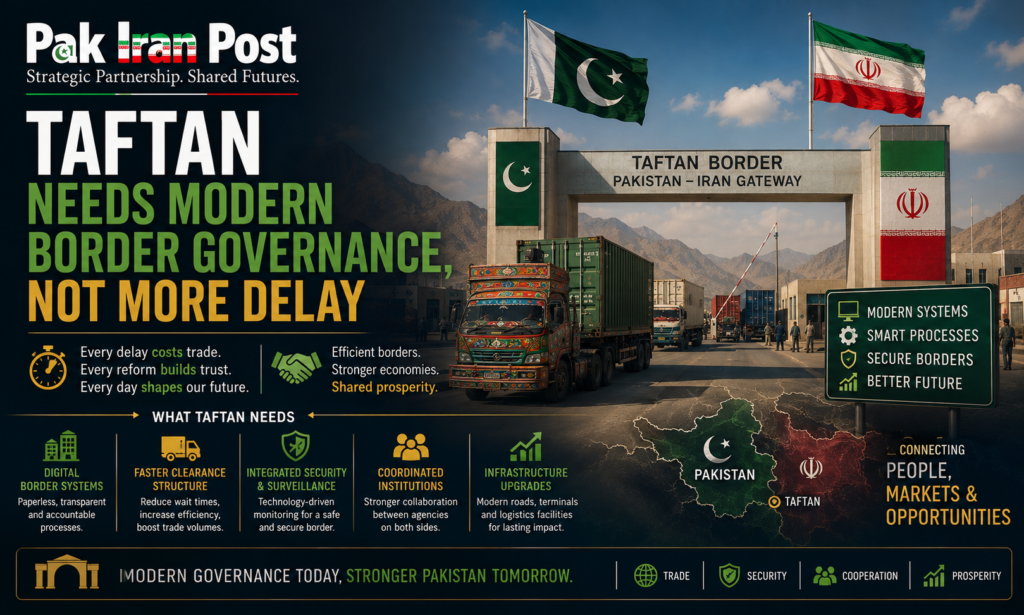
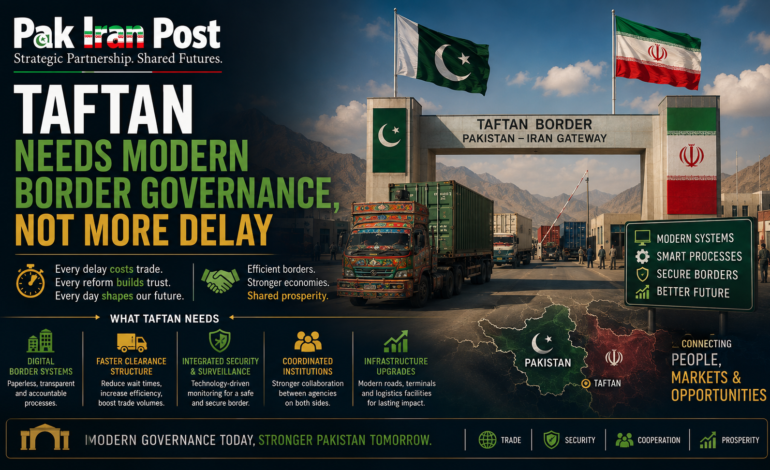
Pak Iran Post views Taftan not as a peripheral customs gate but as a strategic state interface where security, commerce, migration, energy logistics and diplomatic signalling converge. Its underperformance is therefore more consequential than a routine administrative inconvenience. Taftan is Pakistan’s principal land gateway to Iran and has repeatedly demonstrated its importance during periods of commercial normality as well as regional instability. In March 2026, the International Organisation for Migration recorded 5,348 arrivals through the Taftan Mirjaveh crossing between March 1 and 16, representing roughly 80 percent of the recorded movement from Iran into Pakistan through the two principal land crossings monitored during that period. (Dawn) The lesson for Islamabad is uncomfortable but useful: when regional conditions deteriorate, Taftan becomes a humanitarian pressure valve; when conditions stabilise, it becomes a commercial bottleneck. A border facility carrying such strategic weight cannot continue to be governed principally through fragmented departmental routines, physical paperwork, variable inspection practices and capacity that expands only after congestion has become politically visible.
The problem is not that Taftan lacks institutions. It is that too many institutions operate sequentially where they should operate concurrently. Customs, the Federal Investigation Agency, security formations, immigration authorities, provincial administration, health officials, transport agencies, quarantine personnel and border management authorities each possess legitimate mandates, yet the traveller or truck ultimately encounters them as one state. From an operational perspective, this distinction is decisive. A trader does not experience the organisational chart of government. He experiences the total clearance time, the number of physical counters, the frequency of document duplication, the predictability of inspection, the availability of parking, the condition of access roads, the reliability of electricity and communications, and the probability that a consignment will remain immobilised overnight. A pilgrim experiences queues, sanitation, medical screening, immigration processing and security checks. An importer calculates demurrage, driver detention, vehicle utilisation and inventory uncertainty. The national economy absorbs those frictions as higher landed costs.
The strategic weakness is consequently a governance problem before it is an infrastructure problem. Islamabad has taken an important step by formally declaring the 11.75 acre Taftan Railway Station a land customs station for the loading, unloading and clearance of imported and exported goods under SRO 1055 of 2026. (Dawn) That decision should not be treated merely as another notification. It can become the institutional foundation for a genuinely integrated Taftan logistics complex if railway operations, customs clearance, cargo examination, warehousing and road freight management are designed as one system rather than as disconnected facilities. The federal government has also been discussing rehabilitation of the Quetta Taftan railway section and closer railway cooperation with Iran, including the Taftan Zahedan route. (PID) The opportunity is to make these investments mutually reinforcing. A railway customs station without digital pre arrival processing, adequate cargo yards, bonded storage and coordinated release procedures would simply create another formal facility without resolving the underlying transaction costs.
Taftan requires a border operating model built around measurable service standards. Every commercial vehicle should receive a digital transaction identity before reaching the terminal, linking the customs declaration, manifest, vehicle registration, driver credentials, transporter information, origin documentation, destination, commodity classification and applicable permits. The objective should not be to eliminate physical inspection. It should be to ensure that physical intervention is intelligence led rather than indiscriminate. Low risk consignments from compliant traders should move through a green channel with minimal intervention. Medium risk cargo should undergo targeted documentary or non intrusive examination. High risk shipments should be directed to controlled inspection facilities supported by customs intelligence and security databases. Such differentiation would permit the state to intensify scrutiny where national security requires it without imposing the same burden on every legitimate trader.
A credible target would be to reduce routine documentary clearance to less than 30 minutes after submission of a complete electronic declaration, passenger immigration processing to less than 10 minutes for compliant travellers during normal operating conditions, and physical examination of selected commercial vehicles to an average of less than 60 minutes. These should not be aspirational slogans. They should become monthly performance indicators published internally and reviewed by a joint Taftan Border Management Board. Exceptional security alerts would naturally trigger enhanced procedures, but every departure from the normal service standard should generate a recorded operational reason. This would create an auditable distinction between legitimate security escalation and administrative inefficiency.
The passenger side requires an equally fundamental redesign. Taftan has to accommodate ordinary travellers, traders, transport workers, pilgrims, students, returning Pakistani citizens and foreign nationals whose documentation may involve different risk profiles. During the 2026 regional escalation, more than 10,600 passengers entered Pakistan through Taftan between February 28 and April 8, according to FIA figures, demonstrating the facility’s role as a national contingency mechanism as well as a conventional border crossing. (The Express Tribune) A border that becomes indispensable during a crisis must possess surge capacity before the crisis occurs. Passenger processing should therefore be divided into clearly defined streams, with dedicated counters for Pakistani nationals, registered pilgrims, commercial travellers, foreign nationals and exceptional humanitarian cases. Portable processing capacity, additional biometric stations and pre positioned medical and welfare teams should be capable of activation within hours rather than days.
Health screening deserves similar institutional elevation. Border health is often treated as an auxiliary function until an outbreak or mass movement exposes its absence. Taftan should maintain a permanent health surveillance protocol integrating passenger screening, temperature and symptom assessment where epidemiologically justified, referral procedures, isolation capacity, sanitation monitoring and communicable disease reporting. The objective should be neither indiscriminate medicalisation of the border nor superficial screening. It should be rapid identification of genuine health risks without transforming ordinary movement into an unnecessarily cumbersome procedure. Health authorities should also maintain interoperable notification channels with Iranian counterparts for emerging public health concerns, particularly when large passenger movements occur.
The freight environment presents a more complicated challenge because the economics of delay are cumulative. A truck waiting at Taftan consumes fuel, driver time, vehicle depreciation and working capital while the cargo itself may face deterioration. For perishable goods, delay can convert a commercially viable transaction into a loss. For petroleum related products and other sensitive commodities, congestion can generate wider supply effects. The border therefore needs a truck appointment system that allocates arrival windows according to cargo category, risk profile and available processing capacity. Vehicles should not be permitted to accumulate indefinitely outside the controlled terminal simply because the state has no reliable method of sequencing arrivals.
A digital truck queue should be visible to authorised transport operators and customs brokers, with electronic notifications for document deficiencies, inspection allocation and release. The system should measure the time from gate arrival to registration, registration to documentary clearance, documentary clearance to examination, examination to assessment and assessment to exit. Such granular measurement would identify where the actual bottleneck lies. Without this data, every agency can claim that its own process is efficient while the border as a whole remains slow.
Warehousing is another neglected variable. Taftan cannot become a serious commercial gateway if cargo handling depends primarily on trucks standing in open areas while consignments await documentation, inspection or onward transport. The new railway customs designation provides an opportunity to establish a properly zoned logistics area containing bonded warehouses, temperature controlled storage, hazardous cargo handling facilities where legally appropriate, secure truck parking, weighbridges, examination sheds and customs controlled transit areas. Warehousing should be licensed through transparent criteria and monitored through electronic inventory systems. Cargo should retain a digital chain of custody from arrival until release or onward movement.
The integration of railway operations is particularly important because Pakistan cannot credibly discuss larger formal trade with Iran while remaining excessively dependent on road freight. The railway connection to Zahedan has strategic value precisely because it can diversify transport modes, lower unit costs for suitable commodities and provide an additional layer of resilience when road traffic is disrupted. The May 2026 discussions between Pakistan and Iran on rehabilitation of the Quetta Taftan railway section and the Taftan Zahedan route should therefore be translated into a joint implementation schedule rather than left within the conventional vocabulary of bilateral cooperation. (PID) The relevant ministries should identify track rehabilitation milestones, rolling stock requirements, signalling needs, customs interfaces, freight schedules and border handover protocols.
Taftan also needs a more sophisticated relationship between security and facilitation. Security agencies have legitimate reasons to maintain layered controls in a frontier environment exposed to smuggling, militant threats, irregular movement and geopolitical volatility. The answer is not weaker scrutiny. It is smarter scrutiny. Passenger and cargo risk assessment should draw upon verified intelligence, travel history, documentation anomalies, cargo profiles, routing information and established compliance records. Repeated physical inspection of demonstrably compliant operators can become counterproductive because it consumes the very institutional capacity required to examine genuinely suspicious movement. A risk based model allows security personnel to concentrate resources where the probability and consequence of threat are highest.
This requires a joint command architecture without undermining the statutory authority of individual agencies. A Taftan Border Management Coordination Cell should operate permanently at the site, chaired by an empowered federal official with representation from Customs, FIA, security authorities, Balochistan administration, transport and railway authorities, health officials and other relevant departments. Its function would not be to supersede legal mandates but to resolve inter agency friction, monitor throughput, manage exceptional events and maintain a single operational picture. The cell should possess authority to convene rapid decisions on congestion, humanitarian surges, security alerts, infrastructure failures and major cargo disruptions.
Federal provincial coordination is particularly important because Taftan cannot be managed exclusively from Islamabad. The federal government controls many of the core functions, yet Balochistan bears the physical, social and security consequences of border operations. Provincial authorities therefore require a defined role in transport access, local infrastructure, sanitation, health preparedness, emergency response, market regulation and community engagement. This should be institutionalised through a service level agreement specifying responsibilities rather than left to informal coordination between individual officers. The arrangement should include escalation mechanisms for unresolved operational failures and quarterly performance reviews.
The economic objective should also extend beyond the customs gate itself. Taftan needs integration with a formal border economy capable of absorbing legitimate local commerce. The persistence of informal trade cannot be addressed solely through enforcement because economic behaviour responds to prices, transaction costs, employment opportunities and accessibility. Pakistan has already expanded the number of formal crossing points with Iran, including Kohak Cheedgi and Jeerak in Panjgur, partly to channel informal activity into documented commerce and distribute pressure across the frontier. (Dawn) Taftan should therefore be positioned as a specialised high capacity commercial gateway while other crossings perform appropriately calibrated local trade and passenger functions.
The distinction matters for national security. A border economy with no efficient legal outlet creates incentives for informal networks, which subsequently become difficult to distinguish from organised smuggling structures. Formalisation works best when legality is commercially rational. Registered traders should receive predictable clearance, access to designated warehousing, transparent tariff information, electronic documentation and grievance mechanisms. Enforcement should become increasingly intelligence based as legitimate compliance expands. The state should know which operators are repeatedly compliant, which consignments deviate from established patterns and which intermediaries generate disproportionate risk.
The sanctions environment adds another layer of complexity. Pakistan’s economic engagement with Iran cannot be separated from international financial and trade restrictions. A modern Taftan system should therefore incorporate enhanced documentation, beneficial ownership screening where legally applicable, commodity classification controls, end use information and transaction records capable of supporting regulatory scrutiny. This is not merely an external compliance exercise. A transparent customs architecture protects Pakistani banks, transporters, insurers, importers and exporters from avoidable exposure while preserving legitimate bilateral commerce. The state should create a specialised compliance desk capable of advising traders before cargo reaches the border rather than discovering regulatory problems after trucks are immobilised.
The border crossing should also possess a formal contingency doctrine. Regional conflict, sudden border closures, mass return movements, fuel disruptions, cyber incidents, extreme weather and public health emergencies can rapidly alter traffic patterns. Taftan should maintain predefined operating states, ranging from normal commercial operations to heightened security and humanitarian surge conditions. Each state should specify staffing levels, inspection intensity, passenger routing, medical arrangements, communications protocols and command authority. This would prevent the recurring phenomenon in which extraordinary circumstances expose the absence of extraordinary procedures.
The performance of Taftan should ultimately be judged through a public sector dashboard rather than anecdotal claims. Core indicators should include median passenger processing time, commercial vehicle dwell time, percentage of declarations submitted electronically before arrival, percentage of cargo cleared through risk based channels, inspection duration, railway cargo throughput, warehouse utilisation, number of unresolved grievances, border closure hours, health referrals, security incidents and customs revenue per vehicle. A quarterly review should compare Taftan against designated international border management benchmarks and against its own previous performance. If clearance times deteriorate, the responsible agency should be identifiable. If infrastructure remains unused, the reason should be documented. If traders continue shifting toward informal channels, the policy response should examine transaction costs rather than simply increase enforcement.
The immediate policy priority is therefore not another ceremonial inauguration or another declaration that bilateral trade should rise. Pakistan and Iran have already accumulated enough political commitments. What Taftan lacks is operational institutionalisation. The June 2026 decision to recognise the railway station as a land customs station offers a concrete administrative opening. (Dawn) Islamabad should use it to construct a single border logistics architecture in which rail, road, customs, immigration, security, health, warehousing and digital documentation are designed around the movement of legitimate people and goods.
For Pakistan’s strategic community, the central calculation is straightforward. Taftan is simultaneously a commercial asset, a security perimeter, a humanitarian gateway and a diplomatic instrument. Its inefficiency therefore carries costs well beyond the border fence. A truck delayed at Taftan becomes a logistics cost; a pilgrim stranded at an inadequate facility becomes a consular problem; an undocumented transaction becomes a fiscal leakage; an unmanaged crowd becomes a security vulnerability; and an unreliable crossing weakens Pakistan’s credibility when Islamabad seeks greater economic engagement with Tehran. The objective should consequently be neither unrestricted movement nor bureaucratic closure. It should be controlled permeability, in which the state knows who is moving, what is moving, why it is moving, where it is going and what level of scrutiny the movement warrants.
Taftan can become that model only if Islamabad stops treating border management as a collection of departmental tasks and begins treating it as strategic infrastructure. The required reform is less about constructing another gate than about redesigning the operating system behind the gate. Digital pre clearance, risk based inspection, integrated passenger processing, bonded logistics, railway customs integration, measurable service standards, federal provincial coordination and contingency planning would convert Taftan from a place where movement is merely permitted into a gateway where movement is intelligently governed. For the Pak Iran relationship, that distinction is economically consequential and strategically indispensable.
A Public Service Message