

The Border Economy Needs Evidence, Not Enforcement Cycles

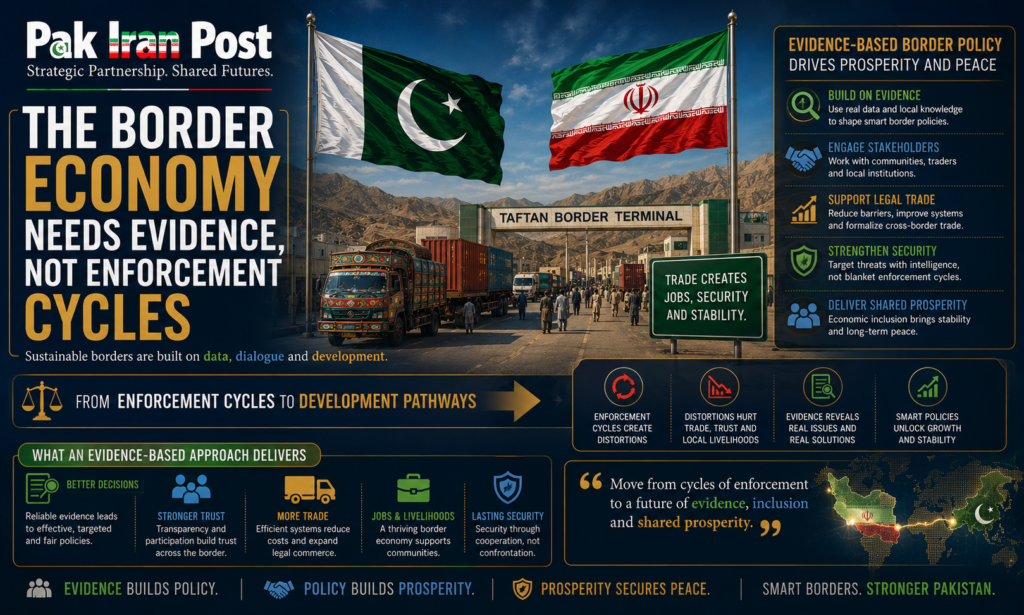
Pak Iran Post approaches the Pakistan Iran border economy as a governance problem with direct implications for fiscal sovereignty, internal security, provincial stability and the credibility of Pakistan’s wider economic engagement with its western neighbour. The recurring pattern is familiar. Restrictions tighten after an episode of revenue leakage, smuggling, security deterioration or political pressure. Commercial activity contracts, prices rise and legitimate traders seek alternative channels. Enforcement is subsequently recalibrated, exemptions appear, informal arrangements proliferate and trade partially reopens without the institutional machinery required to distinguish legitimate commerce from organised evasion. The result is neither effective regulation nor durable liberalisation. It is a policy cycle in which the state repeatedly acts on incomplete information.
The central deficiency is not simply insufficient enforcement capacity. It is the absence of an authoritative evidence architecture capable of telling policymakers what actually happens along the frontier. Pakistan does not require another periodic committee to examine border trade after a crisis. It requires a permanent Border Economy Observatory that continuously measures the composition, value, geography and social dependence of western border commerce and converts those observations into actionable decisions for customs, commerce, taxation, provincial administration and security institutions. Without such an institutional mechanism, every policy adjustment risks being driven by anecdote, political urgency, enforcement statistics or assumptions about local economic behaviour.
The western frontier cannot be administered effectively through a binary distinction between legal trade and smuggling. Border economies operate through graduated forms of commercial activity. A household may purchase limited quantities of fuel or food from across the frontier because the price differential makes formal domestic alternatives unaffordable. A small transporter may operate repeatedly without possessing the financial sophistication or documentation required by conventional commercial regulations. A larger intermediary may exploit the same informal network to move substantial consignments while disguising commercial activity as livelihood based exchange. An organised smuggling enterprise may then appropriate transport routes, storage facilities and informal payment mechanisms. These activities have different economic characteristics and should attract different regulatory responses.
The failure to distinguish them produces two symmetrical errors. Excessively permissive regulation can create a commercial sanctuary for systematic customs evasion, illicit financial flows and organised networks. Indiscriminate enforcement, by contrast, can criminalise communities whose economic survival is structurally linked to cross border commerce. Both outcomes weaken the state. The first compromises fiscal and security interests. The second generates resentment, reduces compliance and creates incentives for traders to evade official channels altogether.
A credible regime therefore begins with measurement. The Border Economy Observatory should be established as a permanent inter institutional analytical body with a statutory mandate to collect, reconcile and publish defined categories of border economic information. Its institutional location should provide sufficient authority to coordinate federal and provincial agencies without creating another autonomous bureaucracy disconnected from operational institutions. A joint governance structure involving the Ministry of Commerce, Federal Board of Revenue, Pakistan Customs, Ministry of Interior, State Bank of Pakistan, provincial authorities, law enforcement agencies and relevant intelligence institutions would allow economic and security information to be assessed within a common analytical framework.
Its mandate should not be confined to calculating trade values. The observatory should maintain a live database covering registered traders, transporters, commodity categories, transaction volumes, declared values, assessed values, market prices, freight costs, tax incidence, exchange rate movements, seizure patterns, route utilisation and household dependence on border commerce. Where commercially or operationally sensitive information is involved, access should be tiered. Strategic institutions should receive appropriate classified assessments, while aggregated economic indicators should be made publicly available to strengthen predictability and reduce arbitrary interpretation.
Price differentials should become a formal component of border policy rather than an incidental statistic. If a commodity sells substantially below its Pakistani market price immediately across the frontier, enforcement alone will not eliminate demand for it. The differential creates an economic incentive that can be suppressed temporarily but will reappear whenever enforcement pressure declines. Policymakers should therefore monitor commodity specific price gaps alongside duties, taxes, transport expenses and transaction costs. A border commodity should be considered high risk when its commercial margin is sufficiently large to compensate traders for the probability and cost of interception.
This approach would transform customs enforcement from a volume based seizure culture into a risk calibrated system. A consignment should not be considered suspicious merely because it originates from a border market. Risk should be generated through measurable indicators, including abnormal quantities, inconsistent declarations, repeated route use, unexplained valuation discrepancies, ownership concentration, unusual payment patterns and links with previously identified commercial networks. The purpose is not to weaken enforcement. It is to make enforcement more intelligent by directing institutional attention towards transactions where fiscal or security risk is demonstrably higher.
Digital trader registration should become the foundation of this architecture. Every person or enterprise seeking recurrent access to designated border markets should receive a verifiable digital trader identity linked to national identification, tax status, transport credentials and permitted commodity categories. Registration should not be designed as a punitive mechanism. Its value would depend upon creating tangible benefits for compliance. Registered traders could receive simplified documentation, predictable inspection procedures, access to designated trading facilities, digital payment channels and eligibility for transparent fiscal incentives.
Such incentives would be particularly important in communities where formalisation currently carries more costs than benefits. A trader will not voluntarily abandon an informal channel merely because the state declares it illegal. Formalisation becomes credible when the legitimate route is faster, safer and economically competitive. The policy objective should therefore be to reduce the transaction cost of compliance while increasing the expected cost of systematic evasion.
Designated border markets offer a practical laboratory for this transition. Rather than attempting to regularise every form of frontier commerce simultaneously, Pakistan could establish controlled commercial zones at selected locations where registered traders, approved commodities and defined transaction limits are brought under a transparent regulatory framework. Customs, immigration, banking, security screening and market administration should operate through an integrated platform rather than separate procedural silos. Every transaction should generate a digital record capable of supporting both revenue assessment and economic analysis.
The designated market model should initially function as a policy experiment, not as an irreversible concession. Government should establish measurable benchmarks before expansion. These should include average clearance time, compliance rate, customs revenue per transaction, documented trade volume, seizure frequency, price transmission, trader registration, digital payment adoption and reported security incidents. If a market produces greater documented commerce without corresponding deterioration in security indicators, its regulatory model could be extended. If it becomes a conduit for commercial evasion, its operating parameters should be revised.
This experimental approach would also resolve a persistent problem in border policy: governments often change regulations without establishing a baseline against which outcomes can be evaluated. A tariff reduction may increase formal imports, but policymakers need to know whether it also reduces smuggling. A new documentation requirement may improve traceability, but it may simultaneously push small traders into informal channels. A crackdown may produce impressive seizure statistics while reducing the availability of essential commodities and depressing local incomes. Without a counterfactual or baseline, officials can mistake activity for effectiveness.
The observatory should therefore develop a Border Economic Stress Index combining price divergence, household dependence, unemployment indicators, commodity shortages, transport costs, enforcement intensity and documented trade flows. The index would provide policymakers with an early warning mechanism. A sudden increase in price differentials accompanied by declining formal trade and rising household dependence should trigger a policy review before informal commerce expands into organised networks. Similarly, a sudden rise in seizures without a corresponding increase in formal trade may indicate that enforcement is displacing rather than eliminating illicit activity.
Fiscal policy must be integrated into this equation. Border trade cannot be regularised while legitimate commerce remains economically uncompetitive against informal alternatives. Duties, levies and procedural charges should therefore be assessed according to their behavioural consequences. The objective should not simply be to maximise nominal taxation on paper. It should be to maximise recoverable revenue while preserving incentives for declaration. A lower but reliably collected fiscal burden can produce greater public revenue than a theoretically higher rate that encourages systematic evasion.
The same principle applies to fuel, food and other politically sensitive commodities. Where cross border price differences are structurally embedded, Pakistan should examine controlled import arrangements, quota based access, licensed distribution and targeted fiscal treatment rather than relying exclusively on raids and road closures. Such mechanisms must remain conditional, auditable and reversible. The objective is to convert economically persistent informal activity into monitored commerce without allowing regulated channels to become camouflage for industrial scale smuggling.
Security agencies should be integrated into this architecture without allowing security imperatives to become the sole determinant of economic policy. The frontier has legitimate security vulnerabilities, including illicit movement, document fraud, weapons trafficking, narcotics networks and financing channels associated with criminal organisations. These risks require robust intelligence and enforcement. Yet the intelligence value of formal commerce should itself be recognised. A registered trader ecosystem creates identities, transaction histories, transport records and behavioural patterns. Formalisation can therefore improve security by making abnormal activity more visible.
A modern border regime should consequently operate on the principle that economic transparency is itself a security asset. Digital customs records, biometric identity verification, electronic cargo documentation, vehicle tracking where proportionate and interoperable agency databases can generate a far more sophisticated picture of frontier activity than periodic physical crackdowns. Information should flow through defined protocols between customs, immigration, taxation, provincial administration and security institutions, with clear responsibility for data quality and authorised access.
The federal government should also resist the temptation to treat Balochistan’s border districts merely as enforcement territories. Their economic dependence on cross border commerce must be incorporated into national policy design. Social protection should be available where regulatory transition temporarily reduces informal income, particularly for households demonstrably dependent on designated commodity channels. This does not mean subsidising illegal commerce. It means preventing formalisation from creating an abrupt social shock that undermines the legitimacy of the reform itself.
The observatory should publish a quarterly Border Economy Assessment for senior policymakers, with a classified annex for security institutions. The public component should disclose aggregate trade values, commodity trends, registration levels, clearance performance and fiscal outcomes. The classified component could address network structures, suspicious transaction patterns, intelligence indicators and emerging security vulnerabilities. Such separation would allow transparency without compromising operational security.
The institutional test should ultimately be straightforward. Every major border policy decision should be traceable to a measurable problem, a defined intervention and an observable outcome. If tariffs are changed, the government should know which price differential it is attempting to influence. If customs procedures are tightened, officials should specify the compliance problem being addressed. If markets are closed, the state should assess displacement effects. If exemptions are granted, their fiscal cost and beneficiaries should be identifiable. If enforcement operations expand, their impact on formal trade and organised criminal activity should be evaluated rather than inferred from seizure figures alone.
Pakistan’s western border does not need perpetual oscillation between permissiveness and prohibition. It needs institutional memory. That memory can only emerge when the state continuously records what traders move, why they move it, what households earn from it, where fiscal leakage occurs, which networks exploit regulatory weaknesses and how consumers respond to price changes. Evidence should become the bridge between commerce and enforcement.
For Pak Iran Post, the strategic proposition is therefore larger than border trade reform. A permanent evidence based border economy observatory would give Pakistan an institutional instrument for managing a frontier where economic interdependence, provincial livelihoods, fiscal interests and security imperatives intersect. It would allow Islamabad to replace episodic reaction with calibrated regulation, replace indiscriminate enforcement with differentiated risk management and replace informal discretion with measurable incentives.
The western border will never become economically governable through enforcement alone. Nor can it be stabilised through liberalisation without controls. The sustainable middle ground is a system in which legitimate commerce is deliberately made easier, organised evasion becomes progressively more difficult and every regulatory intervention generates information for the next decision. That is the architecture Pakistan requires: not a softer border, and not an indiscriminately harder one, but an intelligent border whose economic rules are continuously tested against evidence, fiscal realities and national security requirements.
A Public Service Message