
Pakistan Iran border governance needs an integrated state architecture

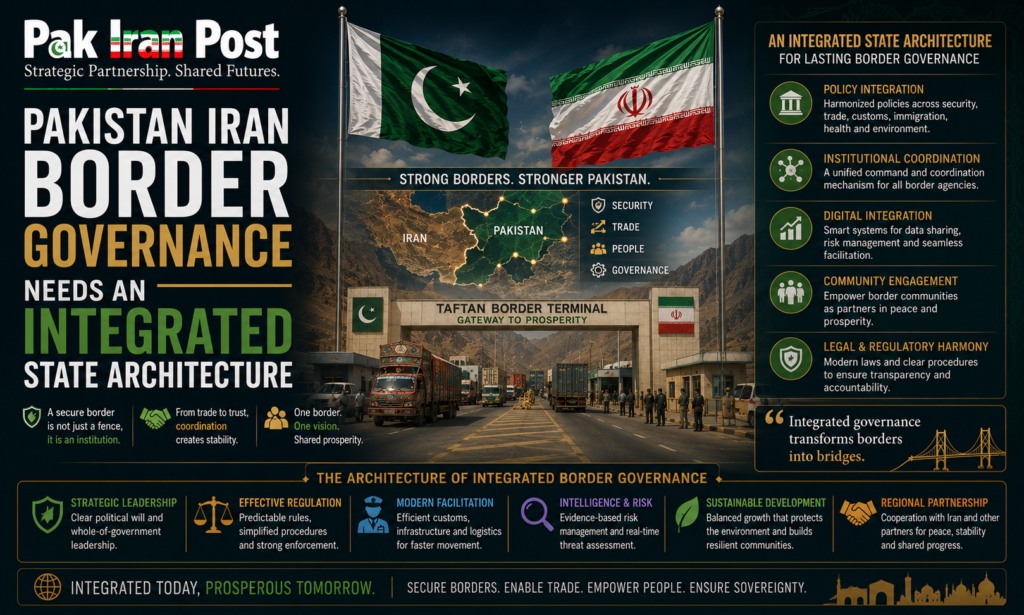
Pak Iran Post enters the border governance question at a moment when the western frontier is becoming simultaneously more consequential and more demanding. Pakistan’s boundary with Iran is no longer adequately understood as a line administered through isolated checkpoints. It is a composite governance theatre where customs, immigration, policing, intelligence, provincial administration, transport regulation, commerce, taxation and national security converge within the same physical space. Taftan illustrates the institutional problem particularly well. The Federal Investigation Agency manages immigration and passenger movement, Pakistan Customs controls the fiscal and commercial perimeter, Balochistan’s provincial institutions remain responsible for local administration and policing, while security agencies operate according to mandates that frequently extend beyond the formal customs or immigration domain. FIA itself identifies Taftan as a western border crossing under its immigration responsibilities, while its broader institutional architecture includes integrated border management and inter agency coordination mechanisms. The difficulty is therefore not the absence of institutions. It is the insufficient integration of institutions that already exist.
This distinction matters because a border can be heavily staffed and still be administratively porous. Multiple uniforms do not automatically constitute a unified border management system. When agencies possess separate databases, incompatible reporting cycles, different risk assessments and overlapping inspection authorities, the state accumulates administrative friction without necessarily acquiring greater control. A trader may encounter customs scrutiny, immigration verification, security screening, transport checks and provincial controls without any single institutional mechanism possessing a consolidated picture of the transaction, the individual, the vehicle and the cargo. Such fragmentation produces two simultaneous failures. Legitimate commerce becomes slower and more expensive, while sophisticated illicit networks learn to exploit the seams between jurisdictions.
The western frontier requires a move from agency centric administration towards a nationally governed border operating model. The federal government should establish a Pakistan Iran Border Governance Council with a permanent operational secretariat rather than another episodic coordination committee. Its mandate should cover customs, immigration, commerce, transport, provincial administration, policing, intelligence coordination, border infrastructure, health screening and emergency response. The council should not command intelligence or security agencies in matters reserved for their statutory authorities. Its function should instead be to establish common operating protocols, adjudicate jurisdictional overlaps, maintain a shared operational picture and impose measurable performance standards on agencies operating at designated crossings.
The architecture should distinguish between sovereign control and operational coordination. Customs must retain responsibility for tariff assessment, valuation, cargo declaration, examination and revenue enforcement. FIA must remain responsible for immigration control, travel documentation, human trafficking and passenger related offences. Provincial authorities must retain their constitutional and administrative responsibilities for local governance, policing and public order. Security institutions must preserve their intelligence and counterterrorism mandates. The institutional reform should therefore not be a bureaucratic merger. It should be an interoperability regime in which each agency remains legally accountable for its own function but works from a common data environment and a jointly defined operational picture.
The present direction of policy makes this reform more urgent. In June 2026, the Federal Board of Revenue formally designated the Taftan railway station as a land customs station for loading, unloading and clearance of imported and exported goods. The decision places an important rail facility more firmly inside the formal customs architecture. Yet infrastructure formalisation without institutional integration risks reproducing the same problem in a larger facility. A customs station can increase capacity, but unless immigration, transport, security and provincial administration operate through synchronised procedures, additional infrastructure may simply redistribute queues rather than eliminate them.
Pakistan’s western border also demonstrates why border governance must be treated as an economic security function. A consignment delayed for hours or days is not merely a customs inconvenience. It creates demurrage, inventory uncertainty, vehicle idling, deterioration of perishables, higher insurance exposure and incentives for informal payments. The cumulative cost ultimately enters the price structure of legal commerce. FBR has previously emphasised the need for expedited clearance at remote customs stations, including Taftan, and the use of automated systems such as WeBOC for cargo processing. The next institutional step should be to ensure that automation does not terminate at the customs interface. A cargo declaration should trigger an interoperable workflow in which relevant agencies receive only the information necessary for their statutory function, rather than forcing traders to submit substantially similar information through multiple administrative channels.
A unified border data architecture should therefore become the central reform instrument. Every commercial consignment should possess a single electronic transaction identity linked to the importer or exporter, vehicle, driver, cargo manifest, customs declaration, inspection history, security assessment and exit confirmation. Passenger movement should operate through an equivalent identity based workflow, subject to applicable privacy, security and legal safeguards. The objective should not be indiscriminate data aggregation. It should be controlled data interoperability. Agencies should access information according to role based permissions, while a central audit system records who accessed what information, when and for what operational purpose.
The architecture should incorporate a national risk engine capable of producing a common risk score before a truck reaches the inspection area. The system should draw upon customs declarations, previous discrepancies, commodity classifications, route history, vehicle records, document anomalies and legally shareable intelligence indicators. High risk consignments would receive intensified inspection. Low risk consignments with a clean compliance history should move through expedited lanes. Such a system would allow the state to become simultaneously more rigorous and less obstructive. The objective is not fewer inspections at any cost. It is fewer unnecessary inspections and more intelligence led inspections.
The distinction is crucial along the Pakistan Iran frontier because informal economic activity cannot be treated as a single criminal category. Border communities, small traders, transporters and households may depend upon cross border commerce for their livelihoods, while organised networks can exploit the same commercial ecosystem for tax evasion, contraband, narcotics trafficking, human smuggling or other illicit activity. A governance model that treats every undocumented or informal transaction as equivalent risks alienating communities whose cooperation is indispensable to border security. Conversely, excessive tolerance can create commercial structures that become difficult to dismantle once they acquire political protection. The appropriate response is calibrated enforcement based on transaction scale, repetition, beneficial ownership, financial patterns, commodity risk and evidence of organised facilitation.
The provincial dimension deserves particular attention. Balochistan cannot be treated merely as the geographical location of a federal border facility. Provincial institutions bear the consequences of congestion, undocumented movement, criminal activity, public disorder and local economic dislocation. They should therefore participate in a formal border governance compact with clearly codified responsibilities. District administration, provincial police, Levies and relevant provincial departments should have defined interfaces with federal agencies, including escalation procedures for incidents that cross from administrative matters into security threats. The present institutional tendency to resolve such questions through personal contacts among officials is fragile. A border of strategic importance requires procedures that survive transfers, postings and changes of command.
Intelligence sharing should receive an equally formal architecture. Agencies should not be required to surrender sensitive sources or operational methods to a generic database. Instead, the border should operate through a fusion mechanism capable of converting agency specific intelligence into actionable alerts. A customs officer does not need to know the origin of a sensitive intelligence lead to know that a particular vehicle requires examination. An immigration officer does not need access to an entire intelligence file to receive a lawful alert concerning a travel document or identity. This principle of minimum necessary disclosure would protect sensitive information while allowing frontline personnel to act on relevant intelligence.
The same system should introduce a unified incident command protocol. A security incident, mass passenger influx, border closure, infrastructure failure or sudden diplomatic restriction should trigger predetermined operational levels. Each level should specify which institution assumes coordination, which agencies reinforce the crossing, how passenger and cargo queues are managed, how emergency communication is activated and when the crossing can safely resume normal operations. The experience of 2026 demonstrates why this capability is not theoretical. FIA reported that more than 10,600 people entered Pakistan through Taftan between February 28 and April 8 amid regional tensions, requiring continuous immigration operations and coordination with other departments. A border system capable of absorbing sudden humanitarian or geopolitical shocks must be designed before the crisis, not improvised during it.
Performance measurement should become the mechanism that converts coordination from administrative rhetoric into institutional accountability. The federal government should establish a Pakistan Iran Border Governance Dashboard updated daily and reviewed at ministerial level every month. Its core indicators should include median passenger clearance time, median commercial vehicle clearance time, percentage of consignments cleared within prescribed service levels, customs revenue collected, detected revenue leakage, number and value of seizures, illegal movement detected, human smuggling cases, security incidents, repeat inspection rates, equipment downtime, system availability, complaints resolved, and citizen satisfaction.
The dashboard should not become another decorative presentation for official meetings. Each indicator should have an agency owner, a baseline, a target, an escalation threshold and a corrective action protocol. If clearance time rises above the defined threshold, the system should identify whether the cause is customs examination, immigration processing, security screening, documentation deficiency, infrastructure failure or another bottleneck. If revenue collection declines while cargo volume rises, the anomaly should automatically trigger a compliance review. If illegal movement increases in a particular corridor, enforcement resources should be reassigned according to evidence rather than institutional habit.
The performance regime should also distinguish security effectiveness from administrative volume. A border agency should not be rewarded simply for increasing seizures because that can create perverse incentives. Similarly, a customs station should not be judged solely by faster clearance if revenue leakage is increasing. The dashboard should therefore use balanced indicators. Security effectiveness, fiscal integrity, processing efficiency and citizen facilitation must be assessed together. A border that clears every truck in minutes but cannot detect organised smuggling is dysfunctional. A border that stops almost every truck for exhaustive examination is equally dysfunctional because it destroys legitimate commerce and encourages evasion.
There should also be an independent audit layer. The Auditor General, relevant parliamentary oversight mechanisms and internal inspection structures should periodically examine border performance against the dashboard. Procurement, fuel consumption, scanning equipment, staffing patterns, overtime, inspection records and revenue outcomes should be subjected to risk based audit. This would address a persistent governance vulnerability in remote border environments, where physical distance from federal headquarters can make institutional underperformance difficult to observe and informal arrangements difficult to challenge.
The Pakistan Iran relationship now requires precisely this administrative maturity. The restoration of trade visas at Taftan in June 2026, after a prolonged suspension, underlines the economic and social significance of maintaining predictable movement. Meanwhile, new transit arrangements and the formalisation of customs infrastructure are creating additional pressure for the border to function as a reliable commercial interface rather than a collection of disconnected checkpoints. Pakistan cannot pursue greater bilateral trade, transit activity and border formalisation while retaining a governance structure designed primarily around episodic enforcement.
The strategic objective should therefore be controlled openness. Islamabad should seek a frontier that is difficult for hostile networks to penetrate but comparatively easy for verified citizens, compliant traders and legitimate cargo to traverse. That requires institutional separation where law demands it, operational integration where efficiency requires it and intelligence fusion where national security demands it. The state should resist the temptation to create another superstructure whose principal achievement is generating meetings. What is required is a command architecture with enforceable protocols, interoperable systems, accountable officials and measurable outcomes.
For the Pakistan Iran Post, the central policy conclusion is straightforward but institutionally demanding. Border security cannot be secured by adding checkpoints to an uncoordinated system. Nor can trade be facilitated by building infrastructure without redesigning the administrative process surrounding it. The western frontier needs a unified operating doctrine in which customs, immigration, provincial administration, policing, intelligence and security institutions retain their legal mandates while functioning through one operational architecture. The measure of success should not be the number of agencies deployed at Taftan, nor the number of official meetings convened in Quetta or Islamabad. It should be whether the state knows who and what is crossing, whether legitimate movement is processed predictably, whether revenue is protected, whether organised illicit networks are identified before they exploit the border and whether citizens encounter one coherent state rather than a sequence of disconnected authorities. That is the threshold between a border that merely exists and a border that is genuinely governed.
A Public Service Message