
Between Fire and Equilibrium: Pakistan’s High-Stakes Mediation in the Iran–United States Ceasefire

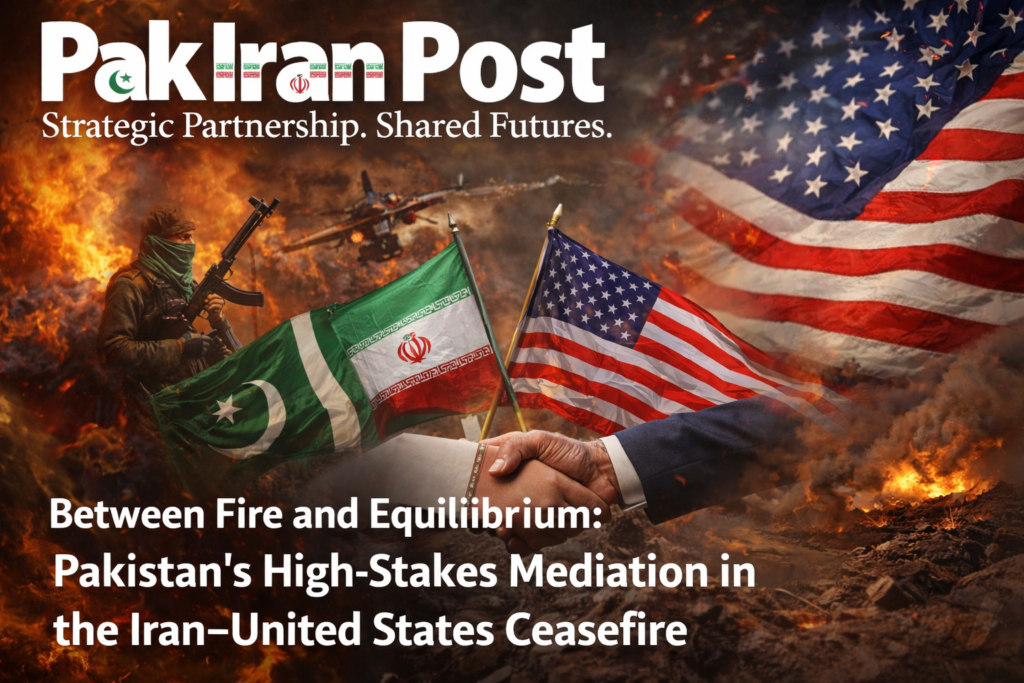
In the uneasy stillness that follows war, diplomacy often performs its most consequential work not in grand conference halls but in the interstices of mistrust, ambiguity, and calculated restraint. The fragile 2026 ceasefire between Iran and the United States is one such moment, suspended between de-escalation and relapse, where the absence of open hostilities conceals the persistence of strategic antagonism. Into this precarious equilibrium steps Pakistan, not as a principal actor but as an intermediary attempting to transform its geographic inevitability into diplomatic agency. The question is not merely whether Pakistan can mediate, but whether it can do so without being consumed by the very rivalries it seeks to manage.
Pakistan’s emergence as a mediator-state is neither accidental nor purely opportunistic; it is the product of accumulated strategic compulsions that have long defined its foreign policy behavior. Situated at the confluence of South Asia, the Middle East, and Central Asia, Pakistan has historically navigated a complex web of alliances and antagonisms, often oscillating between dependence and defiance. What distinguishes the present moment is the degree to which Islamabad appears to be consciously leveraging this positionality, seeking to convert its peripheral status into a form of negotiated centrality. Mediation, in this sense, becomes less a moral posture than a strategic instrument, a means of enhancing relevance in a geopolitical environment increasingly structured by great-power competition.
Yet mediation is an inherently paradoxical enterprise. It requires proximity without partisanship, influence without overt alignment, and credibility in the eyes of actors whose interests are fundamentally irreconcilable. For Pakistan, this balancing act is rendered particularly complex by its simultaneous entanglements with multiple, and often competing, power centers. Its longstanding security relationship with the United States, though attenuated in recent years, continues to shape its military and intelligence architecture. Its deepening economic integration with China, anchored in the China-Pakistan Economic Corridor, binds it to Beijing’s strategic vision of regional connectivity and maritime expansion. Meanwhile, its financial and ideological linkages with Saudi Arabia impose additional constraints, particularly in the context of Riyadh’s rivalry with Tehran.
To mediate between Iran and the United States under such conditions is to engage in a form of strategic tightrope walking, where each step carries the risk of misperception and backlash. Islamabad must reassure Washington that its engagement with Tehran does not signal a departure from its commitments as a security partner, even as it convinces Tehran that it is not merely acting as an extension of American influence. Simultaneously, it must calibrate its actions to avoid alienating Beijing, whose investments in Pakistan are both economically indispensable and strategically significant. The result is a foreign policy that is less about decisive alignment than about continuous adjustment, a dynamic equilibrium sustained through ambiguity and incrementalism.
This approach, often described as “strategic hedging,” reflects a broader shift in the international system, where binary alliances are increasingly supplanted by fluid, issue-specific partnerships. For Pakistan, however, hedging is not simply a choice but a necessity, imposed by the asymmetry of its capabilities and the volatility of its environment. Mediation thus becomes a mechanism for managing this asymmetry, allowing Islamabad to punch above its weight by positioning itself as an indispensable interlocutor. The very act of facilitating dialogue confers a degree of influence, even if the substantive outcomes remain beyond its control.
The immediate drivers of Pakistan’s mediatory engagement are both external and internal. Externally, the prospect of renewed conflict between Iran and the United States poses direct risks to Pakistan’s security and economic stability. Escalation could disrupt regional trade routes, exacerbate sectarian tensions, and generate refugee flows across an already porous border. Internally, Pakistan’s chronic economic fragility—characterized by balance-of-payments pressures, fiscal deficits, and dependence on external financing—creates incentives to avoid regional instability that could deter investment and strain public finances. Mediation, in this context, is as much about risk mitigation as it is about strategic ambition.
At the same time, Pakistan’s domestic political landscape complicates its external posture. The interplay between civilian leadership and military establishment, while often presented as a source of instability, also produces a form of institutional dualism that can be both an asset and a liability in mediation. On one hand, the military’s entrenched role in foreign and security policy provides continuity and credibility, particularly in dealings with actors such as Iran and the United States. On the other hand, the lack of a fully coherent civilian consensus can undermine the consistency of diplomatic messaging, creating opportunities for external actors to exploit perceived divisions.
Moreover, the success of mediation depends not only on the mediator’s intentions but also on the willingness of the parties to engage. In the case of Iran and the United States, this willingness is constrained by deep-seated mistrust, divergent strategic objectives, and domestic political considerations. For Tehran, engagement with a mediator perceived as close to Washington carries risks of internal criticism and strategic vulnerability. For Washington, reliance on a mediator with ties to Beijing and Riyadh raises questions about information security and agenda-setting. Pakistan must therefore navigate not only the substantive issues at stake but also the perceptions that shape the negotiating environment.
In this regard, Pakistan’s diplomatic strategy appears to emphasize incremental confidence-building measures rather than grand bargains. By facilitating backchannel communications, hosting discreet meetings, and providing assurances on specific issues, Islamabad seeks to create a framework within which more substantive negotiations can eventually take place. This approach aligns with the logic of “process diplomacy,” where the maintenance of dialogue is itself a form of progress, even in the absence of immediate breakthroughs. The risk, however, is that such processes can become ends in themselves, sustaining the appearance of engagement without addressing the underlying drivers of conflict.
The broader implications of Pakistan’s mediatory role extend beyond the immediate context of the Iran–United States ceasefire. If successful, it could signal a redefinition of Pakistan’s place in the international system, from a state primarily associated with security challenges to one capable of contributing to regional stability. This, in turn, could enhance its bargaining power in other domains, from economic negotiations to security partnerships. Conversely, failure—or the perception of bias—could reinforce existing narratives of unreliability, undermining its credibility and limiting its future diplomatic options.
Crucially, the sustainability of Pakistan’s mediator-state identity depends on its ability to institutionalize this role. Ad hoc interventions, while valuable in specific crises, do not by themselves constitute a durable foreign policy strategy. Institutionalization would require the development of dedicated diplomatic capacities, the cultivation of expertise in conflict resolution, and the establishment of mechanisms for coordination between civilian and military actors. It would also necessitate a degree of transparency and accountability that can enhance domestic and international confidence in Pakistan’s intentions.
At a deeper level, Pakistan’s engagement in mediation reflects an attempt to reconcile two competing imperatives: the pursuit of strategic autonomy and the reality of structural dependence. Autonomy, in this context, does not imply isolation or neutrality, but rather the ability to make independent decisions within a constrained environment. Mediation offers a pathway toward such autonomy by enabling Pakistan to shape, rather than merely react to, regional dynamics. Yet this pathway is inherently contingent, subject to the shifting calculations of more powerful actors and the unpredictable evolution of the conflicts it seeks to manage.
The interplay between Saudi Arabia, China, and the United States further complicates this equation. Riyadh’s strategic rivalry with Tehran places implicit limits on how far Pakistan can go in engaging with Iran without jeopardizing its relationship with the Kingdom. China’s growing presence in the region, while providing economic opportunities, also introduces new expectations regarding Pakistan’s alignment with Beijing’s strategic objectives. The United States, despite its relative retrenchment, remains a critical security partner whose perceptions of Pakistan’s reliability continue to influence bilateral relations. Navigating these overlapping alignments requires a level of diplomatic sophistication that few states have consistently demonstrated.
In practical terms, this means that Pakistan’s mediation is likely to remain calibrated and cautious, avoiding bold initiatives that could provoke backlash while seeking incremental gains that reinforce its relevance. Such an approach may lack the drama of high-profile summits or sweeping agreements, but it is arguably better suited to the realities of the current geopolitical landscape, where uncertainty and fragmentation are the defining features. The challenge is to ensure that caution does not devolve into inertia, and that incrementalism does not become an excuse for inaction.
Ultimately, Pakistan’s role as a crisis mediator in the Iran–United States ceasefire is a test not only of its diplomatic capabilities but also of its strategic imagination. It requires a rethinking of traditional notions of power and influence, moving beyond the metrics of military strength and economic size to encompass the more elusive qualities of credibility, trust, and adaptability. Whether Pakistan can meet this challenge will depend on its ability to align its internal dynamics with its external ambitions, to manage its relationships with competing powers without being subsumed by them, and to sustain a vision of its role in the region that is both realistic and aspirational.
The stakes are high, not only for Pakistan but for a region in which the costs of miscalculation are measured not just in economic terms but in human lives and long-term instability. Mediation, in this context, is not a panacea, but it is a necessary component of any effort to prevent the recurrence of conflict. For Pakistan, it represents an opportunity to redefine itself, to move from the margins to the center of regional diplomacy, and to demonstrate that even in a world of great-power rivalry, there remains space for states that can bridge divides rather than deepen them.
A Public Service Message


