
Between Riyadh and Tehran: The Illusion and Necessity of Pakistan’s Neutrality in a Polarised Middle East

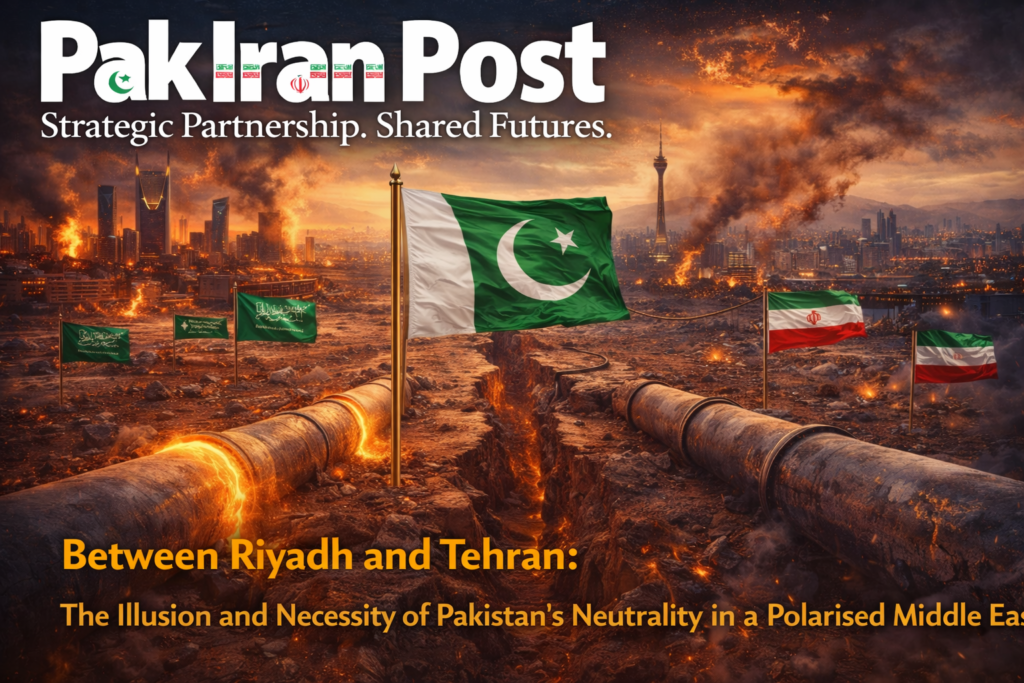
In the shifting geometry of Middle Eastern geopolitics, few states embody strategic ambivalence as acutely as Pakistan, whose foreign policy in the 2026 crisis reveals a delicate, almost paradoxical attempt to sustain neutrality between Iran and Saudi Arabia, two rival poles whose contest is at once ideological, geopolitical and deeply structural. The premise of neutrality, often articulated in official communiqués as a principled commitment to regional stability, appears at first glance to offer Islamabad a viable path through the intensifying crisis. Yet upon closer examination, neutrality emerges less as a coherent doctrine and more as a contingent improvisation, constrained by asymmetrical dependencies and competing strategic imperatives that render it inherently fragile, if not fundamentally contradictory.
Pakistan’s historical alignment with Saudi Arabia is neither incidental nor easily reversible. It is rooted in decades of financial interdependence, military cooperation and religious affinity. Riyadh has repeatedly functioned as an economic stabilizer for Pakistan during periods of fiscal distress, providing concessional oil, deposits in central banks and diplomatic backing in international forums. The Pakistani diaspora in Saudi Arabia constitutes a vital source of remittances, embedding the relationship within the socio-economic fabric of the state. These structural linkages produce a gravitational pull that makes any notion of strict neutrality with respect to Saudi interests exceedingly difficult to sustain in practice.
Conversely, Pakistan’s relationship with Iran is shaped by the logic of geography and the imperatives of coexistence. The two states share a long and porous border, where security challenges such as insurgency, smuggling and militant activity necessitate continuous coordination. Iran’s position as an energy-rich neighbor offers Pakistan a potential avenue for alleviating its chronic energy shortages, particularly through projects such as the long-stalled gas pipeline. Moreover, Iran’s influence in regional theatres, including Afghanistan and the broader Persian Gulf, ensures that antagonizing Tehran would carry significant strategic costs for Islamabad.
The 2026 crisis has amplified these tensions by forcing Pakistan to navigate an increasingly polarized regional environment in which the space for ambiguity is narrowing. Statements of neutrality are scrutinized for implicit bias, and even minor policy gestures are interpreted through the prism of alignment. Pakistan’s participation in multilateral forums, its voting patterns in international organizations and its bilateral engagements are all subject to intense geopolitical signaling, where silence itself becomes a form of communication.
Neutrality, therefore, is not merely a policy choice but a performative act that must be continuously enacted and recalibrated. It requires Pakistan to engage in what might be described as strategic equivocation, maintaining sufficient distance from both Tehran and Riyadh to avoid entanglement, while remaining sufficiently engaged to preserve its interests. This balancing act is further complicated by the asymmetry between the two relationships. Saudi Arabia’s economic leverage and its role in Pakistan’s financial stability far exceed Iran’s capacity to exert influence, particularly under the weight of international sanctions. This asymmetry creates an inherent bias within Pakistan’s neutrality, rendering it more susceptible to Saudi preferences even as it seeks to maintain a façade of equidistance.
The contradictions of neutrality are not confined to the external domain. They are deeply intertwined with Pakistan’s domestic socio-political landscape, where sectarian dynamics mirror the broader Iran–Saudi rivalry. Any perceived tilt towards one side risks exacerbating internal divisions, transforming an external balancing act into a domestic security challenge. The state’s commitment to neutrality is thus partly driven by the imperative of maintaining internal cohesion, even as external pressures push it towards alignment.
The involvement of external powers further complicates the equation. The strategic interests of the United States and China intersect with the Iran–Saudi rivalry in ways that constrain Pakistan’s autonomy. Washington’s longstanding partnership with Saudi Arabia and its adversarial relationship with Iran create expectations that Pakistan align more closely with the Saudi position. Meanwhile, China’s emphasis on regional stability and its growing ties with Iran introduce a countervailing influence, encouraging Pakistan to maintain balanced relations. Caught between these competing pressures, Pakistan’s neutrality becomes a site of negotiation not only between regional actors but also between global powers.
The sustainability of neutrality, therefore, hinges on Pakistan’s ability to manage these intersecting pressures without succumbing to them. This requires a level of diplomatic agility that is difficult to maintain over extended periods, particularly in a rapidly evolving crisis. Neutrality must be constantly redefined in response to shifting circumstances, making it less a stable equilibrium and more a dynamic process. The risk is that this process may eventually reach a point where the contradictions become untenable, forcing Pakistan to make choices that it has thus far sought to avoid.
Yet despite its inherent contradictions, neutrality remains the least costly option available to Pakistan. Alignment with either Iran or Saudi Arabia would entail significant trade-offs, potentially jeopardizing economic stability, security cooperation and domestic cohesion. Neutrality, for all its fragility, offers a means of preserving strategic flexibility and avoiding irreversible commitments. It allows Pakistan to navigate the crisis without becoming a direct participant, maintaining its role as a peripheral yet relevant actor in the regional order.
In this sense, neutrality is both an illusion and a necessity. It is illusory insofar as it masks underlying asymmetries and implicit alignments, creating an appearance of balance that is not fully borne out in practice. Yet it is necessary because it provides a framework within which Pakistan can manage its competing interests without precipitating a crisis of its own. The challenge for Islamabad is not to achieve perfect neutrality, which may be unattainable, but to sustain a workable approximation of it, one that minimizes risks while preserving room for maneuvers.
As the 2026 crisis continues to unfold, the limits of this approach will become increasingly apparent. The intensification of regional rivalries, the involvement of external powers and the pressures of domestic politics will all test the resilience of Pakistan’s balancing act. Whether neutrality can be sustained will depend not only on Pakistan’s diplomatic skill but also on the broader trajectory of the crisis itself. If tensions continue to escalate, the space for neutrality may shrink to the point where it is no longer viable, forcing Pakistan to confront the very choices it has sought to defer.
For now, however, neutrality endures as a pragmatic, if imperfect, strategy, reflecting the complex realities of Pakistan’s geopolitical environment. It is a strategy defined not by clarity but by ambiguity, not by stability but by constant adjustment. In a region where alliances are fluid and rivalries are entrenched, such ambiguity may be less a weakness than a form of resilience, enabling Pakistan to navigate a landscape where certainty is a luxury it cannot afford.
A Public Service Message