
Middle Power Exhaustion Strategic Rebalancing Pakistan Iran Trajectory

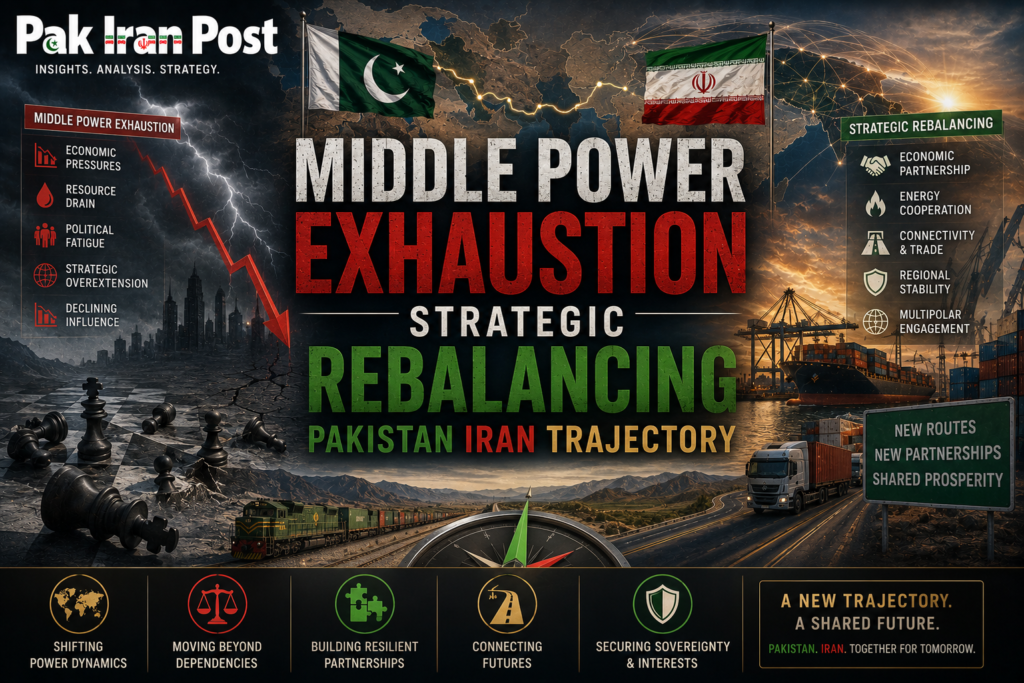
The evolving condition of regional geopolitics is increasingly revealing a structural fatigue among middle powers, where prolonged exposure to external volatility, fiscal constraint, and security entanglement has produced a measurable decline in strategic elasticity. Pakistan and Iran, situated at the intersection of competing regional architectures and global governance pressures, exemplify this phenomenon of strategic exhaustion, in which the capacity to simultaneously absorb shocks, sustain external commitments, and maintain internal cohesion is becoming progressively constrained.
This exhaustion is not episodic but systemic. It emerges from cumulative cycles of economic stress, repeated diplomatic recalibration, and persistent exposure to asymmetric geopolitical pressures. For both states, the burden of continuous adaptation has begun to exceed the institutional bandwidth available for long term strategic planning, resulting in a shift from ambition driven policy orientation to containment driven pragmatism. In this recalibrated environment, the primary objective is no longer expansion of influence but preservation of stability under conditions of constrained choice architecture.
Pakistan’s strategic posture is shaped by recurring engagement with multilateral financial regimes, particularly through International Monetary Fund conditionalities that embed structural reform imperatives into domestic fiscal governance. These engagements, while providing short term macroeconomic stabilization, also generate long term policy rigidity by narrowing the discretionary space available to domestic economic planners. Energy taxation reform, subsidy rationalization, and public expenditure consolidation, while economically rational within global financial orthodoxy, introduce significant political sensitivity within domestic constituencies that are already experiencing inflationary pressure and income volatility.
Iran, operating under prolonged sanction induced financial fragmentation, confronts a parallel but distinct form of exhaustion. Restricted access to global financial systems has necessitated the development of alternative economic circuits, often characterized by opacity, transactional asymmetry, and heightened exposure to secondary volatility. While these mechanisms provide functional resilience, they also impose structural inefficiencies that limit long term growth potential and complicate integration into broader regional economic frameworks.
In both cases, the concept of strategic depth is undergoing reinterpretation. Traditionally associated with territorial buffer zones and military deterrence architecture, strategic depth is now increasingly understood in economic and institutional terms, encompassing fiscal resilience, energy security diversification, and supply chain redundancy. However, the accumulation of multiple overlapping vulnerabilities across these domains has produced what may be described as compressed strategic depth, wherein buffers exist in theory but are constrained in operational practice.
The recalibration underway in both Pakistan and Iran reflects an implicit recognition of this constraint. Policy behavior increasingly exhibits characteristics of risk minimization rather than opportunity maximization. Diplomatic engagements are more selective, economic initiatives more incremental, and security postures more calibrated to avoid escalation rather than to achieve decisive advantage. This shift does not indicate strategic retreat but rather adaptive contraction in response to environmental overextension.
A critical dimension of this exhaustion is its domestic manifestation. Internal political economies are increasingly shaped by external constraint transmission mechanisms, where global financial conditions, energy pricing regimes, and trade access limitations directly influence domestic political stability. The resulting feedback loop between external constraint and internal legitimacy creates a fragile equilibrium in which policy misalignment can rapidly translate into social and political volatility.
Within this context, the role of international institutions, particularly the United Nations system and multilateral financial organizations, becomes structurally significant. While these institutions do not operate as direct coercive actors, their normative frameworks, reporting mechanisms, and conditional engagement structures generate powerful incentive environments that shape domestic policy trajectories. For Pakistan, alignment with these frameworks is often a prerequisite for macroeconomic stabilization. For Iran, partial engagement remains contingent upon geopolitical recalibration and sanctions relief pathways. In both cases, institutional engagement functions as both stabilizer and constraint.
The energy sector represents the most acute convergence point of these pressures. Energy pricing reforms, subsidy reductions, and taxation restructuring are increasingly positioned as necessary adjustments within global sustainability and fiscal discipline frameworks. However, within domestic political economies, energy remains a highly sensitive social contract variable. Any rapid adjustment in pricing structures risks triggering disproportionate social reaction, thereby complicating the implementation of externally influenced reform agendas. This creates a structural tension between macroeconomic necessity and micro political feasibility.
Strategically, both Pakistan and Iran are therefore compelled to pursue a form of managed contraction, wherein engagement with external systems is maintained but carefully bounded. This involves selective integration into global economic circuits, calibrated participation in regional connectivity initiatives, and cautious expansion of bilateral frameworks that do not overexpose domestic systems to external volatility. The objective is not decoupling but controlled interdependence.
However, the effectiveness of this strategy is contingent upon institutional capacity. Strategic exhaustion is exacerbated not only by external pressure but also by internal governance limitations, including bureaucratic fragmentation, policy discontinuity, and uneven implementation capacity. Without institutional strengthening, adaptive strategies risk remaining declarative rather than operational.
Another dimension of middle power exhaustion is informational overload. The acceleration of geopolitical communication cycles has significantly reduced the time available for policy deliberation and response calibration. Governments are increasingly required to operate in a continuous reaction mode, where external developments must be addressed in real time, often without the benefit of comprehensive strategic assessment. This reduces policy coherence and increases the likelihood of fragmented decision making.
For Pakistan and Iran, this environment necessitates a rethinking of strategic temporality. Long term planning must be reintegrated into governance systems that are currently dominated by short term crisis management. This requires the development of anticipatory policy frameworks capable of simulating multiple external scenarios and embedding adaptive response mechanisms within institutional structures.
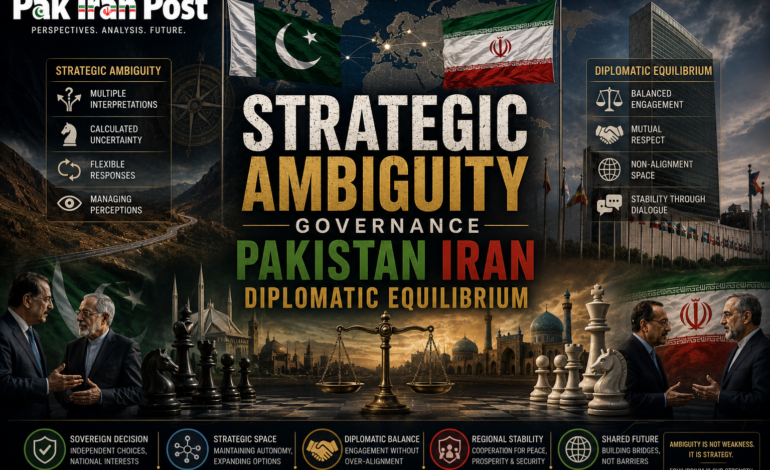
At the regional level, the concept of exhaustion also intersects with shifting alliance patterns. As global power competition intensifies, middle powers are increasingly subjected to competing alignment pressures that demand simultaneous engagement with multiple strategic blocs. This produces alignment congestion, where the cost of maintaining diversified partnerships begins to outweigh the benefits of strategic flexibility. Managing this congestion requires sophisticated diplomatic balancing and a disciplined hierarchy of national priorities.
The Pakistan Iran relationship itself can be understood within this framework as both an opportunity and a constraint. On one hand, bilateral cooperation offers pathways for energy integration, trade facilitation, and regional connectivity that could partially offset external vulnerabilities. On the other hand, the effectiveness of this cooperation is conditioned by broader geopolitical alignments and external regulatory environments that limit the scope of autonomous regional integration.
Policy recommendations emerging from this analysis emphasize the necessity of transitioning from reactive adaptation to structured resilience. This includes strengthening fiscal institutions, diversifying energy portfolios, enhancing regulatory predictability, and investing in institutional coherence. It also requires embedding strategic foresight capabilities within government structures to anticipate external shocks rather than merely respond to them.
Equally important is the need to reframe sovereignty in functional terms. Sovereignty in the current global environment is less about absolute autonomy and more about the capacity to negotiate constraints without systemic breakdown. For Pakistan and Iran, this implies accepting the reality of interdependence while maximizing the degree of policy discretion within that framework.
In conclusion, middle power exhaustion is not a terminal condition but a transitional phase in which existing models of statecraft are being tested against new structural realities. The trajectory of Pakistan and Iran will depend on their ability to transform exhaustion into recalibration, constraint into discipline, and vulnerability into institutional learning. The strategic challenge is not to escape the constraints of the global system but to operate within them with sufficient coherence, flexibility, and foresight to preserve long term stability and regional relevance.
A Public Service Message