
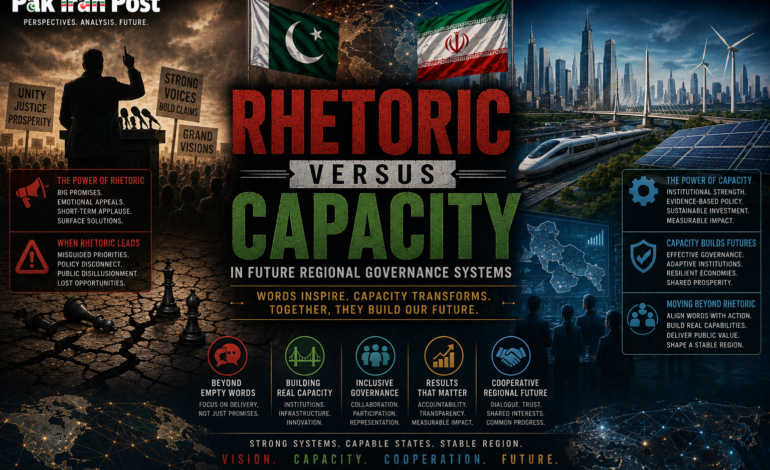
Rhetoric Versus Capacity I n Future Regional Governance Systems

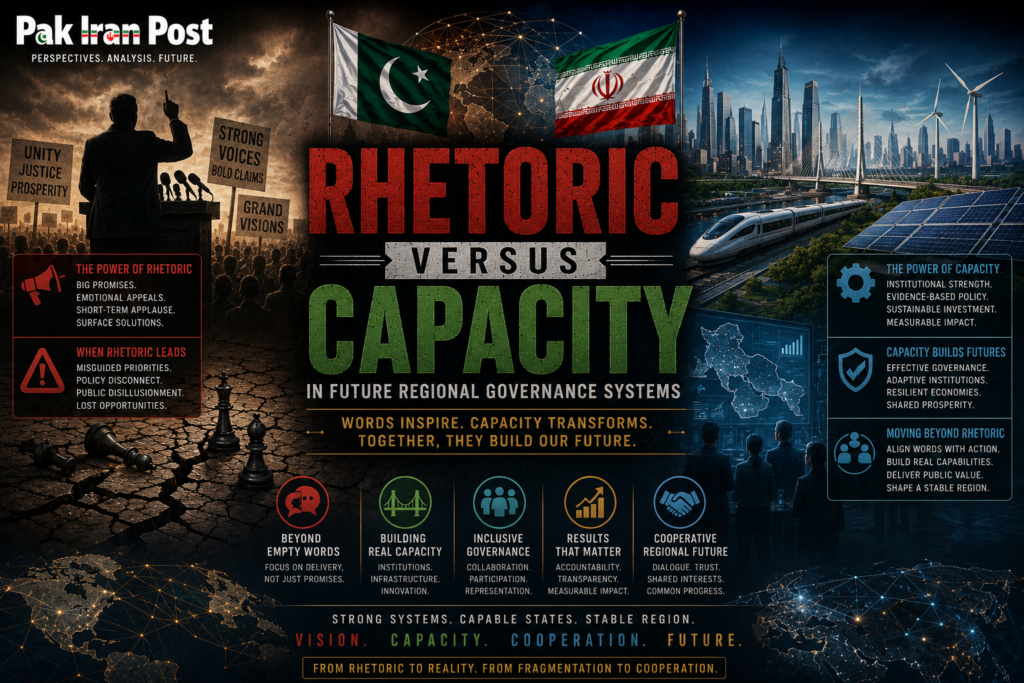
In the evolving grammar of statecraft across South Asia and the broader Middle Eastern strategic arc, a quiet but decisive shift is underway in how governance success is evaluated, articulated, and ultimately legitimised. The historical dominance of political rhetoric, symbolic sovereignty assertions, and declaratory policy narratives is increasingly being challenged by a more demanding metric of state performance, one rooted in measurable administrative capacity, institutional coordination efficiency, and adaptive crisis management capability. This transition is neither abrupt nor formally acknowledged in policy discourse, yet it is structurally visible in the changing expectations of international financial institutions, regional security architectures, and domestic populations increasingly exposed to comparative governance benchmarks through digital information flows.
For states such as Pakistan and Iran, this emerging evaluative order introduces a fundamental reconfiguration of legitimacy logic. Political rhetoric, once sufficient to consolidate internal cohesion or external signalling, now operates in a diminished capacity unless it is substantiated by demonstrable governance outcomes. The discourse of sovereignty, resistance, reform, or development carries reduced persuasive power if it is not matched by fiscal stability, service delivery efficiency, and crisis response credibility. In this sense, rhetoric is no longer an autonomous source of legitimacy but a derivative function of institutional performance.
This shift is particularly evident in the domain of economic governance, where external stakeholders, including multilateral financial institutions such as the International Monetary Fund, increasingly condition engagement not merely on policy commitments but on implementation verifiability. Energy taxation reforms, subsidy rationalisation, and fiscal consolidation frameworks are assessed less by their rhetorical justification and more by their execution consistency. In such an environment, declaratory policy announcements without administrative follow-through generate not confidence but scepticism, often translating into higher risk premiums and reduced fiscal flexibility.
At the domestic level, the rise of digital information ecosystems has fundamentally altered the speed at which governance performance is evaluated. Citizens no longer experience policy as a delayed outcome of bureaucratic processes; they encounter it in real time through inflationary prices, energy availability, employment conditions, and public service delivery metrics that are immediately circulated through social media networks. This compression of perception time reduces the space available for rhetorical mediation between policy intent and lived experience. As a result, the gap between narrative and reality becomes more visible, more immediate, and more politically consequential.
Within establishment-level policy thinking, this transformation introduces a strategic dilemma. On one hand, political rhetoric remains an essential instrument of cohesion, particularly in environments marked by external pressure, economic volatility, and security uncertainty. On the other hand, overreliance on narrative framing without corresponding institutional delivery risks producing what analysts describe as credibility decay, a gradual erosion of trust in state capacity that is difficult to reverse once established. The challenge is therefore not the abandonment of rhetoric but its recalibration within a framework of performance accountability.
Central to this recalibration is the concept of state capacity, which increasingly functions as the primary determinant of governance legitimacy in international policy discourse. State capacity is no longer understood solely in terms of coercive strength or administrative size, but as the ability to design, coordinate, and execute policy under conditions of complexity and constraint. This includes fiscal discipline, inter-agency coordination, data-driven decision-making, and crisis adaptability. In this framework, capacity becomes the operational substrate upon which legitimacy is constructed.
Pakistan and Iran both operate within environments where capacity constraints are structurally embedded. Fiscal limitations, bureaucratic fragmentation, political turnover, and external economic pressures collectively constrain the ability of the state to translate policy into consistent outcomes. However, the divergence between rhetorical ambition and administrative execution often amplifies public disillusionment, particularly when reform agendas are articulated in high-level strategic language but encounter implementation bottlenecks at lower administrative tiers.
In Pakistan’s case, recurring cycles of economic stabilisation programmes, often negotiated under IMF frameworks, illustrate the tension between rhetorical commitment and institutional execution. While reform narratives emphasise structural transformation, export-led growth, and fiscal sustainability, implementation frequently encounters institutional resistance, capacity deficits, and coordination inefficiencies. The resulting policy lag undermines both domestic credibility and external confidence, reinforcing a cycle of repeated stabilisation rather than sustained transformation.
Iran’s governance landscape reflects a different but equally complex dynamic, where ideological rhetoric, strategic resistance narratives, and sovereignty discourse operate alongside a parallel administrative system shaped by sanctions-induced economic adaptation. While rhetorical coherence remains strong, particularly in external geopolitical positioning, internal economic governance faces structural inefficiencies arising from fragmented financial systems, dual-track economic structures, and constrained integration with global markets. This creates a divergence between strategic narrative strength and economic execution capacity.
The emerging global governance environment suggests that this imbalance between rhetoric and capacity is becoming increasingly untenable. International investors, development institutions, and even strategic partners are progressively prioritising governance predictability over political narrative alignment. In other words, the ability of a state to reliably implement policy is becoming more valuable than the ideological framing of that policy.
Cyber-enabled transparency further intensifies this shift. Governance failures, administrative delays, and policy inconsistencies are no longer contained within institutional boundaries; they are rapidly exposed, interpreted, and amplified through digital ecosystems. This creates a continuous feedback loop in which governance performance is permanently visible, reducing the temporal buffer that previously allowed states to manage narrative expectations independently of immediate outcomes.
The strategic implication for regional policymakers is profound. Future governance success will depend less on rhetorical sophistication and more on the construction of resilient institutional architectures capable of sustaining performance under stress. This requires investment in administrative professionalisation, digital governance integration, inter-agency coordination systems, and long-term policy continuity frameworks that reduce dependency on individual leadership cycles.
Establishment-level concerns in this context increasingly revolve around systemic stability rather than narrative coherence alone. The key question is no longer how convincingly a state articulates its strategic vision, but how consistently it can execute that vision across economic cycles, political transitions, and external shocks. This shift reflects a deeper transformation in the logic of governance evaluation, where performance has become the primary currency of legitimacy.
At a structural level, this evolution signals the gradual emergence of a post-rhetorical governance order. In such an order, political narratives remain important but are subordinated to institutional functionality. Sovereignty is no longer demonstrated through declaratory assertion alone but through the capacity to manage complex interdependencies, absorb shocks, and maintain continuity of service delivery under constraint.
For Pakistan and Iran, navigating this transition will require a fundamental rebalancing of governance priorities. Rhetorical coherence must be anchored in institutional capability, and strategic ambition must be matched by administrative feasibility. Without this alignment, the gap between narrative and capacity will continue to widen, producing recurring cycles of reform disappointment, credibility erosion, and policy instability.
In conclusion, the future of governance in the region will not be determined by the volume or sophistication of political rhetoric, but by the depth and resilience of state capacity. In an environment defined by economic pressure, digital scrutiny, and geopolitical uncertainty, the ability to convert narrative into execution will define the boundaries of legitimacy. States that fail to make this transition risk entering a condition of perpetual rhetorical inflation, where promises expand faster than institutional capability, ultimately undermining the very foundations of governance authority.
A Public Service Message