
Pakistan Between Tehran, Riyadh, Beijing and Washington

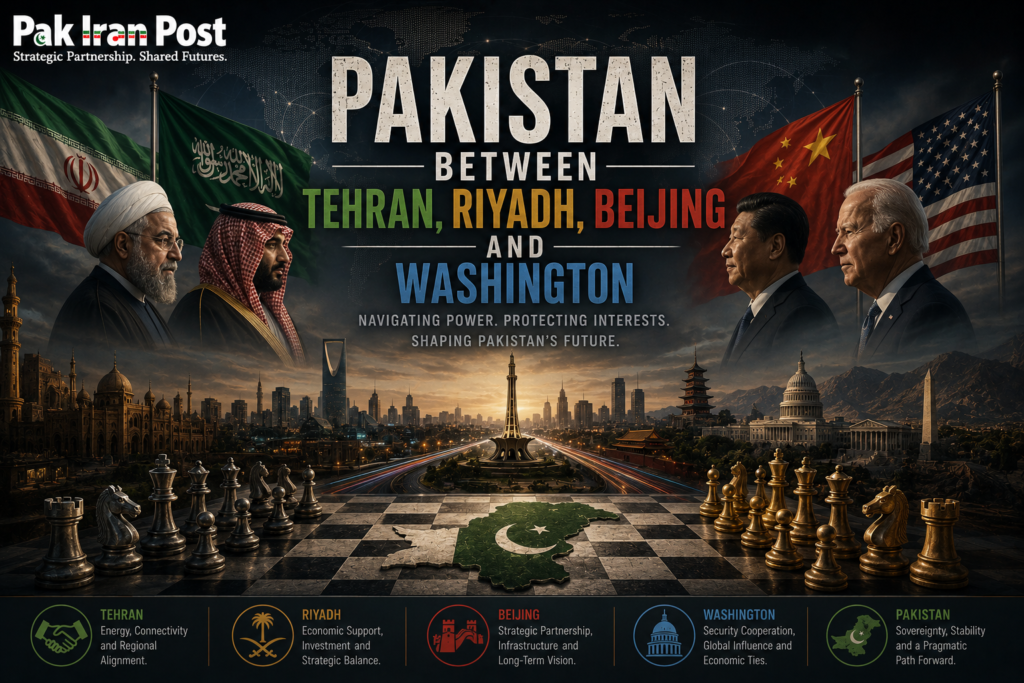
Pakistan’s Iran policy has always rested on a difficult proposition: that geography compels engagement with Tehran, economics requires accommodation with the Gulf, security prudence demands a working relationship with Washington, and long-term strategic insurance lies with China. For years, Islamabad managed these contradictions through calibrated ambiguity. It did not align with Iran, but it did not isolate it either. It did not sever strategic intimacy with Saudi Arabia and the wider Gulf, but it also avoided becoming a frontline party to Gulf-Iran rivalry. It preserved a transactional security relationship with the United States while shifting its structural defence and infrastructure dependence toward China. That balancing act was never elegant, but it was serviceable because the regional environment still allowed room for compartmentalisation. The post-conflict order around Iran may now narrow that room. If Tehran emerges from war and coercive bargaining with a more securitised governing structure and greater internal weight for the Islamic Revolutionary Guard Corps, Pakistan will face a sharper version of a problem it has long deferred: whether it possesses a coherent doctrine for dealing with a militarised Iran without destabilising its ties with Saudi Arabia, the United Arab Emirates, China and the United States.
The answer, at present, is that Pakistan has a pattern of improvisation, not yet a doctrine. It has instincts, habits and tactical reflexes; it does not yet have a clearly articulated strategic framework capable of surviving a region in which alignments are hardening and ambiguity is losing protective value. That distinction matters. Improvisation can manage episodes. Doctrine is required to manage eras. The emerging regional landscape increasingly resembles the latter. Iran’s confrontation with Israel and the United States, the growing prominence of military-security actors inside Tehran, the recalibration of Gulf threat perceptions, China’s desire to protect its economic footprint without assuming direct security burdens, and Washington’s continued interest in selective regional partnerships have together created a Middle East in which Pakistan is relevant, but also more exposed.
Islamabad’s old formula worked because each relationship could be ring-fenced to some degree. Saudi Arabia and the Gulf underwrote remittances, budgetary breathing space, oil facilities and political cover. Iran offered border management, limited electricity trade, symbolic neighbourhood diplomacy and a latent energy option that remained more valuable as possibility than as reality. China provided strategic ballast, infrastructure finance, military technology and diplomatic shielding in multilateral forums. The United States, despite recurring mistrust, remained important for financial signalling, military dialogue, counterterrorism coordination and access to Western institutions that still influence Pakistan’s macroeconomic room for manoeuvre. Pakistan’s foreign policy establishment became adept at ensuring that none of these relationships collapsed, even if none of them fully matured. The problem now is that a more militarised Iran may make compartmentalisation harder, because the costs of engagement and the consequences of distance are both rising at the same time.
A Pakistan policy toward Iran cannot be built on sentiment, religious rhetoric or anti-Western reflexes. It must begin from hard structural facts. Iran is a neighbouring state with which Pakistan shares a long border, overlapping Baloch vulnerabilities, energy complementarities and a direct exposure to regional war spillover. No Pakistani government, civil or military, can afford an adversarial Iran on its western flank while Afghanistan remains unstable and India remains the primary conventional concern in the east. At the same time, Pakistan cannot afford an Iran policy that jeopardises its ties with Saudi Arabia and the Gulf monarchies that host millions of Pakistani workers, provide oil on deferred terms, inject emergency deposits into Pakistan’s central bank and remain central to Pakistan’s financial survival. Nor can Islamabad pursue Iran engagement in a way that triggers punitive friction with Washington at a time when Pakistan still requires Western market access, IMF-linked confidence and a minimum of security cooperation. China complicates the picture further, not because Beijing opposes Pakistan-Iran ties, but because China prefers regional stability, sanctions navigability and controlled risk around corridors that matter to its own strategic investments. Pakistan is therefore not balancing abstract relationships. It is balancing distinct dependency structures, each of which can punish miscalculation differently.
The rise of the IRGC as a more central actor in post-conflict Iran changes the equation because it reduces the utility of older assumptions about Tehran’s internal balancing mechanisms. Pakistan’s policymakers have often relied on a comforting proposition: that even when Iran behaves assertively, its foreign policy is still moderated by a layered system in which clerical authority, economic constraints, diplomatic institutions and regime-survival calculations generate some restraint. That proposition may not disappear entirely, but it is weaker than before. A state in which military-security actors acquire greater weight does not necessarily become irrational. It does, however, become more likely to interpret neighbouring states through the prism of threat corridors, proxy risk, sanctions evasion, strategic signalling and deterrence credibility. That matters for Pakistan because Islamabad’s value to Tehran is double-edged. Pakistan is both a neighbour whose cooperation is necessary and a territory through which Iran may fear hostile activity, intelligence penetration, militant movement or external strategic influence.
This is where the balancing problem becomes acute. Pakistan’s diplomatic success during the recent Iran crisis, including its role in mediation and de-escalatory outreach, has enhanced its relevance across several capitals. Islamabad has demonstrated that it can still function as a useful intermediary in a fragmented region, a role noted by analysts and outside observers as the United States, Iran and Gulf actors sought channels to prevent a wider breakdown..But mediation is not the same as strategic equilibrium. Mediation works when all sides can treat Pakistan as useful without demanding exclusivity. Equilibrium becomes harder when the underlying relationships themselves grow more zero-sum. If Tehran becomes more deeply shaped by the IRGC, Riyadh and Abu Dhabi may become more suspicious of any Pakistani accommodation that appears to enlarge Iran’s resilience. Washington may tolerate Pakistan’s mediation, but not necessarily a Pakistan-Iran security intimacy that appears to dilute sanctions pressure or provide strategic cover to Tehran. China may welcome de-escalation and regional dialogue, but it will not absorb the political costs of every Pakistani gamble.
Pakistan’s difficulty is that it has historically confused non-alignment with non-choice. The two are not the same. A state can refuse formal alignment while still making disciplined choices about hierarchy, red lines and exposure. Islamabad has often preferred ambiguity because it buys short-term flexibility. But ambiguity can become strategic indiscipline if it prevents the state from ranking its interests. Pakistan does not need to choose between Iran and Saudi Arabia in civilisational or ideological terms. It does need to decide which relationships are existential, which are tactical, and which risks it is prepared to bear to preserve flexibility. Without that clarity, every crisis forces ad hoc recalibration, and ad hoc recalibration in a militarised region is a recipe for cumulative vulnerability.
The first principle of a coherent doctrine should be to separate Pakistan’s interests in Iran into three distinct baskets: frontier stability, controlled economic engagement, and regional de-escalation diplomacy. Frontier stability is non-negotiable. Pakistan must have a working security relationship with Iran irrespective of the temperature of Tehran’s ties with Washington or Riyadh. The border with Iran cannot be allowed to become hostage to Gulf politics, American pressure or domestic symbolism. Controlled economic engagement is desirable but conditional. Pakistan should trade where possible, import electricity where feasible, and keep connectivity options alive, but it should do so through sanctions-aware, transparent and limited channels that do not invite systemic punishment. Regional de-escalation diplomacy is valuable, but it should not evolve into a self-deceiving fantasy that Pakistan can indefinitely reconcile all antagonists without cost. Mediation is a tool, not an identity.
Such a doctrine would also require Pakistan to abandon the habit of treating all external relationships as morally equivalent. They are not. Saudi Arabia and the United Arab Emirates are not simply partners among many. They are pillars of Pakistan’s external financial resilience. Millions of Pakistanis work in the Gulf. Remittances from Gulf labour markets matter to Pakistan’s macroeconomic stability. Gulf capital, deposits and oil facilities have repeatedly functioned as emergency stabilisers for Islamabad. This does not mean Pakistan should subordinate its Iran policy to Gulf preferences. It does mean that any Iran strategy that ignores Gulf sensitivities is strategically unserious. Islamabad’s task is not to reassure Riyadh and Abu Dhabi that it will contain Iran on their behalf. It is to convince them that a stable Pakistan-Iran relationship serves Gulf interests by reducing the probability that regional conflict spills into a nuclear-armed Muslim state already under economic stress.
The United States presents a different challenge. Washington’s relationship with Pakistan is too shallow to be foundational, yet too consequential to be neglected. Pakistan no longer occupies the centrality in U.S. strategy that it once did during the Afghan war years, but it remains relevant to regional diplomacy, counterterrorism and crisis management. The recent conflict and Pakistan’s mediation role have reopened channels and created tactical goodwill in Washington, even as structural distrust remains. The danger for Islamabad is to overread this moment and assume that mediation translates into strategic indulgence. It does not. The United States can appreciate Pakistan’s utility in de-escalation while remaining opposed to any material Pakistani role in easing pressure on Iran’s strategic capabilities or sanctions exposure. Pakistan must therefore avoid conflating diplomatic access with policy latitude. If Tehran under stronger IRGC influence seeks denser security coordination or sanctions-circumventing economic arrangements with Islamabad, the American variable will matter immediately.
China is often presented in Pakistan as the easiest leg of the balancing triangle because Beijing maintains ties with Iran, values Pakistan, and prefers regional stability. This is only partly true. China gives Pakistan room, but not unlimited cover. Beijing’s interests are coldly pragmatic. It wants uninterrupted energy flows from the Gulf, a manageable security environment around Xinjiang and the Arabian Sea, and protection for Chinese investments in Pakistan, including infrastructure linked to the China Pakistan Economic Corridor. It is willing to support diplomacy and may welcome Pakistan’s role as a stabilising intermediary, as seen in coordinated positions and discussions during the recent Iran crisis. But China does not want Pakistan to become so entangled in Iran-related confrontation that CPEC assets, Gwadar, or Pakistan’s domestic security environment become more vulnerable. Nor does Beijing want Pakistan to trigger secondary financial instability by mishandling its relations with Gulf donors or Western institutions. China is a strategic partner, not a guarantor against self-inflicted overreach.
The most dangerous illusion available to Pakistani policymakers is that a militarised Iran can be engaged through the same vocabulary of “brotherly ties” and generic neighbourliness that often covers deeper strategic ambiguity. An IRGC-heavy Iran will likely value Pakistan, but it may value Pakistan primarily as a buffer, a channel, a sanctions-adjacent economic space, and a frontier security variable. That is not hostility; it is strategic prioritisation. Pakistan must reciprocate with equal realism. Tehran should not be treated as either a natural ally or an inevitable liability. It should be treated as a transforming security actor with whom Pakistan has unavoidable interests and unavoidable constraints. This requires institutional sobriety, not rhetorical warmth.
A workable doctrine would therefore impose several red lines. Pakistan should not allow its territory, airspace or logistics ecosystem to be used for military activity against Iran by any external actor. Equally, it should not allow its territory to become a sanctuary, facilitation route or covert operating space for anti-Iran militant or intelligence activity. These are not pro-Iran positions; they are sovereignty positions. Pakistan should maintain a clear policy that its soil will not be an instrument in anyone else’s regional war. At the same time, Islamabad must draw a second red line against any expectation, from Tehran or others, that Pakistan will materially support Iranian military posturing against Gulf states or the United States. Neutrality has to be credible in both directions. A state that bars one side from instrumentalising its territory but quietly accommodates the other destroys the very equilibrium it seeks to preserve.
This is particularly important because Pakistan’s domestic debate often oscillates between two unhelpful extremes. One camp frames Iran through ideological solidarity and anti-Western grievance, understating the costs of over-accommodation. Another frames Iran almost entirely as a sanctions problem or Gulf irritant, understating the consequences of alienating a neighbour that can complicate Pakistan’s western flank. Neither frame is adequate. The state must think not in slogans but in exposure matrices. What happens to Pakistan’s energy imports if Gulf-Iran tensions escalate? What happens to Balochistan if Iran’s southeastern security posture hardens? What happens to IMF-linked investor confidence if Pakistan is seen as facilitating sanctions leakage? What happens to Pakistani labour in the Gulf if Islamabad appears strategically unreliable? What happens to CPEC if regional conflict migrates toward the Arabian Sea? These are the questions a doctrine answers.
Pakistan’s current diplomatic habit of “strategic equilibrium” is therefore sustainable only if equilibrium is redefined. It cannot always mean equal distance from all sides. It must mean unequal but stable proximity, based on function. With Iran, Pakistan should pursue security stabilisation, border coordination and limited economic pragmatism. With Saudi Arabia and the UAE, it should deepen financial, labour, energy and defence cooperation while explaining that a stable relationship with Tehran is a buffer for Gulf security, not a betrayal of it. With the United States, it should maintain diplomatic access, intelligence dialogue and sanctions transparency, while making clear that Pakistan’s Iran engagement is defensive and neighbourhood-driven rather than revisionist. With China, it should align on de-escalation, maritime stability and infrastructure security, while avoiding the temptation to outsource hard political choices to Beijing’s umbrella.
To operationalise this, Islamabad needs institutional reform as much as rhetorical adjustment. Pakistan’s Iran file is still too dispersed across agencies with different priorities: the Foreign Office, the military, intelligence services, the petroleum bureaucracy, border management authorities and provincial actors in Balochistan. This fragmentation encourages reactive policy. A more coherent approach would place the Iran file under a formal inter-agency mechanism reporting to the National Security Committee or a dedicated national security structure, with three standing workstreams: security and border management; sanctions-compliant economic engagement; and regional diplomacy. Such a structure would allow Pakistan to model the consequences of decisions across relationships. For example, a proposed electricity import expansion from Iran should not be considered solely as an energy matter. It should be stress-tested for sanctions exposure, Gulf signalling, Chinese commercial interest and frontier stabilisation value.
Pakistan also needs a clearer language for communicating with Gulf capitals. Too often, Islamabad reassures Riyadh and Abu Dhabi privately while preserving ambiguity publicly, creating room for suspicion on all sides. A better approach would be to articulate a doctrine of “buffer diplomacy”: Pakistan’s relationship with Iran exists to prevent western-border destabilisation, reduce the risk of sectarian spillover, keep trade corridors lawful and limited, and preserve channels for de-escalation that benefit the wider region. This is not a request for Gulf permission. It is a strategic explanation of why Pakistan cannot pursue an anti-Iran policy without harming interests that are, in the end, also relevant to the Gulf. Gulf partners may not welcome every element of Pakistan-Iran contact, but they are more likely to tolerate it if Islamabad defines it as stabilisation rather than strategic tilt.
At the same time, Pakistan must resist the temptation to monetise every diplomatic success by overpromising what it can deliver. Mediation in the recent Iran conflict has raised Islamabad’s profile, and there is understandable interest in converting that into economic or geopolitical gains. But mediation capital is fragile. It can be squandered if Pakistan starts presenting itself as an indispensable bridge among all antagonists while lacking the economic resilience, bureaucratic coherence and strategic independence to sustain that role. Pakistan should use the current opening to improve access, reduce suspicion and attract pragmatic cooperation. It should not mistake a useful diplomatic moment for a permanent elevation of status.
The harder question is whether the old formula of cautious ambiguity has become too fragile. In its existing form, yes. Cautious ambiguity worked when regional actors were prepared to tolerate Pakistan’s balancing as an unavoidable feature of geography. It becomes fragile when Iran’s internal power structure shifts toward security actors, when Gulf states are reassessing the durability of de-escalation, when Washington is simultaneously engaging and pressuring Tehran, and when China wants calm but not entrapment. Under those conditions, ambiguity without hierarchy looks less like finesse and more like indecision. Pakistan therefore needs to move from ambiguity to calibrated clarity. Not alignment, but clarity. Not choosing camps, but ranking interests. Not moral grandstanding, but strategic candour.
That candour begins with a simple admission. Pakistan cannot sustain strategic equilibrium by trying to be equally useful to everyone in every theatre. It can sustain equilibrium only by being predictably limited in what it will do for each side. For Iran, Pakistan can be a neighbour, a border stabiliser, a trade interlocutor within constraints and a channel for de-escalation. It cannot be a sanctions shield or a military adjunct. For Saudi Arabia and the UAE, Pakistan can be a defence partner, labour supplier, investment destination and diplomatic interlocutor. It cannot be an instrument for anti-Iran adventurism. For the United States, Pakistan can be a mediator, a security interlocutor and a state interested in regional stability. It cannot be expected to sever functional ties with a bordering Iran. For China, Pakistan can be a strategic partner that contributes to regional calm and corridor security. It cannot assume that Beijing will rescue it from the consequences of poor balancing elsewhere.
In the end, Pakistan does still possess the ingredients for a coherent doctrine, but not yet the discipline of one. Geography gives Islamabad relevance. Its ties with the Gulf give it leverage and vulnerability in equal measure. Its relationship with China gives it strategic depth but not immunity. Its restored utility to Washington gives it access but not exemption. Its border with Iran gives it a permanent stake in preventing Tehran’s crises from becoming Pakistan’s internal emergencies. The challenge is to convert these overlapping exposures into a framework that is explicit about purpose and modest about ambition.
The purpose should be straightforward: keep the western border stable, keep Pakistan out of other states’ wars, preserve indispensable Gulf partnerships, avoid sanctions entrapment, protect Chinese-linked economic assets, maintain a functional channel with Washington, and prevent Iran policy from becoming an ideological battlefield inside Pakistan itself. If Islamabad can organise its diplomacy around those priorities, it can still sustain equilibrium even with a more militarised Iran. But that equilibrium will no longer be maintained by vague neutrality and ceremonial rhetoric. It will require a doctrine of bounded engagement: hard on sovereignty, selective in economics, disciplined in diplomacy, and unsentimental about all sides.
Pakistan does not need to abandon balance. It needs to professionalise it. In a region where diplomatic space is shrinking and security alignments are sharpening, the era of passive ambiguity is ending. The next phase will reward states that know exactly what they are balancing, what they are protecting, and what they will refuse. For Islamabad, the question is no longer whether it can talk to Tehran, Riyadh, Beijing and Washington at the same time. It can. The question is whether it can do so while making clear to each of them, and to itself, that Pakistan’s foreign policy is not a collection of parallel conversations but a hierarchy of national interests. That is the doctrine the post-conflict moment now demands.
A Public Service Message