
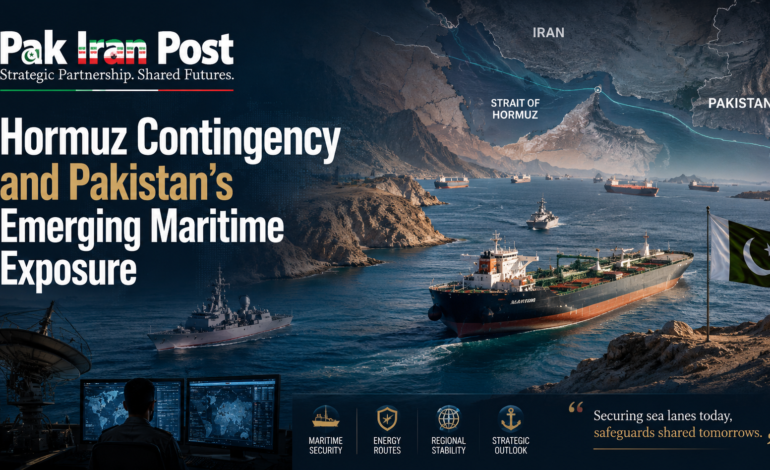
Hormuz Contingency and Pakistan’s Emerging Maritime Exposure

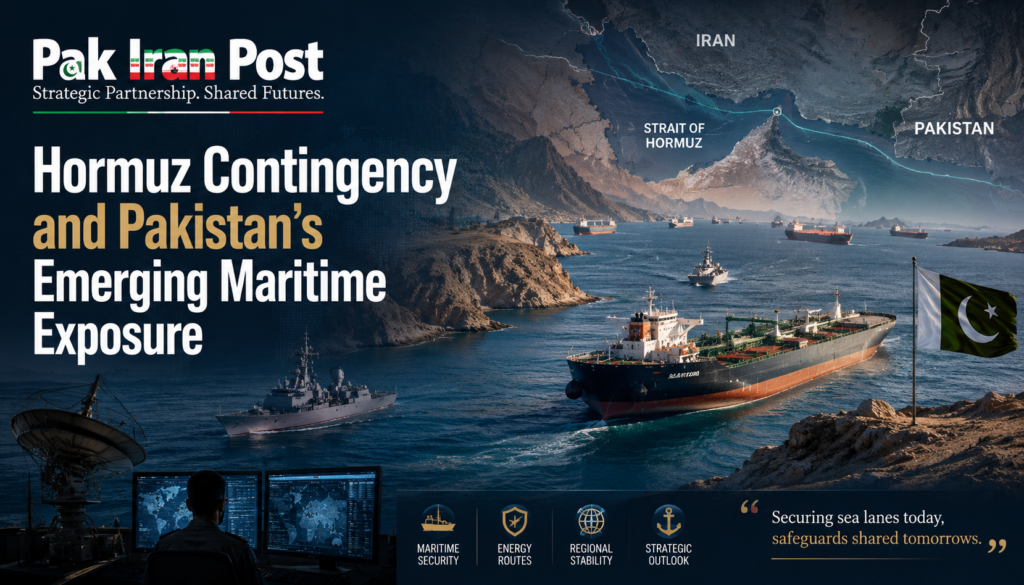
Pak Iran Post examines the Strait of Hormuz crisis not as a distant Gulf confrontation but as an expanding maritime contingency with direct implications for Pakistan’s energy security, commercial shipping, naval posture and diplomatic latitude. The assumption that Pakistan is insulated because its principal ports lie outside the Persian Gulf is becoming increasingly untenable. On August 11, shipping traffic through Hormuz fell dramatically below normal levels, while a fresh security incident involving a commercial vessel in the Gulf of Oman demonstrated that the risk envelope is moving closer to Pakistan’s maritime approaches. Reuters reported that only eight vessels were tracked through Hormuz on Tuesday, against a pre conflict norm of roughly 130 to 140 daily transits. The distinction matters. A disruption confined to the strait is an energy and logistics problem. A prolonged confrontation extending into the Gulf of Oman becomes a national security problem for Pakistan.
The immediate vulnerability is commercial rather than military. Pakistan imports a substantial proportion of its petroleum requirements by sea, and the pricing of those cargoes is determined not merely by the commodity itself but by freight, insurance, vessel availability, routing risk and financing conditions. When insurers classify a maritime theatre as progressively hazardous, the additional premium can become an invisible surcharge on every barrel, cargo and voyage. During the earlier phase of the crisis, war risk insurance premiums reportedly multiplied sharply and freight rates rose substantially, while Pakistan confronted acute uncertainty over LNG and petroleum supplies.A prolonged conflict therefore transmits itself into Pakistan through several channels simultaneously: physical availability, landed cost, delivery schedules, foreign exchange requirements, refinery utilisation, electricity generation and ultimately consumer inflation.
For policymakers, the critical error would be to treat Hormuz disruption as synonymous with complete physical scarcity. Markets can reroute cargoes, suppliers can substitute destinations, vessels can alter sailing patterns and refiners can modify crude slates. The more consequential question is whether alternative arrangements can be executed at an acceptable cost and within Pakistan’s foreign exchange constraints. A tanker diverted around a longer route does not merely arrive later. It consumes more bunker fuel, requires additional vessel days, incurs higher insurance exposure and competes for a finite pool of tankers already being absorbed by global rerouting. The state therefore needs to monitor shipping capacity as closely as it monitors crude prices.
Pakistan’s exposure is particularly sensitive because the Gulf of Oman is not an abstract maritime space. It constitutes the immediate seaward environment through which commercial vessels approach Pakistani ports from the west. Any expansion of hostile activity from Hormuz into the Gulf of Oman could complicate navigation, increase merchant shipping caution and alter the risk assessment attached to Karachi, Port Qasim and Gwadar. Pakistan Navy’s own navigational warnings already record security incidents in the Gulf of Oman, military conflict affecting the Arabian Sea and Hormuz, and instances of GNSS interference and AIS disruption. These are not merely technical maritime notices. Taken collectively, they illustrate how electronic interference, navigational uncertainty, damaged infrastructure, military activity and commercial traffic disruption can converge into a compound operating environment.
The strategic implication is that maritime domain awareness must be elevated from a naval requirement into an integrated national intelligence function. Pakistan requires a continuously updated maritime picture combining naval surveillance, commercial AIS feeds, satellite imagery, port manifests, tanker movements, insurance intelligence, ship ownership data, vessel histories and navigational warnings. The objective should not simply be to know where ships are. Islamabad needs to know which vessels are carrying strategic commodities, which insurers are willing to underwrite them, which charterers are withdrawing from particular routes, which ports are experiencing congestion, which vessels are changing flags or ownership structures, and where electronic navigation systems are being degraded.
Such an architecture would allow the state to distinguish between an apparent shortage and a logistics bottleneck. If crude is available internationally but tanker capacity is constrained, the policy response is different from a situation in which physical supply itself is contracting. If tankers are available but insurance becomes prohibitive, the government needs a different intervention. If cargoes are delayed because vessels are accumulating outside a high risk zone, port authorities need advance warning rather than waiting for berths to become congested. The absence of an integrated maritime commercial intelligence cell could turn manageable disruption into avoidable domestic instability.
The Pakistan Navy consequently faces a more complex task than conventional sea lane protection. It must preserve deterrence while avoiding operational behaviour that could inadvertently associate Pakistan with one side of a wider confrontation. Maritime surveillance should therefore be intensified without becoming unnecessarily escalatory. Merchant vessels approaching Pakistani waters should be monitored through layered surveillance, while suspicious activity, anomalous AIS behaviour, navigation interference and unusual vessel manoeuvres should receive rapid intelligence assessment. The state should also maintain secure communication channels with commercial shipping operators so that risk information can move from government agencies to shipmasters without bureaucratic delay.
The recent strike involving the Panama flagged vessel Vela Nova is particularly instructive because the incident occurred approximately 70 nautical miles from the Pakistani coast, according to reporting cited by the Wall Street Journal. Whether or not such incidents become frequent, their strategic significance lies in geography. A conflict that previously appeared concentrated around Hormuz can generate consequences within the surveillance radius of Pakistan’s western maritime approaches. That changes the calculus for naval patrol patterns, port security, offshore infrastructure protection and civil maritime preparedness.
Port security therefore requires immediate recalibration. Karachi and Port Qasim should operate under a graduated contingency system capable of increasing security screening, berth surveillance, underwater inspection and vessel verification when the regional threat level rises. Gwadar deserves separate treatment because its strategic geography makes it simultaneously a commercial asset, a maritime infrastructure node and a potential object of heightened international scrutiny. Security planning should incorporate not only conventional attack scenarios but also sabotage, cyber intrusion, spoofed navigation data, misinformation concerning port closures and attempts to exploit commercial confusion.
Electronic warfare deserves particular attention. GNSS interference and AIS disruption can create ambiguity without a single missile being fired. A vessel that appears stationary, changes its reported position or disappears from tracking systems can generate operational uncertainty for ports, naval authorities and insurers. Pakistan should therefore establish redundant navigation and communications procedures for critical shipping lanes and ports. Satellite based tracking should not become a single point of dependence. Shore based radar, electro optical systems, naval aviation, automatic identification systems and satellite data need to be fused rather than maintained as isolated technological silos.
Energy planning is the second major pillar of the contingency. The government should stop treating strategic petroleum stocks as a static volume and instead measure them against days of consumption under different disruption conditions. A national emergency inventory model should calculate separate coverage for crude, motor gasoline, high speed diesel, aviation fuel, furnace oil, LPG and LNG. The relevant question is not simply how many days of fuel Pakistan possesses today but how many days remain after accounting for refinery throughput, tanker delays, domestic demand surges and the loss of one or more import routes.
The 30 day contingency should therefore prioritise liquidity and information. The state should secure near term tanker nominations, verify cargo arrival schedules, establish daily communication between the energy ministry, petroleum companies, ports, navy, customs and foreign exchange authorities, and identify cargoes requiring priority clearance. Refiners should receive early visibility of expected crude grades so that operational adjustments can be made before inventories become critical. Foreign exchange planning should include a maritime risk premium rather than relying exclusively on prevailing commodity prices.
The 90 day contingency requires structural adjustment. Procurement contracts should be reviewed for force majeure provisions, alternative loading points and flexible destination clauses. Pakistan should diversify supplier geography where commercially feasible and examine whether additional volumes can be sourced through routes less exposed to the Gulf. Refinery configuration should be evaluated against the availability of alternative crude grades. LNG planning requires special scrutiny because gas supply interruptions can propagate into electricity shortages, industrial disruption and fiscal stress. Emergency power generation arrangements should therefore be linked directly with maritime energy planning rather than treated as separate policy domains.
At 180 days, the issue becomes one of strategic resilience. Pakistan cannot indefinitely manage a structural maritime disruption through emergency procurement. It would need a broader energy security programme involving larger strategic inventories, diversified suppliers, enhanced refinery flexibility, improved storage capacity, stronger domestic energy production and more sophisticated maritime logistics. The objective should be to reduce the number of simultaneous assumptions upon which national energy security depends. A system that requires uninterrupted Hormuz access, stable tanker insurance, predictable freight rates and uninterrupted foreign exchange availability is not resilient. It is merely functioning under favourable conditions.
The diplomatic dimension is equally delicate. Pakistan has strong reasons to preserve constructive relations with Iran while maintaining its relationships with the Gulf states, the United States, China and other commercial partners. A prolonged maritime conflict could generate pressure on Islamabad to facilitate particular naval arrangements, intelligence cooperation or diplomatic positions. Pakistan’s strategic interest should be to preserve sovereign decision space rather than become operationally absorbed into another state’s maritime campaign. Diplomatic messaging should therefore emphasise freedom of commercial navigation, protection of civilian shipping, respect for international maritime law and de escalation without converting neutrality into passivity.
This distinction is crucial for the security establishment. Strategic restraint does not require strategic blindness. Pakistan can intensify surveillance, protect its ports, assist merchant shipping and prepare contingency fuel arrangements while maintaining political distance from offensive military operations conducted by external powers. The state should also maintain discreet maritime communication channels with Tehran, Muscat, Gulf capitals and major shipping stakeholders. The purpose would be practical risk reduction: notification of navigational hazards, protection of commercial traffic, emergency coordination and avoidance of incidents caused by misidentification.
The Gulf of Oman should consequently be treated as a priority intelligence theatre. Pakistan’s maritime agencies should establish a standing fusion mechanism capable of producing a daily classified assessment covering shipping density, vessel diversions, insurance conditions, reported attacks, electronic interference, port congestion, tanker availability, energy cargoes and changes in military deployments. A parallel sanitised commercial version could be issued to Pakistani shipping companies and energy importers. Information asymmetry during a crisis can be economically destructive. A tanker operator making decisions on incomplete information may simply refuse a route, whereas credible government supplied risk assessments can permit commercial continuity.
The contingency matrix should be institutionalised rather than improvised after each escalation. At 30 days, the trigger should be persistent shipping disruption with manageable supply availability. The policy emphasis should be cargo prioritisation, daily maritime intelligence, accelerated port clearance, emergency insurance coordination and protection of critical fuel inventories. At 90 days, persistent disruption should trigger strategic procurement diversification, refinery optimisation, expanded stockholding, alternative shipping arrangements and intensified diplomatic engagement. At 180 days, sustained disruption should be classified as a structural national security contingency, requiring fiscal prioritisation, energy demand management, strategic reserves, infrastructure investment and a permanent redesign of maritime risk governance.
The most important recommendation is organisational. Pakistan should establish a permanent Maritime Energy Security Coordination Cell linking the Navy, Ministry of Maritime Affairs, petroleum authorities, port administrations, intelligence institutions, customs, shipping companies, insurers and foreign exchange regulators. Its mandate should be operational rather than ceremonial. It should maintain a live risk dashboard, establish escalation thresholds, test contingency plans through exercises and report directly to the highest level of national security decision making.
Hormuz has therefore become a test of whether Pakistan understands maritime security as a national system rather than a naval function. The crisis does not necessarily mean that Pakistani ports will become direct targets or that fuel supplies will collapse. The more plausible danger is cumulative: higher insurance, longer voyages, irregular cargoes, expensive freight, uncertain schedules, electronic interference, port congestion and diplomatic pressure gradually narrowing the state’s room for manoeuvre. That is precisely how strategic vulnerabilities become systemic.
For Pakistan, the distinction between a temporary disruption and a structural transformation should be determined by indicators rather than political optimism. If traffic through Hormuz remains materially depressed, security incidents continue in the Gulf of Oman, insurers maintain elevated war risk premiums, tanker availability contracts and alternative routes remain commercially constrained, Islamabad should assume that the maritime risk environment has changed. The correct response is neither alarmism nor complacency. It is institutional preparedness, calibrated naval vigilance, commercial intelligence, energy diversification and diplomatic dexterity.
The central lesson for Pakistan’s strategic planners is straightforward. Hormuz may be geographically narrow, but its consequences are not. A prolonged maritime confrontation can travel through shipping markets, insurance contracts, fuel inventories, port schedules, foreign exchange accounts and ultimately public confidence. Pakistan therefore needs to prepare before scarcity becomes visible. By the time fuel queues appear, the strategic warning will already have been missed. The prudent state acts when the shipping data changes, not when the crisis reaches the petrol station.
A Public Servce Message