Corridor Competition: Positioning Pakistan as the Strategic Bridge in China–Iran–Middle East Realignment

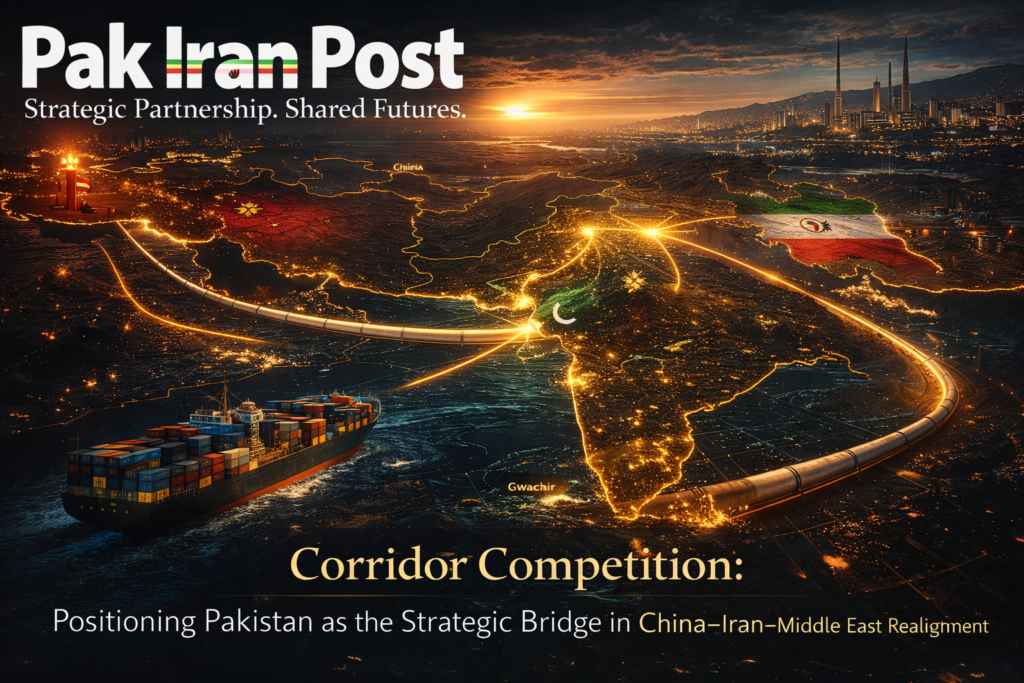
The evolving geopolitical and economic landscape of the Middle East and South Asia is creating a transformative opportunity for Pakistan to emerge as a central node in the regional connectivity and energy architecture. The fragmentation of global trade routes, the monetization of strategic chokepoints such as the Strait of Hormuz, and the deepening China–Iran nexus are redefining regional and global power dynamics. In this environment, Pakistan’s geographic location, port infrastructure, and historical relationships position it uniquely to function as a strategic bridge, linking China, Iran, and the broader Middle East. The challenge is not merely to participate in this realignment but to assert a leading role that secures long-term geostrategic and economic dividends while managing complex regional sensitivities.
The first dimension of this opportunity lies in geography. Pakistan occupies a pivotal location at the crossroads of South Asia, the Middle East, and Central Asia. Gwadar Port, part of the China-Pakistan Economic Corridor, offers direct access to the Arabian Sea and, by extension, to Gulf energy markets and international shipping lanes. The integration of Gwadar into broader regional trade and energy networks positions Pakistan as a potential transshipment hub, facilitating the movement of goods, energy, and resources between major regional actors. The port’s capacity to serve as a logistics and energy redistribution center can anchor Pakistan’s role as an indispensable intermediary in emerging corridor networks.
The second dimension is the strategic realignment of energy corridors. The monetization of the Strait of Hormuz, coupled with disruptions in conventional energy transit routes due to sanctions or conflict, is incentivizing the search for alternative pathways. Pakistan’s infrastructure can serve as a conduit for Iranian energy to reach international markets while also supporting the movement of Chinese goods and investments into the Middle East. By integrating transit, storage, and distribution systems, Pakistan can function as both a facilitator and a regulator of energy flows, extracting economic value and strategic leverage from its centrality in these networks.
China’s strategic interests are central to this opportunity. Beijing’s investment in the China-Pakistan Economic Corridor, its dependence on Middle Eastern energy, and its interest in stable alternative routes for trade and supply chains create an alignment of interests. By positioning itself as a reliable and capable partner in the corridor network, Pakistan can secure investment, technology transfer, and enhanced diplomatic backing from China. This partnership can accelerate the development of logistics infrastructure, security mechanisms, and trade facilitation frameworks, embedding Pakistan firmly in the emerging China–Iran–Middle East axis.
The third-dimension concerns Pakistan’s economic leverage. Corridor competition is not solely about geography; it is about the ability to capture value from the movement of goods, services, and energy. By establishing integrated customs systems, port management structures, and trade facilitation mechanisms, Pakistan can attract transit fees, service charges, and long-term investment flows. The development of industrial zones, energy storage facilities, and logistical support hubs amplifies this effect, creating clusters of economic activity that reinforce Pakistan’s centrality. Over time, these arrangements can enhance foreign exchange reserves, reduce trade imbalances, and strengthen economic resilience against external shocks.
Security considerations are inseparable from corridor strategy. The success of a strategic bridge depends on the reliability and safety of transit routes. Pakistan must develop robust mechanisms to ensure the security of goods, energy shipments, and infrastructure. This involves both conventional and non-conventional approaches, including border monitoring, maritime coordination, and cyber protection of critical logistics networks. By demonstrating capacity for secure management of transit flows, Pakistan not only safeguards its economic interests but also enhances credibility with regional and global partners.
Diplomatic finesse is required to navigate the competing interests of regional and global powers. Pakistan’s engagement with Iran must be balanced with its relationships with Gulf states, the United States, and other stakeholders. Strategic communication and transparent multilateral coordination are essential to mitigate perceptions of exclusivity or alignment against any actor. Pakistan must frame its corridor engagement as a stabilizing and integrative initiative that supports regional prosperity and connectivity rather than as a partisan alignment.
The integration of Gwadar and domestic transit infrastructure is central to operationalizing this vision. Investments in road, rail, and energy connectivity between Gwadar and inland hubs such as Karachi, Quetta, and Islamabad are necessary to ensure smooth flow of goods and energy. The expansion of logistics capacity, including warehouses, dry ports, and energy storage, reinforces Pakistan’s role as a strategic enabler in corridor networks. Coordination with regional partners to harmonize standards, regulatory frameworks, and operational procedures enhances efficiency and reduces friction in the system.
Institutional development is critical to sustaining this strategic role. Pakistan must establish dedicated bodies for corridor management, trade facilitation, and strategic infrastructure oversight. These institutions ensure that projects are implemented with efficiency, transparency, and alignment with national objectives. Embedding policy coherence across ministries and agencies ensures that economic, security, and diplomatic considerations are integrated into a comprehensive corridor strategy.
From a geostrategic perspective, Pakistan’s role as a bridge enhances leverage in multiple dimensions. Control over critical transit routes allows Pakistan to influence trade flows, energy distribution, and regional economic integration. This positional power translates into diplomatic capital, providing Pakistan with bargaining leverage in negotiations over regional stability, trade agreements, and security arrangements. By combining geographic centrality with operational capability, Pakistan can assert influence disproportionate to its relative size or military power.
Energy security benefits reinforce the strategic value of corridor integration. By facilitating the movement of energy from Iran to domestic and international markets, Pakistan reduces vulnerability to supply disruptions and price volatility. Access to diverse energy sources strengthens industrial capacity, supports economic growth, and improves fiscal stability. Energy corridors also offer opportunities for investment in storage, refining, and distribution infrastructure, further embedding Pakistan in regional energy networks.
Technological integration is a force multiplier for corridor strategy. Pakistan must invest in advanced logistics management systems, tracking and monitoring technologies, and secure communication networks. Digital infrastructure enhances efficiency, reduces risk, and enables real-time decision-making across transit corridors. Collaboration with Chinese and regional partners on technology transfer and capacity building ensures that Pakistan remains at the forefront of operational capability in corridor management.
Human capital development underpins the sustainability of strategic corridor engagement. Pakistan requires professionals skilled in logistics, trade management, security, and diplomacy. Establishing specialized training centers, partnerships with international think tanks, and academic programs focused on corridor economics and geostrategy builds a cadre capable of managing complex multi-stakeholder operations. Skilled personnel ensure that corridor management is professional, credible, and adaptable to evolving regional dynamics.
Multilateral engagement enhances legitimacy and reduces political risk. By embedding corridor strategy within broader regional frameworks, including China-led initiatives, OIC cooperation, and Gulf collaboration, Pakistan demonstrates a commitment to shared prosperity and stability. Multilateral arrangements provide platforms for dispute resolution, standardization, and coordination, reducing the potential for friction and ensuring smooth operation of transit networks.
The timing of engagement is crucial. Corridor dynamics are still being shaped, and early movers have the opportunity to define operational standards, regulatory frameworks, and strategic norms. Pakistan’s proactive participation ensures that it shapes the narrative, secures preferential arrangements, and avoids marginalization as competing actors consolidate influence. Delay risks relegating Pakistan to a passive role, limiting both economic and geostrategic returns.
Policy alignment across sectors is essential. Economic planning, energy strategy, and infrastructure investment must be integrated with diplomatic and security considerations. This ensures that corridor engagement delivers multiple benefits simultaneously, creating synergies between economic growth, energy security, and strategic influence. Coherence reduces waste, enhances efficiency, and maximizes the return on investment in both physical infrastructure and diplomatic capital.
Strategic partnerships with China and other regional actors provide additional leverage. Collaborative planning, joint investment, and coordinated security mechanisms strengthen Pakistan’s ability to execute corridor strategy effectively. These partnerships also provide access to technology, expertise, and financing, reducing dependency on any single actor and enhancing resilience against shocks.
Risk management remains central to corridor strategy. Geopolitical volatility, economic uncertainty, and security threats pose ongoing challenges. Pakistan must develop contingency plans for alternative routes, emergency response, and operational disruptions. By maintaining flexibility and redundancy, Pakistan ensures that corridor operations remain robust in the face of external shocks.
In conclusion, Pakistan’s geographic, economic, and diplomatic position allows it to serve as a strategic bridge linking China, Iran, and the Middle East. By integrating infrastructure, energy, and logistics capabilities with proactive diplomacy and security planning, Pakistan can convert corridor competition into long-term geostrategic and economic advantage. The development of Gwadar as a hub, combined with investments in inland connectivity and operational expertise, positions Pakistan as an indispensable facilitator of regional trade and energy flows.
By embracing this role, Pakistan enhances energy security, captures economic value, strengthens foreign exchange stability, and secures a central position in regional strategic architectures. The corridor offers not only tangible economic benefits but also enduring diplomatic and geopolitical leverage, reinforcing Pakistan’s relevance at a moment when regional alignments are being recalibrated. Timely, integrated, and strategic engagement ensures that Pakistan is not merely a participant in corridor competition but a defining architect of the emerging China–Iran–Middle East connectivity landscape, shaping outcomes in ways that deliver long-term national advantage.
A Public Service Message