Governing Borders Through Integrated Pakistan Iran Mechanisms

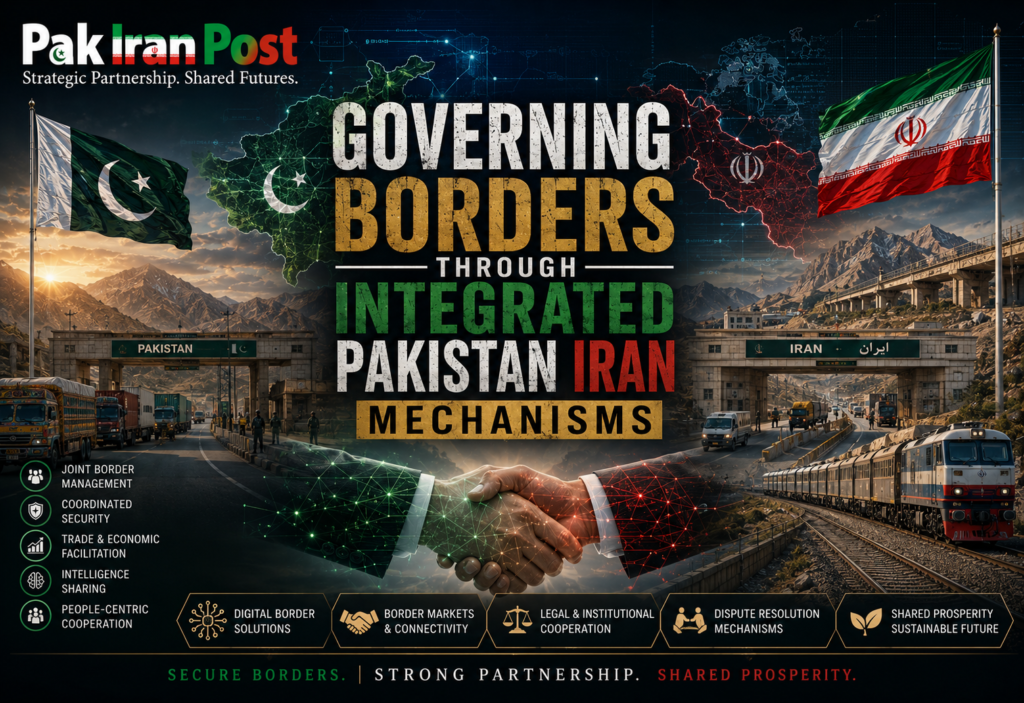
The Pakistan Iran border, stretching across rugged terrain, arid landscapes, and historically porous corridors of mobility, is increasingly emerging as a critical site where twenty first century geopolitics, informal economies, and fragmented sovereignty intersect in complex and often contradictory ways. What has long been treated as a peripheral security frontier is now being reinterpreted, both in policy circles and strategic discourse, as an active zone of transnational circulation where state authority is continuously negotiated rather than unilaterally imposed. This evolving reality demands a fundamental rethinking of border governance not as episodic enforcement but as institutional architecture, embedded in long term coordination, technological integration, and socio economic calibration.
The prevailing governance model along this frontier remains heavily reliant on reactive security mechanisms, characterized by intermittent closures, intelligence driven operations, and militarized containment strategies. While such measures may produce short term stabilization effects, they fail to address the structural conditions that generate persistent instability. These conditions are not merely security related but deeply economic and social in nature, rooted in uneven development, lack of formal trade infrastructure, and the absence of institutionalized cross border regulatory frameworks. As a result, the border functions simultaneously as a barrier and a conduit, restricting formal flows while enabling informal ones, thereby producing a hybrid economy that exists in the interstices of state regulation.
Recent regional dynamics have further exposed the limitations of this fragmented governance model. The increasing volatility of maritime trade routes, combined with disruptions in Gulf shipping corridors, has intensified the strategic significance of overland connectivity between Pakistan and Iran. This shift has elevated border management from a narrow security concern to a central pillar of regional economic planning. Yet institutional frameworks have not evolved at a comparable pace. The absence of a permanent bilateral border governance structure continues to constrain the ability of both states to manage trade, migration, and security in a coordinated and anticipatory manner.
At the heart of this governance deficit lies a conceptual problem. Borders have historically been treated as fixed lines of sovereign demarcation rather than dynamic systems of interaction. In reality, the Pakistan Iran frontier operates less as a rigid boundary and more as a complex adaptive space, shaped by flows of goods, people, information, and security threats. This complexity demands governance mechanisms that are equally adaptive, capable of integrating multiple policy domains into a coherent institutional framework. Without such integration, policy responses remain fragmented, reactive, and vulnerable to external shocks.
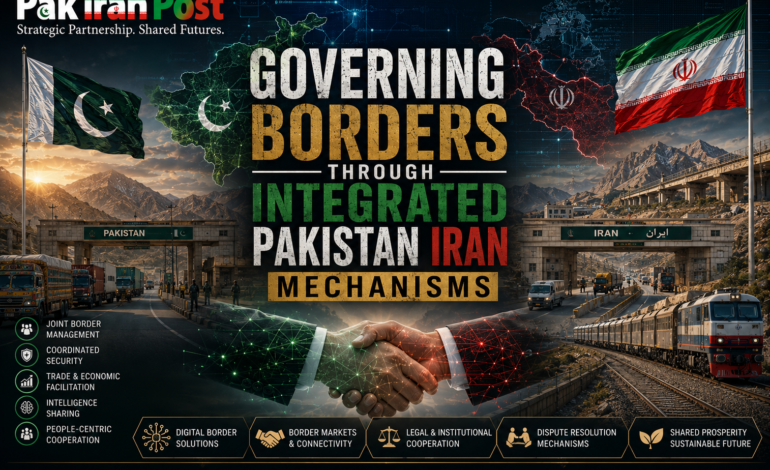
The case for institutionalizing joint border governance mechanisms is therefore not merely administrative but structural. A permanent bilateral border commission, for instance, could serve as the central coordinating body for all cross border activities, including customs harmonization, migration management, infrastructure planning, and security coordination. Such a body would need to operate at multiple levels, combining strategic oversight with operational flexibility, and integrating civilian, military, and economic institutions within a unified decision making architecture. Its effectiveness would depend not only on formal mandate but on sustained political commitment and bureaucratic continuity.
Equally important is the establishment of integrated intelligence sharing frameworks. At present, intelligence cooperation between Pakistan and Iran remains largely episodic, driven by immediate security concerns rather than long term strategic alignment. This fragmented approach limits the ability of both states to anticipate and manage cross border risks, including militant mobility, trafficking networks, and asymmetric security threats. A structured intelligence sharing mechanism, supported by standardized protocols and secure communication channels, would significantly enhance the predictive capacity of both states while reducing the likelihood of miscalculation and operational friction.
However, intelligence integration must be approached with caution, particularly given the sensitivities surrounding sovereignty, internal security, and regional trust deficits. The challenge lies in balancing operational transparency with political autonomy, ensuring that information sharing does not translate into asymmetrical dependency or external influence over domestic security policies. This requires carefully calibrated institutional safeguards, including joint oversight committees and mutually agreed data governance frameworks.
Beyond security coordination, crisis response mechanisms represent another critical dimension of border governance. The Pakistan Iran frontier is frequently affected by natural disasters, cross border displacement, and sudden economic disruptions, all of which require rapid and coordinated institutional responses. The absence of a formalized crisis management protocol often results in delayed reactions, duplication of efforts, and humanitarian inefficiencies. A jointly operated rapid response system, incorporating emergency logistics, medical coordination, and temporary mobility arrangements, could significantly enhance the resilience of border communities and reduce the human cost of crisis events.
The socio economic dimension of border governance is equally significant. Border communities on both sides are deeply embedded in informal economic systems that have evolved over decades in response to regulatory gaps, limited formal employment opportunities, and historical patterns of cross border kinship and trade. These informal economies are not peripheral anomalies but central components of local survival strategies. Any attempt to formalize border governance must therefore engage with the structural realities of these economies rather than attempting to eliminate them through coercive enforcement.
A transition toward regulated trade corridors, supported by simplified customs procedures and localized trade facilitation centers, could gradually integrate informal economic activity into formal systems without triggering abrupt disruption. This would require not only infrastructural investment but also social policy interventions aimed at providing alternative livelihoods, skill development programs, and microcredit mechanisms for affected populations. Without such measures, formalization efforts risk producing new forms of exclusion and economic displacement.
At a broader geopolitical level, the governance of the Pakistan Iran border cannot be separated from the shifting dynamics of global power competition. The increasing fragmentation of the international system, coupled with the proliferation of competing infrastructure initiatives, has transformed borders into strategic interfaces of global connectivity. External actors, through financial incentives, security partnerships, and development programs, indirectly shape the governance priorities of border regions, embedding local policy choices within larger geopolitical frameworks.
In this context, the institutionalization of border governance mechanisms is not merely a bilateral necessity but a strategic imperative. It allows Pakistan and Iran to assert greater control over their shared frontier, reducing vulnerability to external manipulation while enhancing their capacity to shape regional connectivity on their own terms. However, this requires a careful balancing of external engagements with internal institutional coherence, ensuring that border governance structures are not fragmented by competing international agendas.
The technological dimension of border governance also warrants critical attention. Advances in surveillance systems, digital customs platforms, and biometric identification technologies offer new possibilities for enhancing border efficiency and security. Yet these technologies also raise important questions about privacy, data sovereignty, and the militarization of civilian spaces. Their deployment must therefore be governed by clear regulatory frameworks that balance efficiency gains with ethical and political considerations.
Ultimately, the transformation of the Pakistan Iran border from a reactive security frontier into a governed interface of transnational interaction represents a profound institutional challenge. It requires moving beyond the logic of episodic crisis management toward a sustained framework of cooperative governance, embedded in shared institutions, harmonized policies, and long term strategic vision. This transition will not be linear or without friction. It will involve negotiation, contestation, and gradual adaptation across multiple levels of state and society.
Yet the alternative is continued fragmentation, where the border remains trapped in cycles of insecurity, informalization, and institutional neglect. In an era marked by increasing regional interdependence and global uncertainty, such fragmentation is no longer a viable long term strategy. The future of Pakistan Iran border governance will therefore depend on the capacity of both states to construct institutional architectures that reflect the complexity of the space they seek to govern, rather than the simplicity of the models they have inherited.
In this sense, border governance is no longer a technical administrative issue but a central question of regional order. It sits at the intersection of security, economy, and sovereignty, shaping not only bilateral relations but the broader architecture of connectivity across South and West Asia. Whether this frontier becomes a zone of fragmentation or integration will depend on the institutional choices made today, and on the willingness of both states to move beyond inherited paradigms toward more adaptive, integrated, and forward-looking forms of governance.
A Public Service Message