
Faultlines Beneath Emerging Eurasian Connectivity And Regional Security Doctrines Today

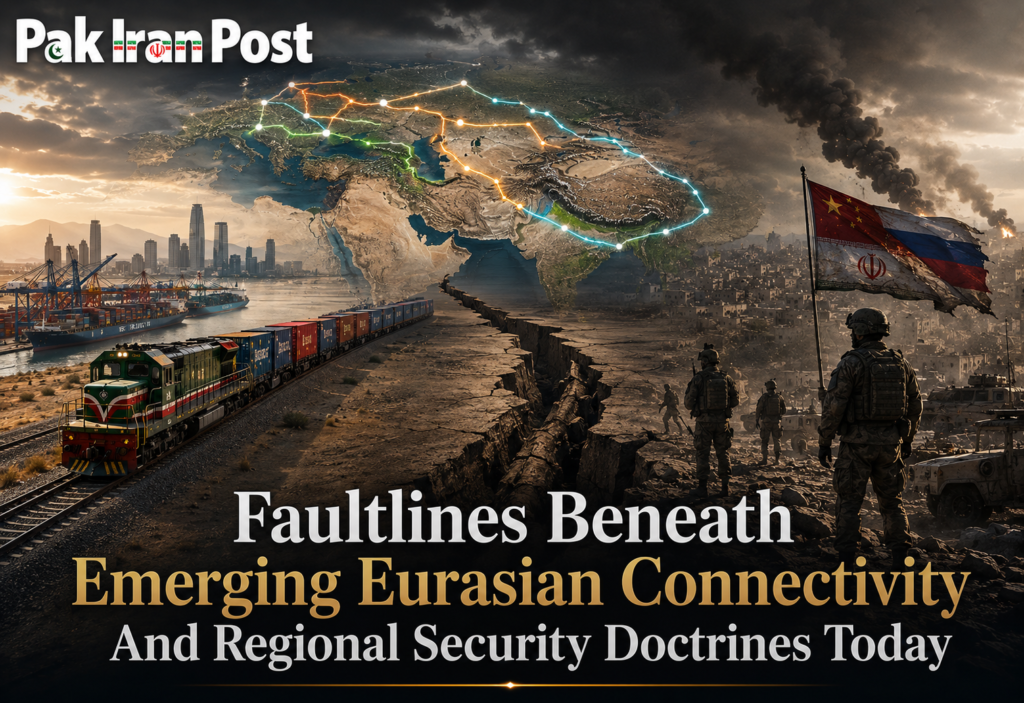
The future of Pakistan Iran relations is increasingly being shaped by a silent strategic contest between two contradictory regional forces. One is the logic of connectivity, driven by trade corridors, energy integration, logistical interdependence, and Eurasian commercial restructuring. The other is the logic of securitized fragmentation, rooted in proxy rivalries, intelligence competition, ideological suspicion, border militarization, and externally reinforced alliance systems. The unresolved tension between these two forces may ultimately determine whether the region evolves toward economic stabilization or drifts deeper into managed instability.
Across Asia and the Middle East, connectivity has ceased to function merely as an economic concept. It is now a geopolitical instrument. Ports, railway grids, energy pipelines, fiber optic routes, and logistics hubs increasingly define strategic influence. States capable of controlling trade corridors acquire political leverage far beyond traditional military capacity. Consequently, the geography connecting Pakistan and Iran has acquired renewed significance within the broader restructuring of Eurasian power dynamics.
Pakistan occupies a critical location linking the Arabian Sea to western China, Central Asia, and the wider Indian Ocean system. Iran functions as a gateway between the Gulf, the Caucasus, Central Asia, and continental Eurasia. On paper, the strategic complementarities are obvious. Combined transit architectures involving Gwadar, Chabahar, western Chinese corridors, and Central Asian markets possess the potential to transform both states into indispensable regional connectors.
Yet strategic geography alone does not guarantee cooperation. History repeatedly demonstrates that regions rich in connectivity potential often become theatres of geopolitical competition precisely because of their location. Pakistan and Iran now confront this reality simultaneously. Their relationship exists within a highly volatile environment where economic incentives for cooperation collide directly with entrenched security anxieties.
The first major contradiction emerges from the wider Middle Eastern security environment. Gulf states are rapidly diversifying their geopolitical alignments. Riyadh and Abu Dhabi increasingly pursue multidirectional diplomacy involving Washington, Beijing, New Delhi, and selective regional de escalation initiatives. This strategic diversification reflects a broader regional understanding that rigid bloc politics no longer provide adequate protection against future instability.
Pakistan, however, remains deeply integrated within Gulf economic ecosystems. Remittance inflows, labor markets, emergency financial support, and investment dependencies collectively bind Islamabad to Gulf stability. At the same time, Pakistan cannot ignore the strategic importance of functional relations with Iran, particularly regarding border security, energy requirements, western regional stabilization, and Afghanistan related security concerns.
This balancing act is becoming progressively more difficult. Every Pakistani attempt to deepen engagement with Iran risks generating unease among Gulf partners and Western financial institutions. Simultaneously, excessive strategic distance from Tehran increases border insecurity and weakens Pakistan’s ability to manage western regional volatility.
Iran confronts an equally complex strategic equation. Tehran seeks regional economic integration to offset sanctions pressure and internal economic exhaustion. Yet Iran’s security doctrine continues to prioritize deterrence through asymmetric influence networks, strategic depth mechanisms, and resistance aligned regional partnerships. This duality creates persistent mistrust among neighboring states.
For Tehran, regional isolation is economically dangerous. For the Iranian security establishment, however, reducing deterrence capabilities appears strategically risky. The consequence is a paradoxical regional posture where Iran seeks economic normalization while simultaneously preserving security structures that generate regional suspicion. This contradiction complicates long term integration efforts with neighboring states, including Pakistan.
Border security represents one of the most sensitive dimensions of bilateral relations. The Pakistan Iran frontier is increasingly evolving from a neglected peripheral zone into a central geopolitical pressure point. Militant movements, narcotics trafficking, fuel smuggling networks, demographic vulnerabilities, and external intelligence penetration have collectively transformed the border into a contested strategic environment.
Importantly, modern border insecurity rarely operates in isolation. Contemporary geopolitical competition frequently exploits fragile border ecosystems to create controlled instability. Non state actors become instruments within wider strategic games involving influence disruption, corridor insecurity, and diplomatic pressure. In this context, episodic border incidents between Pakistan and Iran should not always be interpreted purely through localized security frameworks. They increasingly intersect with broader regional rivalries and external geopolitical calculations.
The informational environment amplifies these vulnerabilities. International media narratives surrounding Pakistan Iran relations often emphasize sectarian undercurrents, proxy risks, border tensions, and militancy concerns while downplaying structural incentives for cooperation. Such framing gradually shapes diplomatic perceptions and investment behaviour. Narratives themselves become tools of geopolitical conditioning.
Meanwhile, economic realities are intensifying the urgency of regional connectivity. Pakistan continues to face structural fiscal vulnerabilities, energy deficits, external debt pressure, and inflationary stress. International Monetary Fund linked restructuring measures, including energy taxation adjustments, subsidy withdrawals, and revenue generation demands, are gradually reshaping domestic economic governance.
These measures may improve short term fiscal indicators, yet they also carry strategic consequences. Rising energy prices and taxation burdens increase industrial costs, weaken middle class resilience, and elevate public frustration. Economic insecurity historically creates fertile conditions for political polarization, information warfare, and anti state mobilization. For strategic planners, economic governance and national security can no longer be treated as separate domains.
Iran experiences parallel pressures under different conditions. Sanctions induced financial constraints, currency depreciation, infrastructural fatigue, and youth unemployment continue to strain long term economic sustainability. Tehran increasingly seeks regional trade alternatives, local currency arrangements, and non Western financial mechanisms to mitigate exposure.
This convergence of economic vulnerability theoretically creates powerful incentives for Pakistan Iran cooperation. Energy integration alone could substantially benefit both states. Pakistan requires affordable energy access. Iran possesses significant hydrocarbon resources. Yet geopolitical constraints repeatedly obstruct meaningful progress. External pressure systems, sanctions frameworks, and strategic mistrust continue to override economic rationality.
China’s expanding regional role adds another layer of complexity. Beijing’s strategic vision prioritizes corridor stability, maritime access security, and uninterrupted trade flows linking East Asia to Eurasia and the Middle East. Pakistan occupies a central position within this architecture through the China Pakistan Economic Corridor. Iran’s geographic location also holds long term strategic significance for Chinese westward connectivity ambitions.
However, Chinese involvement simultaneously intensifies counterbalancing behaviour from rival powers. Western strategic circles increasingly interpret Chinese infrastructure investments through the lens of geopolitical penetration rather than purely economic development. This perception transforms regional projects into arenas of strategic competition.
The maritime domain reflects these tensions vividly. Gwadar and Chabahar are frequently portrayed as rival ports representing competing strategic alignments. In reality, both facilities could theoretically operate within complementary regional trade ecosystems. Yet geopolitical narratives increasingly frame them within zero sum strategic frameworks linked to India China competition, Gulf influence calculations, and Western maritime concerns.
The wider Indian Ocean region is itself entering a period of accelerated militarization. Naval deployments, surveillance capabilities, cyber maritime systems, undersea infrastructure monitoring, and logistical access agreements are proliferating rapidly. The Arabian Sea is evolving into a strategic crossroads where economic connectivity and military competition intersect simultaneously.
For Pakistan and Iran, the danger lies in becoming trapped between competing external architectures without developing sufficient autonomous regional coordination mechanisms. Excessive reliance on external security guarantees or financial structures gradually reduces strategic flexibility. States become reactive rather than adaptive.
This risk is particularly acute in periods of global transition. The gradual weakening of singular hegemonic dominance has not produced stable multipolarity. Instead, it has intensified fragmented competition across overlapping geopolitical theatres. Middle powers now face mounting pressure to align with larger strategic blocs while preserving internal stability amid external volatility.
For Pakistan’s strategic establishment, several policy imperatives are becoming unavoidable. First, regional connectivity must be approached as a national security priority rather than solely an economic initiative. Corridor stability, energy integration, and trade diversification directly influence long term strategic resilience.
Second, Pakistan requires institutionalized western border management frameworks involving intelligence coordination, economic inclusion mechanisms, technological surveillance systems, and integrated development initiatives. Persistent peripheral instability creates enduring opportunities for hostile influence operations.
Third, Islamabad must preserve calibrated strategic equilibrium between Gulf partnerships, Chinese cooperation, Iranian engagement, and Western financial relationships. Strategic overalignment with any singular axis risks long term vulnerability.
Iran faces equally important strategic choices. Tehran’s future regional influence may depend less upon permanent confrontation and more upon controlled normalization capable of reducing economic exhaustion without compromising strategic deterrence. Excessive securitization generates diminishing returns over time.
For both states, the most dangerous threat may not emerge through open warfare. It may emerge through cumulative institutional fatigue produced by economic stress, demographic pressure, cyber vulnerability, information manipulation, and fragmented governance structures. Modern geopolitical competition increasingly unfolds beneath the threshold of formal conflict.
The future of Pakistan Iran relations will therefore be determined not merely by diplomatic declarations, but by whether both states can construct durable strategic trust within an environment specifically designed to prevent autonomous regional integration. Connectivity alone cannot succeed without security stabilization. Security doctrines alone cannot generate sustainable prosperity.
The defining challenge of the coming decade is whether Islamabad and Tehran can prevent external rivalries from converting their geography into a permanent zone of managed instability. If they fail, the region risks becoming trapped within an endless cycle where corridors remain unfinished, borders remain securitized, economies remain vulnerable, and sovereignty gradually erodes beneath the weight of competing geopolitical architectures.
In the emerging Eurasian order, strategic survival will belong not necessarily to the strongest states, but to those capable of balancing connectivity with sovereignty, deterrence with diplomacy, and regional integration with institutional resilience. The Pakistan Iran equation sits directly at the centre of this unfolding geopolitical transformation.
A Public Service Message