Algorithmic Media and Fragmented Sovereignty Across Pakistan Iran Region Order

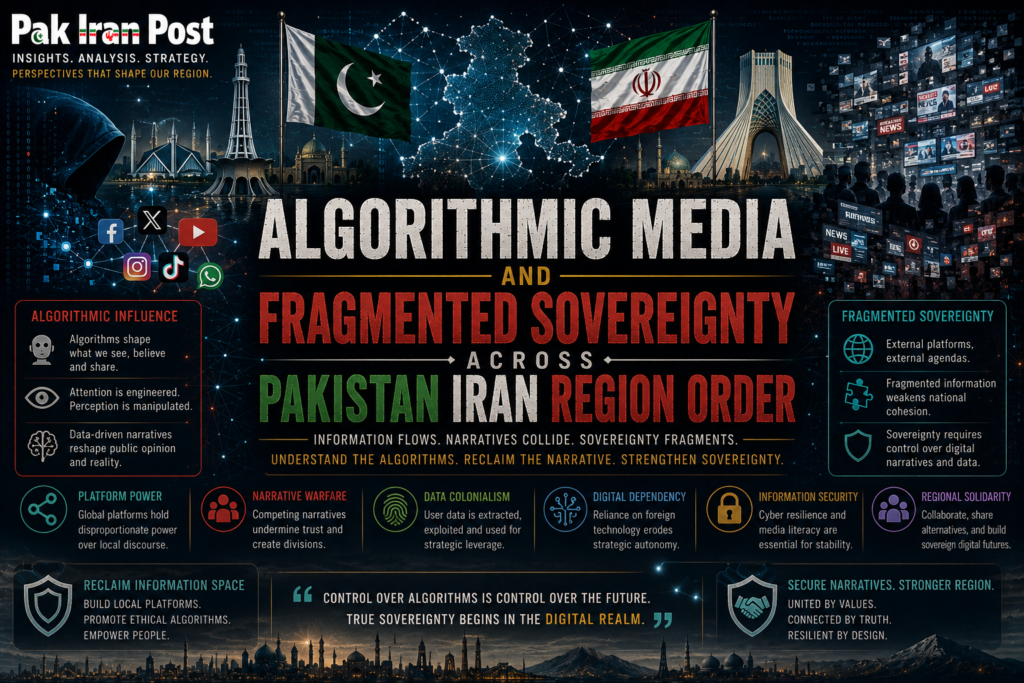
The contemporary informational landscape across Pakistan, Iran, and adjacent geopolitical corridors is undergoing a structural mutation that is no longer adequately described by conventional media theory, nor by legacy models of state propaganda, public diplomacy, or broadcast regulation. What is emerging instead is a condition of algorithmically mediated sovereignty fragmentation, in which the production of meaning, legitimacy, and collective psychological orientation is increasingly outsourced to opaque computational infrastructures operating beyond the traditional jurisdiction of nation states. In this evolving order, digital media ecosystems do not simply reflect political reality; they actively construct, destabilize, and recursively re-engineer it, generating a continuous loop of perception and counter-perception that complicates both governance and strategic forecasting.
Within Pakistan and Iran, this transformation is particularly acute due to the convergence of demographic youth bulges, high mobile penetration, politically charged diasporic networks, and sustained exposure to cross-border informational flows that are neither fully regulated nor meaningfully contained. The result is a hybrid informational environment where national narratives coexist uneasily with transnational algorithmic currents, producing a fragmented epistemic terrain in which citizens no longer inhabit a singular mediated reality but multiple competing realities simultaneously. This multiplicity is not benign; it is structurally destabilizing because it erodes the coherence of shared civic truth, which historically underpinned institutional legitimacy.
The rise of platformed communication architectures has effectively displaced older gatekeeping institutions. Traditional journalism, once the principal arbiter of verified knowledge, now operates as one node among many in a vastly expanded ecosystem that includes influencer economies, automated content farms, state-linked digital amplification networks, and decentralized ideological communities. In such an environment, the velocity of information circulation outweighs its verifiability, and emotional salience increasingly supersedes factual accuracy as the primary determinant of virality. This shift has profound implications for governance systems that were designed in an era where information scarcity, not abundance, defined the communicative order.
In Pakistan–Iran informational space, this dynamic is further complicated by strategic mistrust, regional alignments, and intermittent geopolitical signalling, all of which are amplified through digital channels in real time. Narrative incidents that once would have remained contained within diplomatic or institutional channels now rapidly escalate into mass-perception events, often detached from their original context. The informational sphere thus behaves less like a structured marketplace of ideas and more like a high-frequency volatility engine, where meaning is continuously arbitraged by algorithmic recommendation systems optimized for engagement rather than stability.
It is within this context that public psychology itself becomes a strategic variable. The sustained exposure of populations to algorithmically curated outrage cycles, emotionally charged political content, and fragmented news ecosystems produces measurable shifts in cognitive processing patterns. Attention spans contract, trust thresholds decline, and interpretive frameworks become increasingly polarized. The outcome is not merely ideological division but what may be termed epistemic fatigue, a condition in which individuals disengage from verification altogether and instead default to identity-based information acceptance. This phenomenon has direct consequences for governance legitimacy, as institutional messaging is increasingly filtered through pre-existing emotional alignments rather than objective evaluation.
Establishment-level concerns in both Pakistan and Iran are increasingly oriented toward this deeper informational instability, particularly as it intersects with national security narratives and external influence operations. However, the challenge lies in the fact that influence itself is no longer easily attributable. Unlike classical propaganda models, which relied on identifiable state or non-state actors, contemporary information warfare is diffuse, decentralized, and often emergent from the interaction of automated systems and human amplification behaviors. Attribution, therefore, becomes probabilistic rather than deterministic, complicating both response and deterrence mechanisms.
At the same time, global governance institutions, including multilateral financial and regulatory bodies, are beginning to recognize the macroeconomic implications of digital instability. The International Monetary Fund’s increasing emphasis on fiscal restructuring, including energy taxation frameworks in developing economies, intersects indirectly with informational volatility, as domestic policy reforms are often refracted through highly charged digital narratives that frame such measures as externally imposed constraints rather than internally negotiated adjustments. United Nations agencies, similarly, have begun to acknowledge the role of digital misinformation ecosystems in undermining sustainable development goals, particularly in areas related to governance transparency and institutional trust.
Yet the core issue remains insufficiently theorized at the policy level: the digitization of legitimacy itself. In earlier political orders, legitimacy was anchored in institutional continuity, constitutional frameworks, and the relative stability of mass media narratives. In the current order, legitimacy is increasingly contingent upon real-time perceptual validation within digital ecosystems that are neither centrally governed nor uniformly structured. This creates a condition of perpetual legitimacy volatility, where governments must continuously negotiate not only policy outcomes but also their instantaneous perception across fragmented digital publics.
In Pakistan–Iran informational corridors, this volatility is further intensified by cross-platform narrative leakage, where localized political developments are rapidly reframed through external geopolitical lenses. Such reframing often strips events of their domestic policy context and repositions them within broader ideological or strategic narratives, thereby distorting their functional meaning. This process generates what may be described as narrative externalization, wherein internal political discourse is progressively reinterpreted through external informational grammars.
The implications for national identity formation are profound. Identity, once anchored in relatively stable cultural, linguistic, and historical continuities, is now increasingly mediated through algorithmically selected content streams that privilege novelty, emotional intensity, and ideological extremity. The result is a form of identity pluralization that is not necessarily inclusive but often contradictory, producing internal cognitive dissonance at the societal level. Citizens simultaneously inhabit overlapping identity frameworks that are continuously reshaped by exposure to divergent informational ecosystems.
From a strategic governance perspective, this necessitates a recalibration of informational policy architecture. Conventional approaches rooted in censorship, content restriction, or reactive disinformation countermeasures are increasingly insufficient in addressing system-level informational instability. Instead, what is required is a shift toward what may be conceptualized as epistemic infrastructure building, wherein states invest in long-term capacity to generate credible, adaptive, and culturally resonant informational systems capable of competing within algorithmically mediated environments.
Such an approach would require the integration of advanced data analytics, behavioral science insights, and platform governance partnerships to map informational flows in real time and identify emergent narrative vulnerabilities before they crystallize into systemic instability. It would also require a rethinking of public communication strategies, moving away from episodic messaging toward continuous narrative engagement calibrated to digital consumption patterns.
At the same time, there is a growing need for institutional restraint and credibility preservation. Over-securitization of information environments risks further eroding public trust and may inadvertently accelerate the very fragmentation it seeks to contain. The challenge, therefore, lies in achieving a delicate equilibrium between informational security and epistemic openness, a balance that is increasingly difficult to maintain in high-volatility digital ecosystems.
The Pakistan–Iran informational interface, in particular, represents a critical test case for this emerging global condition. Both states operate within overlapping spheres of strategic interest, religious-cultural affinity, and geopolitical sensitivity, yet are simultaneously exposed to divergent external informational pressures. This duality creates a complex informational topology in which narratives are continuously negotiated, contested, and reconfigured across multiple layers of digital interaction.
In this environment, policy coherence becomes contingent not only on institutional design but also on narrative adaptability. Governments must increasingly function as dynamic informational actors capable of engaging with fluid digital publics while maintaining strategic consistency. This requires a form of statecraft that integrates communication strategy, cybersecurity awareness, and geopolitical signaling into a unified operational framework.
Ultimately, the transformation of digital media ecosystems across Pakistan, Iran, and the broader region signals a deeper shift in sovereignty itself. Sovereignty is no longer exclusively territorial or institutional; it is increasingly cognitive, informational, and algorithmic. The ability of states to maintain coherent narratives within fragmented digital environments is becoming as critical as their ability to maintain physical borders or economic stability.
In conclusion, the emerging order is characterized by a paradox: greater informational connectivity has produced greater epistemic fragmentation. The challenge for policymakers is not merely to manage information flows but to reconstruct the conditions under which shared meaning remains possible. Without such reconstruction, the risk is not simply misinformation or propaganda, but a more fundamental disintegration of the shared cognitive infrastructure upon which modern governance depends.
A Public Service Message