
Narrative Asymmetry and the Displacement of Classical Propaganda Architectures

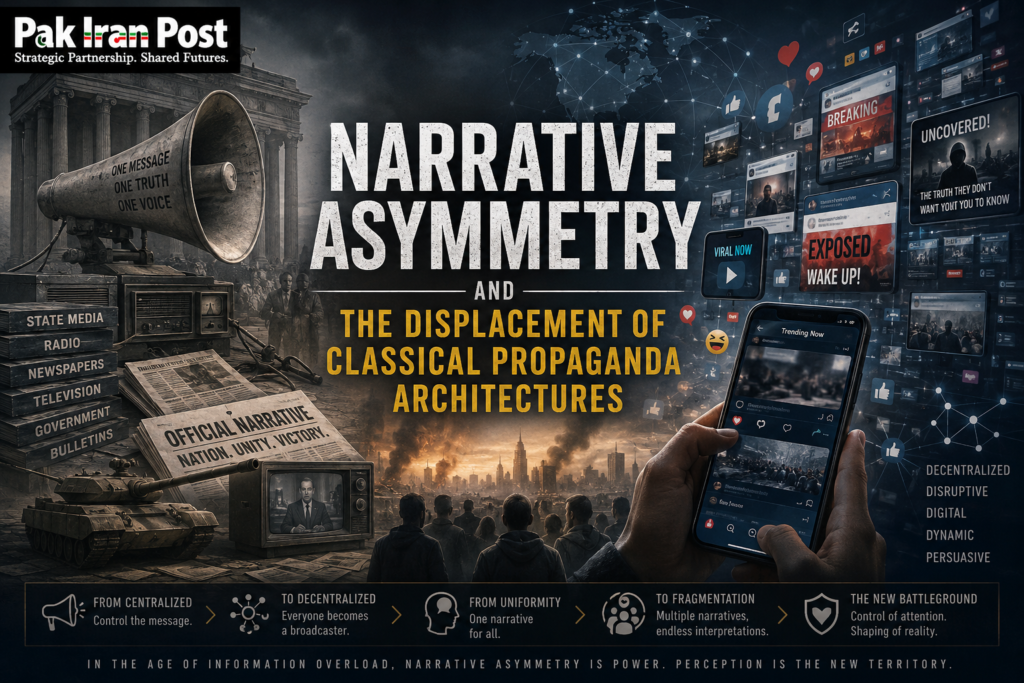
The global information order has entered a phase of structural disjunction in which the classical concept of propaganda, once anchored in centralized messaging systems and state-controlled broadcast apparatuses, has been progressively displaced by a more volatile, decentralized, and algorithmically mediated regime of information warfare. Across Pakistan, Iran, and the broader regional informational continuum, this transition is not merely technological but epistemological, reshaping the very grammar through which power is communicated, contested, and legitimized.
In earlier geopolitical epochs, propaganda operated through relatively linear channels of transmission. States, through carefully curated media institutions, sought to project coherence, continuity, and controlled persuasion. The objective was not immediacy but durability, the gradual consolidation of interpretive frameworks within the public consciousness. That architecture assumed a stable audience, limited channels of dissemination, and a measurable relationship between message and reception. None of these assumptions hold in the contemporary digital environment.
The emergence of platformized communication ecosystems has dismantled the structural monopoly once enjoyed by state actors over narrative production. In its place has arisen a fragmented informational field in which meaning is generated through continuous interaction between human actors, algorithmic recommendation systems, and transnational content networks. Within this field, information is no longer simply transmitted; it is actively optimized for engagement, resonance, and virality. Therefore, narrative authority has become decoupled from institutional origin, and legitimacy is increasingly derived from circulation intensity rather than provenance.
In the Pakistan–Iran informational sphere, this shift has acquired distinctive geopolitical contours. The region is characterized by a dense layering of strategic sensitivities, ideological narratives, and socio-religious affinities that render it particularly susceptible to rapid narrative escalation. Information events that would once have been contained within diplomatic or bureaucratic circuits now immediately spill into digital ecosystems where they are refracted through competing interpretive lenses. The result is a condition of narrative instability in which meaning is continuously contested, recomposed, and re-weaponized in near real time.
Information warfare in this context does not resemble classical propaganda campaigns. It is not centrally orchestrated, nor does it rely on singular narrative coherence. Instead, it operates as a distributed system of influence, where multiple actors, state-linked, non-state, commercial, and algorithmic, participate in shaping perceptual outcomes without necessarily sharing intent or coordination. The battlefield is not discrete; it is continuous. The weapon is not message alone but amplification, timing, framing, and emotional modulation.
This evolution has profound implications for the strategic doctrines of states traditionally accustomed to hierarchical communication models. Pakistan and Iran, like many states in the Global South, find themselves navigating an informational environment in which control is no longer absolute but probabilistic. Influence operations are increasingly characterized by opacity, where attribution is ambiguous and causality is diffused across platform infrastructures. This creates a strategic dilemma: responses designed for identifiable adversaries are ill-suited to systems defined by distributed agency.
The displacement of propaganda by information warfare is also evident in the transformation of audience behavior. Citizens are no longer passive recipients of messaging but active nodes within the informational ecosystem. Through sharing, remixing, commenting, and algorithmic interaction, they participate in the construction of narrative trajectories. However, this participation is not necessarily deliberative. It is often driven by affective triggers engineered by platform architectures optimized for engagement maximization. Emotional salience, particularly anger, fear, and moral outrage, becomes the primary currency of circulation.
This emotionalization of information flow has created what may be described as a permanent attention economy of conflict. Within this economy, stability is structurally disadvantaged. Content that reinforces equilibrium or nuance is algorithmically outcompeted by content that generates disruption, polarization, or moral urgency. The result is a systemic bias toward informational volatility, where narratives evolve not through consensus formation but through competitive escalation.
In Pakistan–Iran digital environments, this dynamic is amplified by pre-existing socio-political fault lines and external geopolitical framing pressures. Regional developments are rapidly subsumed into broader narrative templates that emphasize confrontation, alignment, or ideological divergence. This process of narrative compression reduces complex policy realities into simplified symbolic binaries, thereby accelerating polarization and reducing the space for deliberative interpretation.
The implications for governance are profound. Traditional state communication strategies, which rely on periodic messaging and institutional authority, are increasingly mismatched with the temporal dynamics of digital information warfare. In the current environment, narrative events unfold in seconds, not news cycles. By the time institutional responses are formulated, interpretive frameworks have often already been established within digital publics. This creates a structural lag between governance communication and informational perception.
Establishment-level strategic concerns are therefore shifting toward the question of narrative pre-emption rather than narrative correction. However, pre-emption in a decentralized informational environment is inherently complex. It requires not only rapid response capacity but also anticipatory mapping of potential narrative trajectories across multiple platforms and linguistic domains. This necessitates the integration of advanced data analytics, behavioral modeling, and platform-level intelligence coordination.
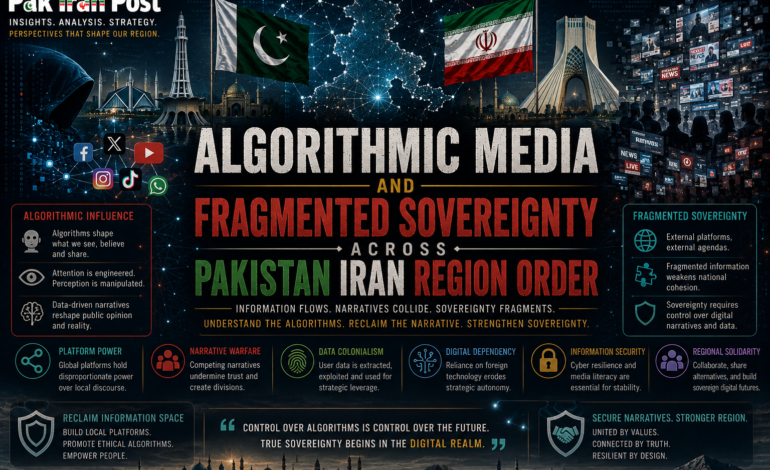
Yet even with such capabilities, the fundamental challenge remains structural rather than operational. Information warfare today is not simply about competing narratives but about competing informational infrastructures. Platforms themselves act as sovereign-like entities in the informational domain, shaping visibility, amplification, and suppression through opaque algorithmic logics. This introduces a new form of asymmetry in which state actors must operate within privately governed informational ecosystems whose internal rules are neither fully transparent nor nationally bounded.
In this sense, the replacement of propaganda by information warfare signals a deeper transformation: the erosion of narrative centrality itself. Where propaganda once sought to impose a unified interpretive framework, information warfare thrives on fragmentation. Its effectiveness lies not in coherence but in controlled disorder, not in persuasion but in destabilization of certainty. The objective is not necessarily to convince but to disorient, to saturate the informational environment with competing signals until interpretive fatigue sets in.
Such fatigue is increasingly observable across digital populations in the region. Users exposed to sustained cycles of contradictory narratives, rapid information turnover, and emotionally charged content often exhibit declining trust in institutional sources altogether. This withdrawal does not produce neutrality but vulnerability, as information vacuums are quickly filled by more extreme or emotionally resonant narratives.
From a policy perspective, this suggests that resilience cannot be achieved solely through defensive counter-disinformation measures. Instead, it requires a rethinking of informational ecology itself. States must begin to conceptualize information not merely as content to be regulated but as an environment to be structured. This involves fostering credible domestic information ecosystems capable of competing with transnational narrative flows on both speed and legitimacy.
At the same time, there is a growing necessity to engage with platform governance regimes. Since algorithmic systems function as de facto arbiters of informational visibility, strategic engagement with platform operators has become an essential component of national informational policy. This raises complex questions regarding sovereignty, jurisdiction, and regulatory authority in digital spaces that transcend territorial boundaries.
International institutions, including multilateral financial and governance bodies, are increasingly attentive to the macro-political consequences of information instability. While their primary mandates may relate to economic stabilization or development financing, the informational environment in which policy reforms are communicated significantly influences their domestic reception. Economic adjustment measures, including taxation reforms or energy restructuring initiatives influenced by global financial frameworks, often become entangled in digital narratives that frame them as externally imposed constraints rather than domestically negotiated policies. This narrative reframing can generate political resistance that exceeds the technical scope of the original reform.
Within Pakistan–Iran informational dynamics, such reframing effects are particularly pronounced due to heightened sensitivity to sovereignty discourse and external influence perceptions. As a result, policy communication must now operate simultaneously on technical, political, and informational levels. Failure to manage any one of these dimensions can compromise the entire reform trajectory.
The broader strategic implication is that information warfare is no longer a peripheral dimension of geopolitical competition; it is its central operating environment. Military, economic, and diplomatic instruments are increasingly mediated through informational channels that determine their perception and effectiveness. In this sense, the informational domain has become the primary theatre in which legitimacy, influence, and strategic positioning are contested.
The displacement of propaganda by information warfare therefore represents not simply an evolution of communication techniques but a fundamental reordering of power itself. Authority is no longer solely exercised through control of messages but through influence over informational architectures, algorithmic systems, and attention economies.
In conclusion, the contemporary informational order is defined by a paradoxical condition: greater connectivity has produced greater contestability, and greater access to information has produced greater instability of meaning. For Pakistan, Iran, and the broader regional system, the strategic imperative is no longer to restore the conditions of classical propaganda coherence but to develop adaptive frameworks capable of operating within permanent informational contestation. Without such adaptation, states risk persistent narrative asymmetry in which their capacity to govern perception is continuously outpaced by the velocity of decentralized information warfare.
A Public Service Message