

Affective Overload and Algorithmic Polarisation in Governance Stability

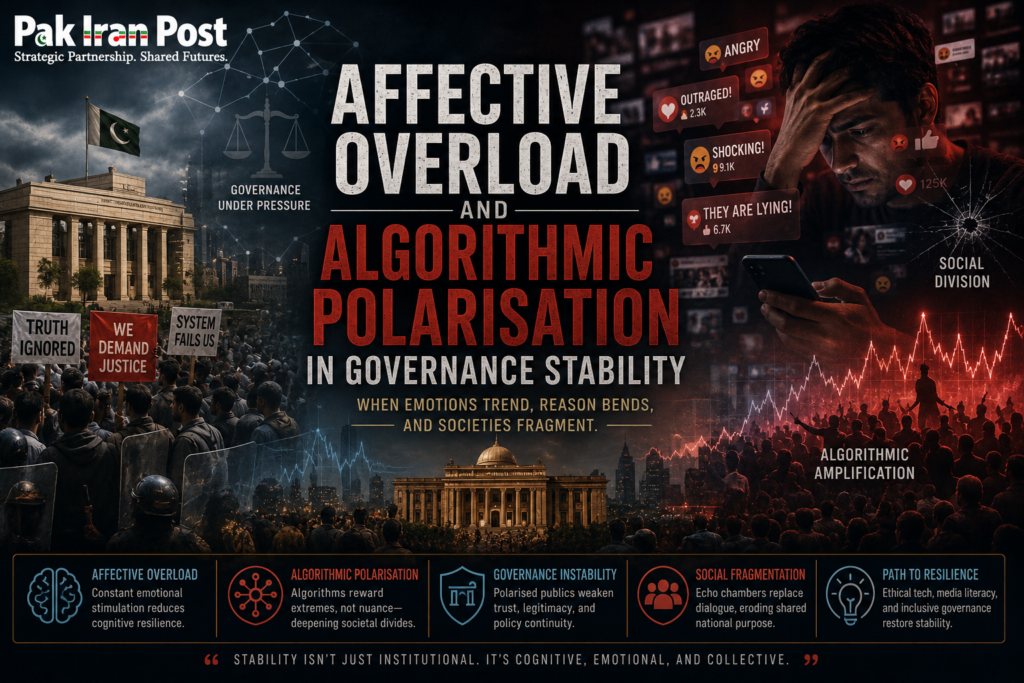
The contemporary digital condition has ushered in an unprecedented reconfiguration of emotional life within political societies, where affect, rather than ideology or rational deliberation, increasingly mediates the relationship between citizens and the state. Across Pakistan, Iran, and adjacent informational theatres, governance stability is no longer determined solely by institutional capacity or economic performance, but by the volatility of digitally engineered emotional ecosystems that continuously reshape public perception, trust, and civic responsiveness.
What distinguishes the present moment from earlier phases of media evolution is not merely the speed of information dissemination, but the industrialisation of affect itself. Social media architectures, governed by engagement-maximisation logics, have transformed human emotion into a quantifiable and optimisable resource. Outrage, indignation, fear, and moral shock are not incidental outcomes of content circulation; they are structurally incentivised outputs within algorithmic systems whose primary objective is behavioural retention. In this configuration, emotional intensity becomes a proxy for informational value, regardless of factual integrity or policy relevance.
Within Pakistan–Iran informational environments, this dynamic acquires heightened political sensitivity due to existing socio-economic pressures, demographic complexity, and recurrent exposure to transnational narrative spillovers. The consequence is a digitally accelerated emotional economy in which public sentiment oscillates between episodic surges of collective anger and abrupt phases of disengagement. These oscillations do not produce stable political attitudes; rather, they generate what may be described as affective turbulence, a condition in which emotional states are continuously destabilised by algorithmically curated stimuli.
Governance systems operating within this environment confront a paradox. On one hand, digital platforms provide unprecedented access to public sentiment, enabling real-time feedback loops between state action and societal reaction. On the other hand, this feedback is increasingly distorted by algorithmic amplification mechanisms that privilege extreme signals over representative ones. As a result, policy perception becomes skewed, with highly emotional minority reactions often appearing as majority sentiment, thereby complicating decision-making at institutional levels.
The implications for civic trust are profound. Trust, historically constructed through slow accumulation of institutional credibility, procedural transparency, and predictable governance behavior, is now subject to rapid erosion cycles driven by viral content dynamics. A single narrative event, irrespective of its empirical grounding, can trigger disproportionate institutional credibility shocks if amplified through emotionally charged digital networks. This introduces a condition of structural fragility in which trust becomes episodic rather than cumulative.
In such an environment, political legitimacy is increasingly contingent upon the ability of institutions to manage not only outcomes but also perceptions of emotional coherence. Governments are compelled to operate within compressed temporal cycles of reaction, where delayed communication is often interpreted as opacity, and measured policy articulation is perceived as evasion. This temporal compression significantly reduces the space for deliberative governance.
The phenomenon of algorithmic polarisation further intensifies this instability. Digital platforms, through personalised content delivery systems, segment populations into increasingly insulated informational clusters. These clusters are not merely ideological; they are affectively distinct, each governed by its own emotional baseline, interpretive logic, and narrative ecosystem. The result is a fragmentation of the public sphere into parallel emotional realities, where consensus becomes structurally difficult to achieve.
In Pakistan and Iran, this fragmentation is compounded by existing socio-political heterogeneity and external narrative interference. Cross-platform content flows frequently recontextualise domestic political developments within broader geopolitical or ideological frameworks, thereby amplifying polarisation effects. Policy debates are thus displaced from their technical substance and re-encoded into emotionally charged identity contests, reducing the scope for pragmatic consensus-building.
From a strategic governance perspective, this condition necessitates a fundamental rethinking of state communication architecture. Conventional models of public information dissemination, which rely on episodic briefings and reactive clarification mechanisms, are insufficient in an environment defined by continuous emotional modulation. Instead, governance systems must develop persistent engagement frameworks capable of maintaining narrative stability across fluctuating digital emotional cycles.
However, such engagement must be carefully calibrated to avoid over-securitisation of the informational environment. Excessive intervention in digital discourse risks reinforcing perceptions of state opacity or coercion, thereby further eroding trust. The challenge lies in achieving a delicate equilibrium between informational responsiveness and institutional restraint, ensuring that corrective communication does not itself become a source of polarisation.
At a deeper structural level, emotional fatigue is emerging as a defining characteristic of digital publics. Continuous exposure to high-intensity content streams produces cognitive depletion, reducing individuals’ capacity to engage with complex policy issues. This fatigue manifests not only as disengagement but also as susceptibility to simplified narratives that offer emotional clarity at the expense of analytical depth. In such conditions, governance communication faces a dual challenge: combating misinformation while simultaneously addressing the cognitive exhaustion that facilitates its acceptance.
International governance institutions, including multilateral financial and developmental bodies, are increasingly encountering the downstream effects of this emotional instability. Policy reforms related to fiscal adjustment, energy restructuring, or taxation frameworks often face distorted reception within digital ecosystems, where technical measures are reframed as existential threats or external impositions. In Pakistan, IMF-linked economic reforms, particularly in the energy sector, frequently become embedded within emotionally charged narratives that obscure their technical rationale. This narrative distortion amplifies public resistance, complicating implementation timelines and increasing political costs.
The United Nations system, similarly, has acknowledged the growing relevance of informational environments in shaping development outcomes, particularly in relation to governance legitimacy and institutional resilience. However, the integration of affective dynamics into policy design remains underdeveloped. Emotional economies are still treated as peripheral phenomena rather than central variables in governance stability models.
The emergence of algorithmic outrage cycles represents one of the most destabilising features of the contemporary informational order. These cycles are characterised by rapid escalation of emotionally charged content, followed by saturation, exhaustion, and eventual desensitisation. Each cycle leaves behind residual trust degradation, gradually eroding institutional credibility over time. Unlike traditional political crises, which are episodic and temporally bounded, algorithmic outrage cycles are continuous, overlapping, and self-reinforcing.
For Pakistan–Iran strategic informational space, this creates a persistent background condition of instability in which governance legitimacy must be continuously renegotiated. The absence of emotional equilibrium within digital publics means that even routine policy actions can trigger disproportionate reactions if they intersect with pre-existing narrative tensions. This introduces a structural unpredictability into governance communication that conventional policy frameworks are ill-equipped to manage.
The strategic response to this condition cannot be limited to content regulation or misinformation countermeasures. It requires a more fundamental reconfiguration of digital governance philosophy, one that recognises emotional stability as a core component of national resilience. This includes investment in digital literacy frameworks, development of publicly trusted information infrastructures, and establishment of institutional mechanisms capable of monitoring affective trends at scale.
At the same time, there is an urgent need to reconsider the design logic of digital platforms themselves. Engagement-driven architectures that systematically privilege emotional extremity over informational balance are incompatible with long-term governance stability. Without structural reform in platform incentive systems, states will remain perpetually reactive to cycles of digital polarisation that originate outside their regulatory reach.
In conclusion, emotional fatigue and algorithmic polarisation are not peripheral phenomena but central determinants of contemporary governance stability. In the Pakistan–Iran informational landscape, they function as silent structural forces that continuously reshape civic trust, institutional legitimacy, and policy feasibility. The challenge for policymakers is not merely to manage information flows, but to stabilise the emotional environments within which those flows acquire meaning. Without such stabilisation, governance systems risk operating in a permanently reactive mode, unable to establish durable legitimacy in an environment defined by perpetual affective volatility.
A Public Service Message