
The Shared Frontier Requires A New Social Security Architecture

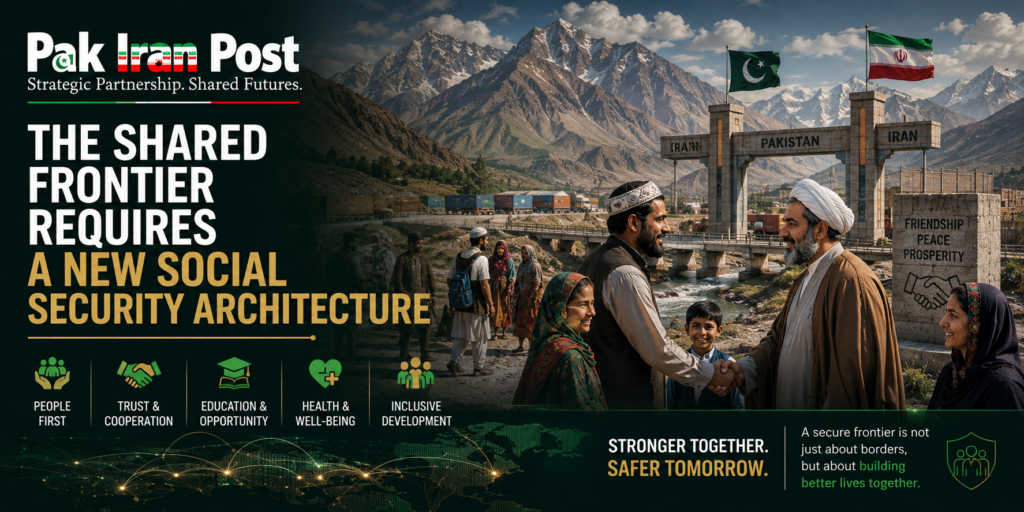
Pak Iran Post must treat the Sistan Balochistan and Pakistani Balochistan frontier as a social security environment rather than merely a territorial line requiring greater physical control. The strategic difficulty arises from a population whose linguistic affinities, kinship structures, commercial practices, historical memories and patterns of mobility precede the modern jurisdictional boundary, while the security apparatuses on both sides increasingly interpret the same geography through the prism of sovereignty, militancy, narcotics, irregular migration and hostile intelligence activity. This produces an inherently complicated policy problem. A person crossing the frontier may represent an ordinary economic necessity, a family obligation, a customary movement pattern, an undocumented migrant, a smuggler, an intermediary for an armed network or an intelligence enabled facilitator. The physical act is identical. The security meaning is not.
For Pakistan, the principal danger is therefore not simply uncontrolled movement. It is analytical ambiguity. When legitimate mobility and clandestine activity occupy the same geographic, familial and commercial channels, conventional border management becomes insufficiently discriminating. Excessive securitisation can alienate communities whose cooperation is indispensable to intelligence collection, while inadequate scrutiny can provide organised networks with precisely the social camouflage they require. A sustainable frontier doctrine must consequently distinguish between mobility that sustains border society and mobility that exploits border society. That distinction cannot be produced by fencing, patrols or checkpoint interrogation alone. It requires an integrated assessment architecture capable of detecting behavioural anomalies without criminalising an entire population.
The frontier has historically functioned as an economic and social ecosystem. Small traders, transporters, livestock owners, labourers, families and religious travellers may possess relationships extending across the boundary that are entirely comprehensible within local society but opaque to institutions operating through national databases. Informal commerce can similarly exist on a spectrum ranging from subsistence exchange to sophisticated illicit logistics. A household that purchases goods through an unofficial channel because formal trade is inaccessible is not equivalent to a network moving narcotics, weapons or terrorist financing. Yet both may appear in an administrative record simply as irregular cross border economic activity. The policy failure occurs when classification replaces investigation.
This distinction has become more consequential as the security environment around the Pakistan Iran frontier has acquired greater technological complexity. Digital communication allows communities to maintain instantaneous contact across jurisdictions, while encrypted applications, mobile payments, informal remittance channels and social media can facilitate both legitimate social interaction and covert coordination. Geospatial technology can identify movement patterns that were previously invisible, but technical visibility does not automatically generate analytical understanding. A sudden increase in crossings, unusual vehicle movements or repeated communications between apparently unrelated individuals may constitute useful indicators, but indicators become intelligence only when correlated with economic, demographic and behavioural information.
Pakistan therefore requires a dedicated cross border social risk assessment mechanism operating alongside, rather than inside, conventional border security structures. Its purpose should not be to create another bureaucratic layer. It should be to construct an intelligence picture that existing institutions frequently encounter in fragmented form. Civil administration can contribute population movements, market conditions, migration pressures and local grievances. Border forces can provide crossing patterns and operational observations. Intelligence agencies can identify organised networks, foreign facilitation and anomalous associations. Customs authorities can map commercial flows. Financial intelligence can identify suspicious remittance patterns. Telecommunications analysis, within applicable legal authorities, can identify networks and recurring communication behaviour. Provincial institutions can provide information about employment, education, displacement and community tensions. When these datasets remain institutionally isolated, the state sees fragments. When appropriately fused, it can begin to see patterns.
Such an architecture should be built around risk rather than ethnicity, nationality or political affiliation. The existence of Baloch social connectivity across the frontier cannot itself be treated as a security indicator. Nor should cultural affinity be interpreted as evidence of political disloyalty. Such assumptions would be strategically counterproductive because they would convert precisely those communities capable of supplying granular local knowledge into reluctant observers of the state. The security establishment requires a more sophisticated principle: identity may explain connectivity, but behaviour establishes risk.
That principle should inform a graduated risk classification system. Routine family movement, documented commercial activity, established pilgrimage routes and recurring livelihood patterns should generate low risk assessments unless contradictory evidence emerges. Irregular movement without corroborating criminal indicators should generate enhanced administrative scrutiny rather than immediate security escalation. Repeated movement involving unexplained financial transactions, suspicious communications, concealed identities, anomalous vehicle activity or associations with known facilitators should trigger targeted investigation. Organised movement connected with weapons, narcotics, terrorist financing, clandestine logistics or hostile intelligence activity should enter a separate operational category. The objective is not surveillance for its own sake. It is proportionality.
The distinction is vital because indiscriminate enforcement generates its own security externalities. When communities perceive border controls as arbitrary, economically punitive or humiliating, informal networks can acquire social legitimacy. Smuggling may cease to appear as organised criminality and become framed locally as an economic necessity. Once that narrative consolidates, state enforcement becomes more expensive and intelligence cooperation becomes less reliable. The security establishment should therefore recognise community legitimacy as an operational asset. A border community that trusts the state is an additional sensor network. A border community that distrusts the state is an information blind spot.
Economic deprivation deserves similar treatment. Poverty does not cause militancy in any automatic or deterministic sense, but chronic economic exclusion can increase the market for illicit intermediaries. Where formal employment, regulated trade and transport opportunities are inadequate, criminal networks can recruit through economic incentives rather than ideological commitment. This creates a particularly difficult security environment because an individual may participate in illicit activity without possessing a sustained political or militant identity. Counterterrorism frameworks designed around ideological motivation can consequently overlook commercially motivated facilitation.
Pakistan should develop a frontier economic intelligence layer capable of monitoring commodity prices, transport flows, customs discrepancies, informal market dependence, fuel movements, livestock trade, remittance patterns and sudden changes in local purchasing behaviour. The purpose would not be to suppress informal commerce indiscriminately. It would be to identify the point at which informal economic activity becomes structured criminal logistics. This requires baseline data. Without knowing what normal commerce looks like in a particular district, authorities cannot reliably identify abnormal commerce.
Migration presents another complex dimension. The frontier cannot be understood through the binary categories of legal resident and illegal entrant alone. Seasonal labour, family relocation, displacement, commercial travel and temporary residence generate legitimate mobility that may not always correspond neatly with formal documentation. At the same time, organised facilitators can exploit these patterns to move people, commodities and information. The policy response should therefore combine biometric verification with contextual risk assessment. Biometric identity establishes who crossed. It does not establish why the crossing occurred. That second question requires integration with travel history, declared purpose, economic activity and relevant security information.
The same logic applies to border infrastructure. Pakistan has invested heavily in physical barriers and formal crossing arrangements, but infrastructure should now be evaluated according to its intelligence yield as well as its deterrent function. Every legitimate crossing point should progressively become an information node. Passenger identification, vehicle recognition, customs data, travel documentation and relevant watchlist information should operate through interoperable platforms rather than disconnected institutional systems. Data duplication should be reduced, identity discrepancies should be automatically flagged, and authorised analysts should be able to reconstruct movement histories without repeatedly requesting information from multiple departments.
Artificial intelligence can assist this process, but it should not replace human judgement. Machine learning systems can identify anomalous travel frequencies, unusual commercial relationships, repeated vehicle associations and geographically concentrated activity. They can prioritise cases for human review. They cannot independently determine whether a social relationship is benign, culturally normal or operationally suspicious. In a frontier environment characterised by complex kinship and trading networks, algorithmic overclassification could be particularly damaging. Any automated risk scoring system should therefore remain auditable, explainable and subject to human adjudication.
Pakistan also needs an institutional mechanism for analysing digital narratives emerging from the frontier. Social media can amplify grievances, circulate rumours after border incidents and provide hostile actors with an inexpensive means of manipulating perceptions. A minor arrest, checkpoint confrontation or civilian casualty can rapidly become a transnational political narrative. The appropriate response is not blanket censorship. It is rapid verification, credible public communication and community level engagement. The state should maintain a permanent incident communication protocol capable of establishing facts quickly before competing narratives harden into diplomatic accusations.
This is especially important because Pakistan Iran relations can be destabilised by incidents that acquire political meaning faster than officials can establish their factual basis. A local security encounter may initially involve only a handful of individuals, yet allegations concerning territorial violation, militant sponsorship or civilian mistreatment can transform it into a bilateral dispute. Early warning must therefore include an escalation indicator. Security institutions should monitor not only operational activity but also the speed with which an incident is entering political, media and diplomatic discourse.
A bilateral mechanism with Iran could complement Pakistan’s internal architecture. The two sides need not exchange sensitive intelligence indiscriminately. They could establish controlled channels for incident notification, border community concerns, missing persons, unusual movement patterns, trafficking indicators and verified operational information. A secure incident registry could record recurring events, disputed encounters and agreed factual findings. Such a mechanism would reduce the probability that tactical misunderstandings become strategic crises.
There is also a case for institutionalising local consultation. District administrations, regulated traders, transport associations, community elders, women representatives, religious figures and civil society organisations can provide information unavailable to conventional intelligence collection. This does not mean outsourcing security policy to communities. It means establishing structured channels through which local observations can enter an assessed intelligence environment. Information should be verified rather than accepted automatically, but ignoring local knowledge would amount to discarding one of the frontier state’s most valuable sources of situational awareness.
The establishment should consequently resist the temptation to measure frontier security through arrest numbers, seizures or patrol density alone. These are outputs, not necessarily indicators of strategic control. A more meaningful dashboard would measure the percentage of legitimate crossings digitally verified, time required to identify anomalous movement, number of institutions contributing interoperable data, frequency of unresolved border incidents, trends in illicit market concentration, community cooperation indicators, response time to emerging narratives and the proportion of security cases generated through integrated analysis rather than isolated reporting.
The strategic objective should be a frontier that is simultaneously harder for organised clandestine networks to exploit and easier for legitimate communities to navigate. That equilibrium is difficult but achievable. It requires abandoning the assumption that stronger security necessarily means greater restriction. In a socially interconnected frontier, excessive restriction can displace activity into less visible channels, whereas intelligent regulation can bring more movement into observable and accountable systems.
The central policy challenge is therefore one of discrimination, not merely deterrence. Pakistan must become capable of distinguishing the grandmother visiting relatives from the facilitator transporting instructions, the trader moving legitimate commodities from the network laundering illicit proceeds, the seasonal worker from the trafficker, and ordinary digital communication from operational coordination. Such distinctions demand institutional memory, integrated data, local knowledge and analytical discipline.
For the national security establishment, the frontier should ultimately be conceived as a layered human security environment. Territory remains fundamental, but territorial control without social intelligence is incomplete. The most sophisticated border system is not the one that prevents every movement. It is the one that understands movement sufficiently well to identify which activity requires intervention and which activity sustains social stability. Pakistan’s challenge along the Iran frontier is to construct precisely that capability before ambiguity becomes crisis.
The strategic dividend would extend beyond Balochistan. A successful model could provide a template for managing other frontiers where communities, markets and identities traverse sovereign boundaries. It would demonstrate that border security need not be reduced to fortification, coercion or technological surveillance. It can instead become an evidence based system in which civilian administration, intelligence institutions, economic authorities and local communities collectively generate a more granular picture of risk.
For Pak Iran Post, the conclusion is consequential. The shared social geography of Sistan Balochistan and Pakistani Balochistan is not an anomaly to be eliminated. It is a permanent condition to be governed intelligently. Pakistan cannot redraw the social landscape through security policy. It can, however, build institutions capable of understanding it. The decisive transition is from guarding a line to interpreting a living frontier. That is where the next generation of Pakistan Iran border security will be won or lost.
A Public Service Message