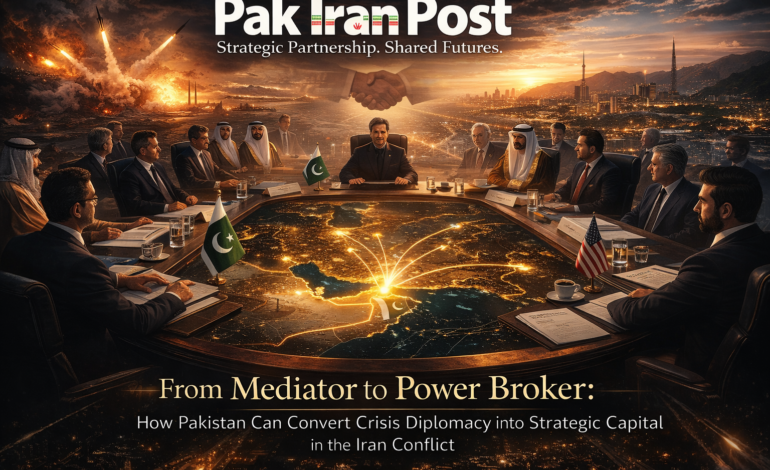
From Mediator to Power Broker: How Pakistan Can Convert Crisis Diplomacy into Strategic Capital in the Iran Conflict

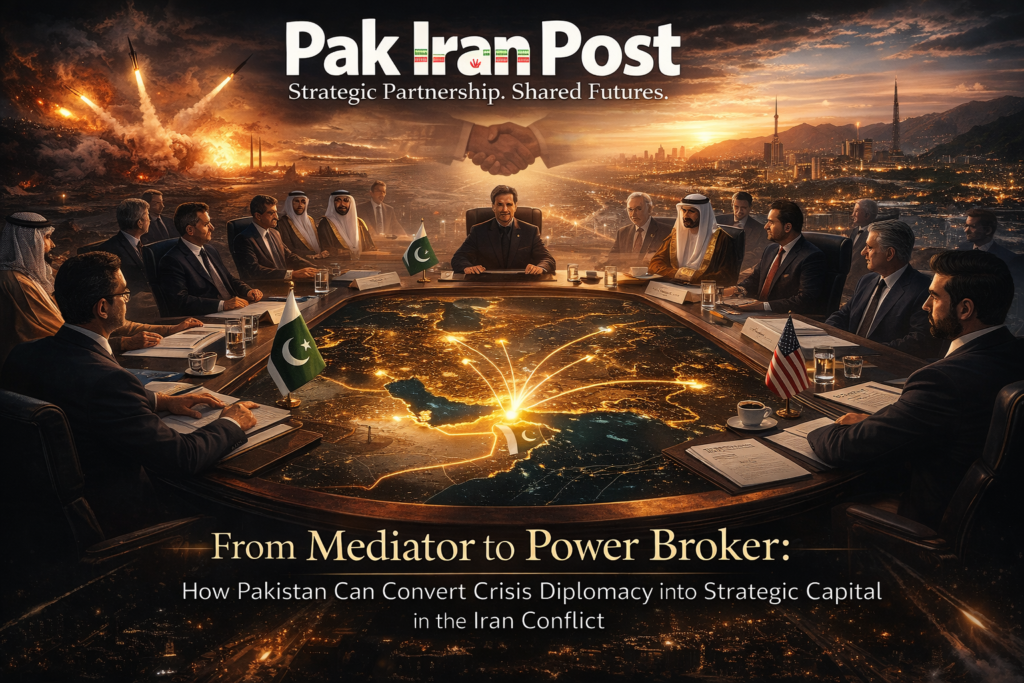
The contemporary Middle Eastern landscape is being reshaped by conflict, strategic recalibration, and the emergence of new power alignments. Among the most consequential theaters is Iran, whose political, economic, and military positioning is influencing not only regional security but global energy and trade systems. In this evolving context, Pakistan finds itself at a crossroads. Its historical, cultural, and religious linkages with Iran, combined with its geographic proximity and balanced relations with major global powers, position Islamabad as a potential intermediary capable of bridging divides and influencing outcomes. The question before Pakistan is no longer whether it can act as a mediator but how it can convert this role into a source of durable strategic capital, strengthening its geopolitical influence, economic resilience, and diplomatic relevance in the post-conflict Middle East.
The Iran conflict has exposed critical vulnerabilities in regional governance and diplomatic frameworks. Traditional intermediaries have been sidelined, and the vacuum of credible mediation has created both risk and opportunity. Pakistan’s historical engagement with Iran, including its diplomatic channels, military-to-military ties, and economic cooperation, provides it with a foundation that other states lack. This is complemented by Pakistan’s pragmatic relationships with Gulf states and its ongoing partnerships with global powers, including China and the United States, which afford it a rare latitude to operate as a trusted interlocutor across competing blocs. The confluence of these factors represents a structural opportunity for Pakistan to transition from a reactive participant to an active architect of post-conflict regional architecture.
Effective mediation in the current crisis requires a multidimensional approach that integrates diplomatic, economic, and security considerations. Diplomatically, Pakistan can leverage its credibility with both Iran and regional actors to establish channels for dialogue, reduce tensions, and coordinate conflict management mechanisms. This may include facilitating bilateral discussions, hosting multilateral summits, and acting as a conduit for backchannel negotiations where official diplomacy is constrained. By offering a neutral platform that respects the sovereignty and strategic sensitivities of all parties, Pakistan can build trust and position itself as an indispensable actor in regional negotiations.
Economic leverage is equally critical in converting mediation into strategic capital. The Iran conflict has disrupted energy flows, trade networks, and investment patterns. Pakistan can position itself as a facilitator of economic normalization, enabling access to markets, trade corridors, and energy infrastructure in ways that reinforce stability. By integrating its ports, logistics networks, and industrial hubs into regional reconstruction and trade facilitation mechanisms, Pakistan can capture tangible benefits from its diplomatic engagement. This not only enhances its economic resilience but also strengthens the credibility of its role as a mediator who can deliver concrete outcomes beyond symbolic engagement.
Security considerations are central to the calculus. Iran’s security environment is fluid, with potential spillover effects into neighboring states and critical trade corridors. Pakistan’s military capabilities, while calibrated for its own regional context, provide an avenue for constructive engagement in areas such as border monitoring, intelligence sharing, and crisis management coordination. By offering support in non-combative domains, Pakistan can contribute to stability without overextending itself militarily. This participation reinforces its image as a responsible and capable actor in the region, further consolidating its position as a credible mediator.
Institutionalization is a key determinant of long-term strategic gain. Ad hoc diplomacy, while useful in the short term, does not translate into durable influence. Pakistan must develop structures that embed its mediation capabilities within formal frameworks, ensuring continuity, accountability, and strategic coherence. This may include a dedicated national center for conflict resolution and regional engagement, staffed with experts in diplomacy, economics, and security policy. Institutionalized mediation allows Pakistan to respond to evolving dynamics systematically and to convert episodic influence into a persistent strategic advantage.
However, navigating this role requires careful management of risks and perceptions. Overexposure to the conflict could expose Pakistan to criticism or backlash from major powers, particularly if mediation outcomes conflict with broader strategic interests. Islamabad must balance its engagement with Iran against its relationships with Gulf states, maintaining a posture that is credible, neutral, and oriented toward constructive outcomes. Transparency, communication, and calibrated signaling are essential in managing perceptions and ensuring that Pakistan’s mediation is viewed as stabilizing rather than partisan.
The United States, despite its adversarial stance toward Iran in some domains, retains influence in shaping regional security architectures. Pakistan’s ability to maintain channels of communication with Washington allows it to mitigate risks associated with mediation and to secure support for stabilization initiatives. Engagement with the U.S. must emphasize Pakistan’s role in promoting regional stability, protecting global energy flows, and facilitating crisis resolution, thereby framing mediation as aligned with broader international interests rather than unilateral alignment with Iran.
Integration with regional frameworks amplifies Pakistan’s impact. By aligning its mediation efforts with initiatives led by organizations such as the Organization of Islamic Cooperation, the Gulf Cooperation Council, and China-led connectivity projects, Pakistan can embed its influence in broader mechanisms that transcend bilateral disputes. This multilateral orientation enhances legitimacy, reduces perceptions of bias, and allows Pakistan to shape outcomes while distributing responsibilities across multiple actors.
Timing is critical in leveraging the mediator role into strategic capital. Early engagement allows Pakistan to influence the initial structuring of post-conflict arrangements, set the terms for reconstruction, and establish mechanisms for energy and trade continuity. Delay risks marginalization as other actors consolidate influence, leaving Pakistan as a reactive participant. A proactive strategy must therefore prioritize rapid engagement, leveraging existing relationships and operational capacity to establish a position of authority early in the post-conflict environment.
From a geostrategic perspective, Pakistan’s mediation has the potential to create durable advantages beyond immediate crisis management. By positioning itself as an essential node in the post-conflict order, Pakistan can secure preferential access to energy corridors, investment opportunities, and trade flows. This translates into enhanced leverage in regional negotiations, improved foreign exchange stability, and increased relevance in broader geopolitical calculations. Mediation thus becomes a mechanism not only for conflict resolution but for structural empowerment in a complex regional ecosystem.
Energy and trade corridors represent particularly significant dimensions of influence. Pakistan’s integration into post-conflict reconstruction, transport, and logistics networks allows it to capture economic rents while facilitating regional stability. By linking its ports, transit infrastructure, and industrial capacity with emerging opportunities, Pakistan can position itself as an indispensable gateway between the Middle East and South Asia. This reinforces its strategic importance while simultaneously generating tangible economic benefits.
Human capital and institutional readiness are essential enablers of this strategy. Effective mediation requires personnel skilled in negotiation, economic analysis, security assessment, and regional languages. Pakistan must invest in training diplomats, analysts, and military liaison officers capable of operating in high-stakes environments. Partnerships with international think tanks and research institutions can provide expertise, scenario modeling, and strategic insights to support informed decision-making. Developing a cadre of specialized professionals ensures that Pakistan’s mediation is informed, credible, and capable of adapting to evolving circumstances.
Communication strategy is another vital element. Pakistan must articulate the rationale, objectives, and scope of its mediation to domestic, regional, and international audiences. Effective messaging reinforces legitimacy, builds support, and mitigates misinterpretation. By framing mediation as a constructive, stabilizing initiative that benefits multiple stakeholders, Pakistan can strengthen its diplomatic standing while preserving strategic flexibility.
Technology and intelligence integration further enhance mediation capacity. Real-time monitoring of conflict developments, supply chains, and energy flows enables Pakistan to respond proactively, anticipate risks, and coordinate solutions. Investments in secure communication networks, satellite reconnaissance, and data analytics allow Pakistan to operate with a precision and situational awareness that increases the effectiveness of its mediation efforts. This technological edge becomes a force multiplier in both diplomatic and operational domains.
The credibility of Pakistan’s mediation is reinforced by its balanced approach to power projection. Unlike regional actors whose influence is derived from military dominance or economic coercion, Pakistan’s leverage is primarily diplomatic, economic, and relational. This form of influence is uniquely suited to mediation, as it emphasizes dialogue, coordination, and constructive engagement rather than coercion. By maintaining this orientation, Pakistan preserves trust among conflicting parties and enhances its role as a neutral facilitator.
Financial instruments can complement diplomatic efforts. Pakistan can explore mechanisms to facilitate post-conflict reconstruction, trade financing, and energy investment, effectively linking mediation outcomes with tangible economic incentives. By creating structured opportunities for investment and collaboration, Pakistan reinforces the value proposition of its mediation and embeds its influence in the operational mechanics of post-conflict stabilization.
The integration of Gwadar Port, transport corridors, and energy infrastructure into mediation frameworks further strengthens Pakistan’s strategic positioning. By offering tangible platforms for regional engagement, Pakistan demonstrates its capability to translate diplomatic dialogue into actionable outcomes. This approach reinforces credibility, creates economic returns, and embeds Pakistan into the structural architecture of regional recovery and integration.
Strategically, Pakistan’s role as a power broker extends beyond the immediate post-conflict environment. By institutionalizing mediation, integrating infrastructure, and coordinating economic and security mechanisms, Pakistan can secure long-term influence over regional dynamics. This includes shaping energy flows, trade patterns, and security arrangements, ensuring that Pakistan is recognized not only as a participant but as a stakeholder capable of shaping outcomes.
Risk management remains central to this strategy. Mediation inherently involves exposure to volatility, competing interests, and the possibility of failure. Pakistan must develop robust contingency planning, including alternative diplomatic channels, energy sourcing strategies, and security coordination, to ensure resilience. By mitigating risks while maintaining an active presence, Pakistan can preserve credibility and avoid strategic setbacks.
In conclusion, the Iran conflict presents Pakistan with a historic opportunity to transition from passive observation to active power brokering. By leveraging its geographic proximity, historical ties, balanced diplomatic relationships, and economic infrastructure, Pakistan can convert mediation into strategic capital that enhances national security, economic resilience, and geopolitical influence. Success requires proactive engagement, institutionalized capacity, and integrated approaches that combine diplomacy, economics, and security.
Pakistan’s potential as a mediator-turned-power-broker is unmatched in its combination of credibility, capability, and opportunity. By seizing this moment decisively, Islamabad can secure a position of enduring influence in the Middle East, shaping post-conflict architectures, controlling access to critical energy and trade corridors, and reinforcing its relevance in global strategic calculations. The stakes are significant, but the potential rewards—including enhanced stability, economic gain, and diplomatic preeminence position Pakistan to convert crisis diplomacy into lasting strategic capital.
A Public Service Message