
Middle Powers Seek Space in a Broken Order

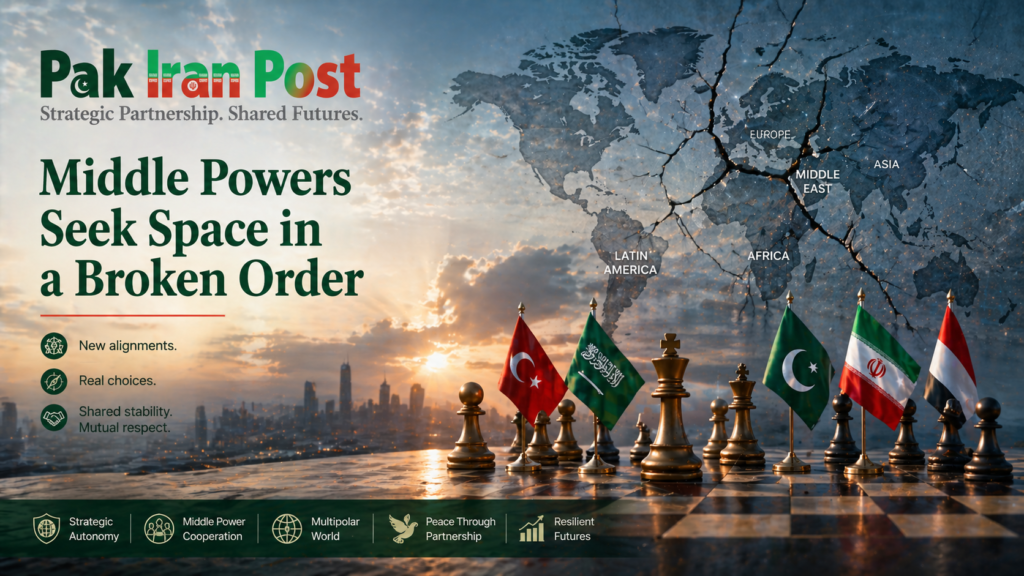
The international system has entered one of those untidy historical moments when old labels survive longer than old realities. Many institutions built in the aftermath of the Second World War still function, but with diminishing authority. The vocabulary of alliances, blocs, deterrence, and liberal order remains familiar, yet practice has become more transactional, selective, and fragmented. States now hedge where they once aligned, diversify where they once depended, and improvise where they once obeyed. In this unsettled landscape, middle powers are neither passive spectators nor commanding architects. They are strategic navigators, attempting to preserve room for manoeuvre amid the pressures of larger rivals. Pakistan and Iran, despite different histories and ideological trajectories, are instructive cases of this broader struggle for autonomy in a broken order.
Strategic autonomy is one of those fashionable phrases that can mean everything and therefore nothing. At its most serious, it means the ability of a state to make consequential external choices without crippling dependence on any single patron. It does not imply isolation. Nor does it require neutrality in every contest. Rather, it suggests diversified relationships, resilient domestic capacity, and enough diplomatic credibility to avoid becoming an instrument of someone else’s design. By that standard, few states fully qualify. But many aspire to it, especially those that have experienced the costs of overreliance.
Pakistan’s search for autonomy has been shaped by a long history of asymmetric partnerships. During the Cold War and beyond, it often tied itself closely to Washington for security and economic reasons, only to discover that strategic marriages of convenience can end abruptly. Cycles of cooperation around Afghanistan, counterterrorism, and regional balancing were followed by mistrust, sanctions, or neglect. This does not erase the benefits Pakistan gained, but it helps explain why Islamabad increasingly seeks a more plural external posture.
That plural posture rests on several pillars. China remains Pakistan’s most significant long term strategic partner, particularly through defence cooperation, infrastructure finance, and diplomatic support. The Gulf monarchies remain crucial sources of remittances, investment potential, and political backing. The United States still matters deeply for markets, financial influence, technology access, and military legacy systems. Russia, once peripheral to Pakistan’s calculations, has become a relationship explored more cautiously than dramatically. Türkiye offers defence collaboration and symbolic affinity. In theory, such diversification resembles strategic maturity.
In practice, Pakistan’s autonomy remains constrained by domestic fragility. States bargain better abroad when they are coherent at home. Chronic fiscal stress, repeated recourse to international lenders, elite polarisation, governance inconsistency, and energy insecurity reduce external flexibility. A country negotiating urgently for reserves or bailout support has less room to posture as fully sovereign. Pakistan’s challenge, therefore, is not merely diplomatic geometry. It is state capacity.
Iran’s version of strategic autonomy emerged under harsher conditions. Decades of sanctions, diplomatic isolation, covert pressure, and episodic military confrontation forced Tehran to construct a model of resilience under siege. Its leaders describe this as resistance. Critics describe it as costly defiance. Both descriptions contain truth. Iran has preserved regime continuity, indigenous military capabilities, and regional influence despite sustained pressure. It has also paid a steep price in inflation, investment scarcity, technological constraints, and societal strain.
Unlike Pakistan, Iran did not inherit broad access to Western capital or security partnerships that later became unstable. Instead, it developed parallel systems. Barter arrangements, sanctions circumvention networks, regional commercial channels, and strategic partnerships with non Western powers became tools of survival. The eastward turn toward China and closer cooperation with Russia were not simply ideological choices. They were rational responses to exclusion from Western dominated systems.
Yet Iran’s autonomy is also incomplete. Dependence can take new forms. Heavy reliance on a narrow set of external buyers, constrained access to global finance, and vulnerability to commodity price cycles limit freedom of action. Partnership with larger powers is useful, but even friendly powers negotiate hard. China buys pragmatically, not sentimentally. Russia cooperates where interests converge, not as a guardian of Iranian prosperity. Strategic autonomy acquired through isolation can still produce asymmetry.
The comparison between Pakistan and Iran reveals an important truth. There is more than one route to constrained sovereignty. Pakistan’s constraints often arise from financial dependence and political volatility. Iran’s constraints often arise from sanctions and structured exclusion. One has had access without stability. The other has had resilience without normalisation.
Both countries operate in a wider environment where blocs are less disciplined than headlines suggest. The United States remains the most powerful military actor, yet its partners increasingly pursue independent agendas. China has immense economic weight, but many states seek Chinese commerce without Chinese hierarchy. Russia retains coercive capacity but faces limits. Gulf monarchies now hedge among Washington, Beijing, and regional rivals with notable confidence. India buys from multiple suppliers while deepening selected partnerships. Türkiye combines alliance membership with autonomous behaviour. The era is less bipolar contest than competitive fluidity.
For Pakistan, this fluidity offers opportunities if handled intelligently. It need not choose between Washington and Beijing in absolute terms. It can deepen commercial ties with the United States while retaining strategic cooperation with China. It can welcome Gulf capital while expanding regional trade. It can maintain selective engagement with Russia where useful. But balancing requires credibility. If every relationship is announced as transformational and few are implemented seriously, partners discount rhetoric.
Washington should understand this evolution more clearly. Too often, Pakistan is viewed through outdated binaries, either as ally, liability, or Chinese proxy. Such categories miss the logic of middle power behaviour in the current era. States diversify because concentration has become risky. American policy would be wiser to compete where necessary, cooperate where useful, and avoid forcing artificial exclusivities that few partners can sustain.
For Iran, the strategic question is sharper. Can it convert endurance into durable prosperity without surrendering core sovereignty claims. Resistance can preserve a regime, but it does not automatically modernise an economy. Tehran’s diplomacy with Gulf states, selective openings to neighbours, and transactional ties with major powers suggest awareness that perpetual siege is economically exhausting. Yet domestic political constraints and recurring confrontation cycles complicate recalibration.
There is a monetary dimension to this fragmented order that often receives exaggerated treatment. Talk of de dollarisation is fashionable, but the dollar’s role remains formidable. Even so, sanctions policy has encouraged experiments in local currency trade, alternative payment systems, and reserve diversification. Pakistan and Iran both observe these shifts closely, though from different positions. Pakistan seeks financial stability within existing systems while exploring supplementary options. Iran seeks escape valves from systems used against it. Neither can easily rewrite global finance, but both adapt around it.
Defence posture also shapes autonomy. Pakistan retains a conventional military orientation anchored in deterrence vis à vis India, supplemented by counterterrorism experience and expanding naval interests. Iran emphasises missiles, drones, proxies, and denial capabilities. One model seeks balance through institutional military strength. The other seeks leverage through asymmetric cost imposition. Both are products of threat environment and resource constraint.
Media narratives surrounding autonomy deserve scrutiny. In Pakistan, strategic autonomy is sometimes sold domestically as a rhetorical recovery of dignity, detached from the hard reforms needed to sustain it. In Iran, state narratives often frame endurance itself as triumph, while critics emphasise material decline. Across the region, social media amplifies fantasies of effortless sovereignty. Reality is less romantic. Independence is expensive. It requires tax capacity, industrial competence, educational quality, legal predictability, and bureaucratic discipline.
This is where many middle powers stumble. They seek diplomatic grandeur without administrative foundations. They celebrate multipolarity as if the mere existence of multiple great powers guarantees room for manoeuvre. In truth, fragmented orders can be harsher than stable ones. Great powers compete for influence. Supply chains weaponise. Debt costs rise. Security guarantees become conditional. Ambiguity increases the premium on competence.
Pakistan therefore faces a strategic choice deeper than alignment. It can continue oscillating between external patrons whenever crises intensify, or it can undertake the slower work of internal strengthening that makes external diversification meaningful. Tax reform, export competitiveness, energy rationalisation, judicial predictability, and institutional continuity sound domestic, but they are foreign policy instruments in disguise.
Iran faces a parallel dilemma. It has proven capable of survival under pressure. The next test is whether it can achieve normal economic functionality without forfeiting strategic identity. That may require calibrated compromise abroad and adaptive legitimacy at home. Survival and flourishing are not the same achievement.
For the United States, dealing with such states requires intellectual adjustment. Not every country declining exclusive alignment is anti American. Often it is merely post dependent. Middle powers want options. They may cooperate on maritime security, counterterrorism, or trade while resisting bloc discipline elsewhere. Punishing such behaviour can accelerate the very drift Washington dislikes.
For Pakistan and Iran alike, autonomy also has a regional dimension. Neighbourhood policy can either enlarge or shrink strategic space. Stable ties with neighbours reduce dependence on distant patrons. Dysfunctional neighbourhoods create security burdens that invite external intervention. Here both states have mixed records. Geography can be blessing or trap depending on diplomacy.
The phrase broken order should not imply collapse. The world still trades, institutions still matter, and deterrence still restrains many conflicts. But coherence has weakened. Rules are applied unevenly. Power is diffused. Narratives compete. In such systems, middle powers matter because they can tilt balances, sustain corridors, host industries, or obstruct strategies.
Pakistan and Iran will not define the century. But they illuminate its mechanics. Both seek sovereignty amid pressure. Both use diversification as shield. Both discover that external room for manoeuvre depends heavily on domestic resilience. Both confront publics less persuaded by ideology than by inflation, jobs, and dignity.
That may be the decisive lesson. Strategic autonomy begins not in summit communiqués but in competent governance. A passport stamped by many capitals is no substitute for a state that functions. In a fragmenting world, middle powers can indeed carve space. But the map of that space is drawn first at home.
A Public Service Message