
Eurasian Corridors Transform Pakistan Iran Geopolitical Relevance Beyond Traditional Buffer Status

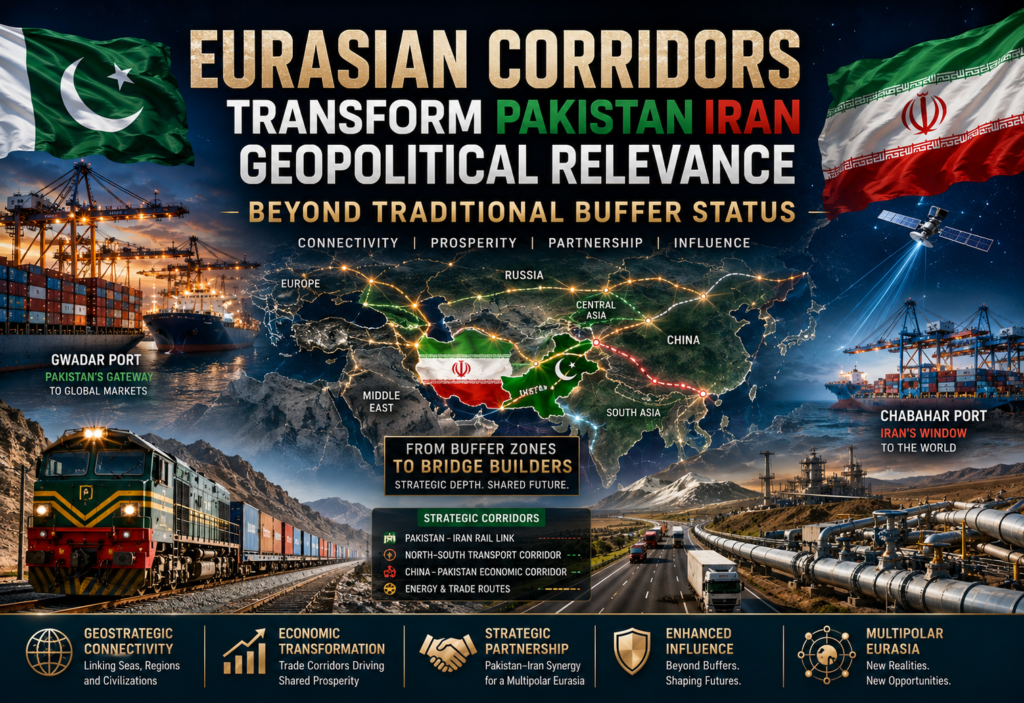
For much of modern geopolitical history, Pakistan and Iran were interpreted through the vocabulary of strategic buffering. Their territorial significance derived largely from their utility to external powers seeking insulation, containment, or military access within broader regional rivalries. During the Cold War, both states functioned as peripheral stabilizers positioned between competing ideological blocs. In the post Cold War period, their geopolitical identities remained constrained by security crises, sanctions regimes, militancy, and dependency upon external alliances. Yet the accelerating transformation of the international order is steadily dissolving this older strategic logic. Pakistan and Iran are no longer being positioned merely as buffer states at the margins of global politics. They are increasingly emerging as pivotal connective corridors within a rapidly evolving Eurasian geopolitical architecture shaped by infrastructure, logistics, energy transit, and geo economic competition.
This transformation reflects a profound restructuring of global power itself. In the twenty first century, geopolitical influence is becoming progressively linked to connectivity rather than territorial control alone. The ability to regulate transport routes, maritime access points, digital infrastructure, energy corridors, and supply chains increasingly determines strategic relevance. Roads, railways, pipelines, fiber optic systems, ports, and logistical hubs now function as instruments of political leverage comparable to traditional military assets. Geography is no longer static territorial space. It has become dynamic infrastructural architecture.
Within this emerging environment, Pakistan and Iran occupy uniquely consequential positions. Together, they connect South Asia, Central Asia, the Middle East, western China, and the Arabian Sea. Their territorial geography intersects multiple strategic theatres simultaneously, granting both states substantial potential influence over future patterns of trade, energy distribution, and regional integration. The geopolitical meaning of their location is therefore being fundamentally recalibrated.
The rise of continental connectivity initiatives has accelerated this process dramatically. China’s Belt and Road Initiative, the China Pakistan Economic Corridor, the International North South Transport Corridor, Gulf investment strategies, and evolving Eurasian trade realignments collectively reflect a broader shift toward corridor geopolitics. Major powers increasingly compete not only through military alliances or ideological influence but through the construction of infrastructural systems capable of organizing economic dependency and strategic access across entire regions.
The China Pakistan Economic Corridor represents one of the clearest manifestations of this transformation. Initially framed primarily as a bilateral development initiative, the corridor has evolved into a broader geopolitical project reshaping Pakistan’s strategic identity. Gwadar port, transport infrastructure, energy investments, and industrial zones collectively seek to reposition Pakistan from a security dependent peripheral state into a logistical gateway linking western China to the Arabian Sea.
Yet the corridor’s significance extends beyond Pakistan itself. CPEC forms part of a larger Eurasian restructuring in which continental integration increasingly challenges older maritime dominated models of globalization. China’s western orientation reflects an attempt to reduce strategic vulnerability associated with traditional sea lanes while expanding influence across inland Eurasia. Pakistan’s geography therefore acquires renewed importance because it offers access, continuity, and connectivity within this wider continental strategy.
Iran occupies a similarly strategic position within emerging Eurasian frameworks. Despite prolonged sanctions and economic isolation, Tehran’s geography remains extraordinarily valuable. Iran links the Persian Gulf to the Caspian region, Central Asia, South Asia, and Russia. The International North South Transport Corridor seeks to capitalize upon this position by creating alternative trade routes connecting Eurasia through multimodal transport networks involving rail, road, and maritime systems.
The growing strategic convergence between Russia, Iran, and sections of Central Asia has further intensified interest in these alternative corridors, particularly as geopolitical fragmentation disrupts traditional trade patterns. Western sanctions upon Russia, instability in maritime chokepoints, and concerns regarding supply chain resilience have collectively accelerated the search for diversified logistical routes across Eurasia. In this context, Iran’s infrastructural significance is steadily increasing despite continuing diplomatic constraints.
The broader implication of these developments is the emergence of connectivity as the central organizing principle of regional power. States capable of functioning as indispensable connectors gain geopolitical leverage because they influence the movement of energy, goods, information, and capital across multiple regions simultaneously. Pakistan and Iran therefore possess the potential to transition from objects of geopolitical competition into active architects of regional integration.
However, this transformation also generates new vulnerabilities. Infrastructure today is not politically neutral. Connectivity projects increasingly operate within environments shaped by sanctions regimes, strategic rivalry, debt dependency, technological competition, and information warfare. The struggle over Eurasian integration is simultaneously a struggle over who defines the terms, rules, and dependencies of future regional order.
This dynamic has given rise to what may be termed connectivity imperialism. Unlike classical imperial systems based upon direct territorial occupation, contemporary powers often seek influence through infrastructural penetration, financial dependency, technological integration, and logistical control. Ports, railways, digital systems, energy grids, and telecommunications networks become instruments through which external actors shape political orientation and strategic alignment.
Pakistan and Iran must therefore navigate a highly complex strategic environment. China seeks stable access and infrastructural continuity across the region. Russia views continental integration as a mechanism for reducing Western economic dominance. Gulf monarchies pursue investments and trade diversification while seeking to maintain regional influence. Western powers remain concerned regarding the geopolitical implications of expanding Eurasian connectivity frameworks outside traditional Atlantic centered systems.
The challenge for Islamabad and Tehran lies in leveraging their strategic geography without becoming excessively dependent upon singular external patrons. Historically, both states have struggled with forms of geopolitical dependency that limited strategic autonomy. Pakistan’s security establishment developed within frameworks heavily influenced by Western and Gulf partnerships, while Iran’s post revolutionary isolation intensified reliance upon selective strategic alignments. The emerging Eurasian order offers opportunities for diversification but also risks reproducing new asymmetrical dependencies under different geopolitical conditions.
Media narratives surrounding Eurasian integration play a crucial role in shaping these dynamics. Chinese discourse frequently presents connectivity initiatives as cooperative developmental frameworks promoting shared prosperity and regional integration. Western narratives often portray the same projects as instruments of strategic coercion, debt entrapment, or authoritarian influence. Russian perspectives emphasize multipolarity and resistance to Western dominated globalization. Gulf media increasingly frame connectivity through economic modernization and post oil diversification.
These competing narratives influence international legitimacy, investor confidence, and domestic political perceptions. Infrastructure projects are no longer evaluated purely through economic criteria. They are interpreted symbolically as indicators of geopolitical orientation and ideological alignment. Consequently, the politics of perception increasingly shapes the practical viability of corridor projects themselves.
Pakistan and Iran face additional challenges because both states continue to grapple with internal instability, governance limitations, and uneven economic development. Large scale connectivity projects require institutional capacity, policy continuity, financial sustainability, and domestic legitimacy. Without these foundations, infrastructural expansion risks generating social inequality, local resentment, and political fragmentation rather than national integration.
Balochistan illustrates many of these tensions with particular clarity. Positioned at the center of multiple connectivity initiatives, the region possesses enormous strategic importance. Yet it also remains marked by underdevelopment, insurgency, and longstanding grievances regarding political marginalization and resource distribution. Connectivity without inclusion risks deepening instability by reinforcing perceptions that local populations bear security costs while external actors capture economic benefits.
Similarly, sanctions continue to constrain Iran’s ability to fully operationalize its geographic advantages. International financial restrictions complicate infrastructure financing, technology acquisition, and foreign investment. Nevertheless, sanctions have also encouraged Iran to pursue alternative economic networks and strategic partnerships outside traditional Western systems. This process may accelerate broader regional realignments if Eurasian trade integration deepens over the coming decade.
The transformation from buffer zones to strategic corridors also alters the meaning of sovereignty itself. In the contemporary era, sovereignty increasingly involves managing interdependence rather than resisting it entirely. States must regulate how they connect to global systems while preserving decision making autonomy. Corridor sovereignty therefore depends upon diversification, institutional resilience, and the capacity to negotiate among competing external interests without excessive subordination.
Pakistan and Iran possess important opportunities in this regard. Their strategic locations provide leverage that many other regional states lack. However, geography alone cannot guarantee geopolitical relevance. Effective corridor governance requires long term strategic planning, infrastructural coordination, regulatory modernization, and diplomatic sophistication.
One of the most important emerging requirements is the need for regional synchronization rather than isolated national projects. Connectivity systems function most effectively when integrated across borders through harmonized customs procedures, interoperable transport regulations, coordinated energy frameworks, and shared digital infrastructure. Fragmented corridor politics risks duplication, inefficiency, and strategic competition that undermines overall regional potential.
This reality creates space for cautious Pakistan Iran cooperation despite persistent political differences. Selective coordination regarding border infrastructure, energy transit, maritime logistics, and regional trade could produce stabilizing forms of economic interdependence. Such cooperation would not eliminate geopolitical competition but could reduce incentives for destabilizing rivalry.
The future trajectory of Eurasian integration remains uncertain. Great power competition, sanctions escalation, regional conflicts, and technological fragmentation could all disrupt emerging connectivity systems. Yet the structural forces driving continental integration remain significant. Population growth, energy demand, supply chain diversification, and shifting economic centers of gravity continue to reinforce the strategic logic of alternative corridors across Eurasia.
For Pakistan and Iran, the stakes are therefore exceptionally high. Successful integration into evolving regional networks could enhance economic resilience, geopolitical relevance, and strategic autonomy. Failure to manage connectivity effectively, however, risks transforming both states into arenas of external competition vulnerable to infrastructural dependency and geopolitical manipulation.
The old geopolitical era treated Pakistan and Iran primarily as spaces to be contained, balanced, or utilized by external powers. The emerging era increasingly positions them as connective arteries within broader continental systems. This transformation carries enormous potential but also profound responsibility. States that function as corridors shape not only their own futures but the organization of entire regions.
In the coming decades, the contest over Eurasian integration will likely define much of the global geopolitical landscape. Infrastructure, logistics, energy systems, and digital corridors will increasingly determine patterns of influence and dependency. Pakistan and Iran now stand at the intersection of these historic transformations. Their ability to convert geography into strategic advantage without surrendering sovereignty may determine whether they emerge as autonomous regional actors or remain vulnerable to the ambitions of larger powers operating across an increasingly interconnected Eurasian order.
A Public Service Message