
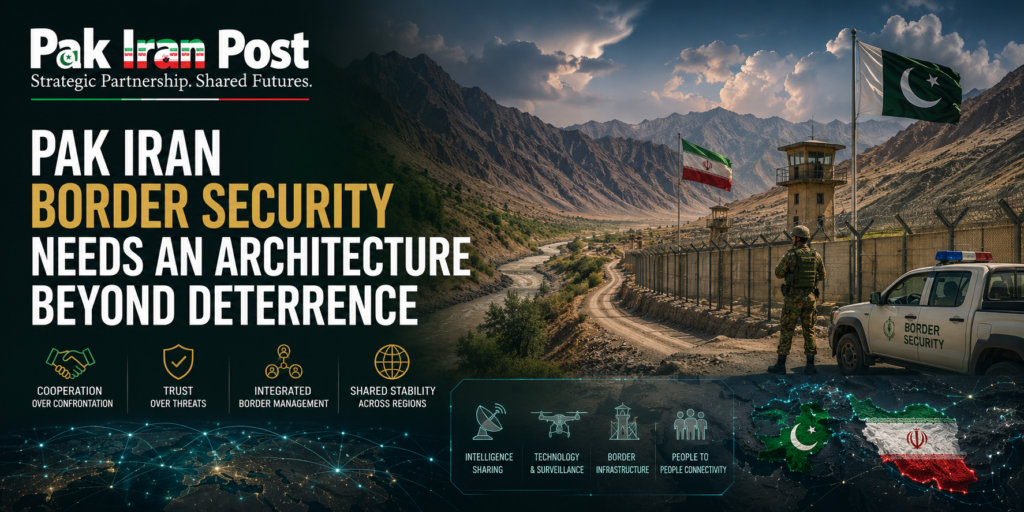
Pak Iran Border Security Needs An Architecture Beyond Deterrence

Pak Iran Post views the Pakistan Iran frontier as a security environment in which the distinction between border management, intelligence collection and crisis diplomacy is becoming progressively less tenable. The frontier is no longer adequately described through the vocabulary of checkpoints, fencing, patrols and episodic military deployments. It is evolving into a continuously contested information space where armed groups, smugglers, criminal facilitators, unmanned platforms, electronic surveillance, irregular movement and digitally accelerated narratives can interact within minutes. The strategic complication for Pakistan is not simply that an incident may occur along a difficult frontier. It is that an incident whose original scale is limited can now acquire disproportionate diplomatic weight before conventional institutions have established an authoritative account of what happened. The central policy requirement is therefore not greater securitisation in isolation, but an architecture capable of detecting anomalous activity, attributing events rapidly, communicating through protected channels and preventing tactical friction from becoming bilateral rupture.
The missile exchanges of recent years have altered the psychological geography of the frontier. They demonstrated that territorial proximity can permit a localised security concern to acquire strategic consequences almost instantaneously. For Islamabad, the lesson is particularly consequential because the western frontier intersects with an intricate geography of dispersed settlements, difficult terrain, informal commercial routes and communities whose social and economic connections frequently precede the modern boundary. A border management model designed primarily around physical control cannot adequately process this complexity. Surveillance must therefore become layered, persistent and intelligence led, while remaining calibrated to the political sensitivities of sovereign territory. The objective should not be to create an impenetrable frontier, an unrealistic proposition in such terrain, but to construct sufficient visibility to distinguish ordinary movement from preparatory activity associated with violence, trafficking or infiltration.
Pakistan should consequently move towards an integrated frontier intelligence architecture in which information from border posts, immigration systems, customs records, aerial surveillance, satellite imagery, local reporting and law enforcement investigations can be correlated rather than maintained as institutional silos. The significance of integration is frequently misunderstood. It does not require indiscriminate accumulation of data. It requires the creation of a common operational picture in which authorised institutions can identify patterns that remain invisible when information is examined separately. A vehicle crossing at an unusual hour may be innocuous. Repeated crossings by associated individuals, irregular telecommunications activity, unexplained movements near vulnerable routes and contemporaneous intelligence concerning an armed network may collectively produce a materially different assessment. The policy problem is therefore one of correlation, authentication and timely dissemination rather than surveillance volume.
A practical system would require an interagency frontier fusion mechanism with clearly defined responsibilities, classification protocols and escalation thresholds. The military, intelligence services, border management authorities, customs, police, immigration authorities and provincial administrations should not merely exchange reports through established correspondence. They should operate within a secure architecture capable of producing time stamped alerts, confidence assessments and geographic visualisation for authorised decision makers. Every significant alert should distinguish between confirmed information, corroborated reporting, unverified allegations and analytical inference. Such differentiation is indispensable because crisis management deteriorates rapidly when political leadership receives intelligence stripped of confidence levels. An uncertain report presented as fact can generate unnecessary mobilisation, while excessive scepticism towards a credible warning can produce strategic surprise.
Biometric verification should be strengthened, but its expansion must be governed by intelligence relevance rather than technological enthusiasm. Border crossings generate enormous quantities of personal information, yet not every identity record has equal security value. Pakistan should establish risk based verification protocols that permit legitimate commercial and familial movement to proceed without disproportionate obstruction while enabling enhanced scrutiny where indicators justify it. Interoperability between immigration databases, watch lists, criminal intelligence systems and customs information would be more valuable than simply increasing biometric collection. The architecture should also contain mechanisms for correcting erroneous records. A flawed identity match can transform an innocent traveller into a security suspect, creating precisely the resentment that hostile networks subsequently exploit.
Geospatial monitoring deserves similar recalibration. Satellite imagery, high altitude platforms and unmanned aerial systems can provide persistent observation across sectors where conventional patrol density is inherently constrained. Yet technology becomes strategically useful only when imagery can be processed into actionable intelligence. Pakistan should establish defined analytical cells responsible for detecting changes in routes, temporary encampments, unusual vehicle concentrations, construction activity and movement patterns around historically vulnerable crossing areas. Machine assisted analysis could identify anomalies for human review, reducing the burden on analysts without transferring sovereign security decisions to automated systems. Every technologically generated alert should remain subject to human validation, particularly where an operational response could carry diplomatic consequences.
Unmanned systems introduce another layer of complexity. Drones can be used for reconnaissance, smuggling, weapons movement and communication support, while state forces can employ them for border observation and incident verification. The proliferation of relatively inexpensive unmanned platforms means that Pakistan cannot rely exclusively on traditional radar or visual observation. A layered counter unmanned system should therefore combine detection, identification, tracking and proportionate response. The critical requirement is not merely the ability to neutralise an unidentified aircraft. It is the ability to determine whether the platform is commercial, criminal, militant or state operated before an encounter produces an escalation cycle. Rules of engagement should accordingly incorporate graduated responses and clear authority for escalation.
Electronic surveillance presents an equally sensitive problem. Communications intelligence can provide early warning of mobilisation, logistical preparation or coordination between dispersed actors, but indiscriminate monitoring can generate legal, diplomatic and social liabilities. Pakistan requires a disciplined doctrine that separates intelligence collection authorised for national security purposes from mass monitoring without defined operational justification. Data retention, access controls and audit mechanisms should be incorporated into the architecture from the outset. Strategic effectiveness is weakened, rather than strengthened, when intelligence systems become opaque even to the institutions responsible for their oversight.
The greatest vulnerability may nevertheless lie in the interval between detection and diplomatic communication. A frontier incident can generate contradictory claims through social media, local television, partisan commentary and anonymous digital accounts before official institutions have established the facts. Once competing narratives acquire public momentum, governments face pressure to respond to perception rather than evidence. Pakistan and Iran therefore need a protected incident notification mechanism that can operate continuously, including during periods of political tension. The mechanism should permit rapid communication between designated military, diplomatic and border authorities when an unidentified intrusion, armed clash, accidental exchange of fire, drone incident or unusual military movement is detected.
Such a mechanism should not be mistaken for a political concession. It is a stabilising instrument designed to preserve decision space. A secure notification within minutes can prevent an unverified incident from being interpreted as deliberate state action. The channel should contain graduated categories, ranging from routine operational clarification to urgent strategic notification. Each category should identify who is authorised to communicate, what minimum information must be exchanged and which level of leadership must be informed. This would reduce the dangerous dependence on improvised telephone calls or politically exposed intermediaries during moments of tension.
The border also requires a more sophisticated understanding of smuggling. Conventional enforcement often treats smuggling primarily as a customs problem, yet sophisticated networks can overlap with militant financing, human trafficking, narcotics movement, weapons procurement and informal currency channels. Pakistan should therefore develop network based financial and logistical intelligence around recurrent trafficking corridors. Vehicle ownership, cargo manifests, customs anomalies, repeated crossing behaviour, telecommunications associations and financial transactions can reveal networks that physical interception alone cannot dismantle. The policy objective should be to identify the architecture supporting illicit movement rather than merely arresting individuals at its visible edges.
Iran presents a particular operational challenge because legitimate commerce and illicit movement can occupy the same geographic spaces. Excessive restrictions can damage border economies and strengthen incentives for clandestine trade, while inadequate controls create opportunities for criminal and militant networks. Pakistan therefore needs calibrated border governance rather than blanket securitisation. Legal trade corridors should become faster, more transparent and more predictable, while intelligence resources should concentrate on anomalous behaviour and high risk consignments. Digital customs systems, pre arrival cargo information and interoperable trader identification could reduce the burden on legitimate commerce while improving the visibility of suspicious transactions.
The institutional relationship between Islamabad and Tehran also requires greater proceduralisation. Strategic confidence cannot depend on personal rapport between senior officials because leadership changes, domestic political pressures and regional crises can rapidly alter the diplomatic environment. A standing border security commission with permanent technical working groups could institutionalise consultation on intelligence alerts, border incidents, trafficking, unmanned systems and humanitarian movement. Its purpose should not be ceremonial diplomacy. It should generate measurable procedures, maintain contact directories, conduct periodic simulations and review unresolved incidents before institutional memory disappears.
Joint verification mechanisms could be particularly valuable after contested incidents. Where circumstances permit, Pakistan and Iran should establish protocols for exchanging geospatial evidence, imagery, timestamps and other technically verifiable information through designated channels. This would not require either side to surrender sensitive intelligence sources. It would allow the parties to distinguish between what can be independently corroborated and what remains disputed. Such differentiation matters because strategic ambiguity is manageable when governments possess confidence in their private assessments. It becomes dangerous when uncertainty is converted into public accusation.
Pakistan should also treat border resilience as an establishment level planning requirement rather than a purely frontier command responsibility. National security institutions need contingency scenarios in which a minor border incident coincides with heightened regional tensions, hostile information operations, unusual military activity and domestic political mobilisation. Tabletop exercises should test whether decision makers can identify the incident, verify it, communicate with Tehran, inform political leadership, control public messaging and prevent unnecessary force mobilisation within the first several hours. The test should not merely ask whether Pakistan can respond militarily. It should determine whether the state can prevent an incident from acquiring a strategic trajectory.
There is also a requirement for calibrated public communication. Silence during an uncertain incident can create an information vacuum, but premature attribution can close diplomatic options. Pakistan should develop a doctrine of factual minimalism during the verification period. Initial statements should confirm only what is established, explicitly distinguish investigation from attribution and avoid language that creates irreversible political commitments. Once evidence is sufficiently robust, communication can become more specific. This approach would deny hostile actors the opportunity to manufacture escalation through fabricated certainty.
The strategic objective should ultimately be shock absorption. Pakistan cannot eliminate every militant movement, smuggling attempt, drone intrusion or accidental encounter along a frontier of this complexity. It can, however, reduce the probability that an isolated event will trigger an uncontrolled sequence of mobilisation, accusation, retaliation and diplomatic deterioration. That requires a system in which sensors feed analysts, analysts inform commanders, commanders communicate through established channels and political leaders receive an assessed picture before public narratives harden. Technology is valuable only when embedded within such institutional sequencing.
For Pak Iran Post, the principal policy conclusion is therefore clear. Pakistan should stop conceptualising the western frontier as a line that must merely be guarded and begin treating it as a dynamic security system that must be continuously understood. The investment priority should move from isolated surveillance acquisitions towards interoperable architecture, trained analytical personnel, protected communications, biometric integrity, geospatial intelligence, counter unmanned capabilities and institutionalised crisis notification. Tehran should be offered a parallel mechanism based on reciprocal notification and technical dialogue without compromising Pakistan’s sovereign intelligence requirements.
The frontier will remain exposed to structural pressures arising from geography, militancy, informal commerce, regional conflict and technological diffusion. The strategic question is whether those pressures are allowed to dictate the tempo of bilateral relations. A resilient border architecture would give Pakistan something more valuable than additional visibility. It would provide decision time. In contemporary security competition, decision time is itself a strategic asset. The state that can detect an anomaly, establish attribution, communicate discreetly and impose proportionality before political momentum takes over possesses a markedly greater capacity to preserve deterrence without manufacturing escalation. For Pakistan, that is the appropriate evolution from border control towards border resilience, and from crisis reaction towards institutionalised strategic management.
A Public Service Message