
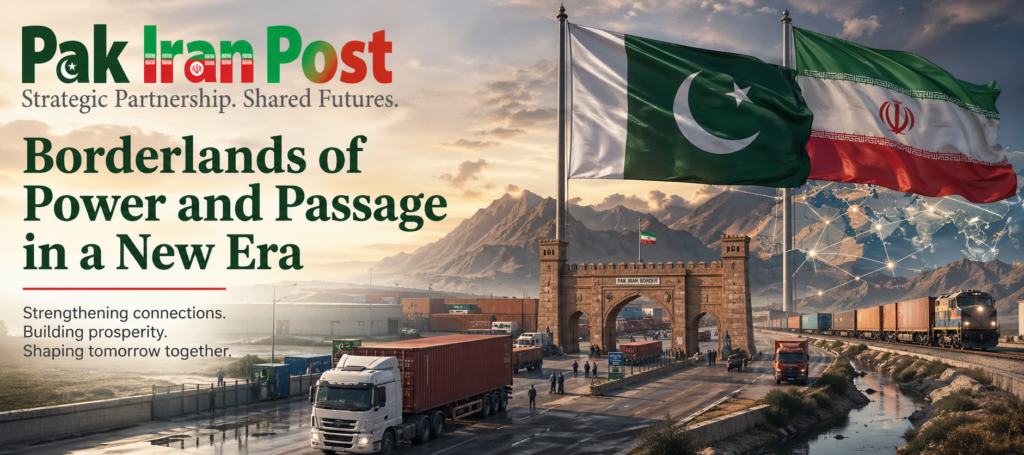
Borderlands of Power and Passage in a New Era.

For much of modern statecraft, the frontier between Pakistan and Iran existed in policy imagination as a cartographic afterthought. It was a long, arid, politically delicate belt where sovereignty was asserted episodically, commerce moved informally, and governments looked inward rather than across. Security officials saw smuggling routes, insurgent sanctuaries, and sectarian vulnerabilities. Development planners saw distance, sparse populations, and difficult terrain. Foreign capitals saw little at all. Yet geography has a habit of returning to relevance when larger systems begin to fracture. As supply chains become politicised, maritime chokepoints grow unstable, and great powers seek shorter, safer, and more redundant routes, the Pakistan Iran borderlands are being reconsidered not as a buffer to be contained, but as a bridge to be built.
This transformation is neither linear nor guaranteed. It is occurring amid mistrust, underdevelopment, and recurring violence. But it is real enough to deserve attention in Washington, Islamabad, Tehran, Beijing, Riyadh, Abu Dhabi, and New Delhi alike. The old strategic map of the region was organised around capitals, coastlines, and military alliances. The emerging map is increasingly organised around corridors, ports, logistics chains, data cables, minerals, and energy resilience. In such a map, peripheral spaces can suddenly become central.
The frontier links Pakistan’s Balochistan province with Iran’s Sistan and Baluchestan province, two regions historically marked by neglect and heavy securitisation. Both host communities with deep kinship ties across the border, as well as grievances against distant capitals. Both have experienced militant violence, criminal economies, and developmental shortfalls. Yet both also sit beside waters of growing strategic value and astride routes that connect South Asia to the Gulf, Central Asia, and beyond. If the twenty first century rewards connectivity, then this once marginal zone possesses latent importance.
The most visible symbols of that importance are Gwadar and Chabahar. For years they were framed as rival ports in a geopolitical morality play. Gwadar, developed with Chinese support, was portrayed as the maritime jewel of the China Pakistan Economic Corridor. Chabahar, backed at various moments by India and tolerated by Western powers because of its utility for Afghan trade, was described as a counterweight. Rivalry made for dramatic headlines. It also simplified reality.
Ports rarely thrive because of symbolism alone. They succeed through hinterland access, customs efficiency, shipping confidence, insurance costs, road and rail connectivity, and political predictability. On these measures, both Gwadar and Chabahar have moved more slowly than their boosters promised. Yet that should not obscure their continuing relevance. The more fractured the global trading environment becomes, the greater the value of redundancy. Companies and states increasingly prefer multiple routes rather than single points of failure. In that world, two ports on adjacent coasts need not be mortal enemies. They can become differentiated assets within a broader regional logistics ecosystem.
For Pakistan, Gwadar still offers the possibility of strategic depth on the Arabian Sea and long term commercial diversification beyond Karachi and Port Qasim. For Iran, Chabahar provides an outlet less vulnerable than the Gulf bottleneck and a gateway to eastern markets. For Afghanistan and Central Asia, both ports can offer alternatives. For China, Gulf investors, and other external actors, the question is becoming less ideological and more practical. Which routes are insurable, bankable, and governable.
That pragmatic turn matters. China’s Belt and Road Initiative has matured from headline making expansion to more selective calibration. Beijing now emphasises viability, debt sustainability, industrial returns, and security risk. Grand announcements are less fashionable than targeted execution. This creates an opening for projects that can demonstrate clear commercial logic rather than merely strategic theatre. If Pakistan can improve governance and security conditions around Gwadar, and if Iran can provide predictable operating frameworks around Chabahar, both may attract more serious interest than in the era of inflated promises.
Meanwhile, Gulf capital is evolving in purpose. Saudi Arabia and the United Arab Emirates are no longer content merely to buy prestige assets abroad or recycle hydrocarbon wealth into passive holdings. They seek logistics influence, food security, mining access, technology partnerships, and diversified geopolitical leverage. South Asia’s western seaboard naturally attracts such attention. Investments in terminals, industrial zones, warehousing, renewable energy, and transport links could alter the economics of the Pakistan Iran frontier more profoundly than many military deployments.
Yet infrastructure dreams confront a stubborn political fact. Borders that have long been managed as security problems do not instantly become trade platforms. Pakistan and Iran have each hardened aspects of frontier control in response to militant attacks and smuggling networks. Fencing, checkpoints, surveillance systems, and cross border patrols reflect understandable state concerns. But hard borders can impede the very legal commerce needed to undercut illicit economies. This is the classic paradox of frontier governance. Too little control invites disorder. Too much indiscriminate control suffocates opportunity.
The solution is not naivety. Militancy in these regions is real, and attacks have periodically strained bilateral ties. But purely military approaches have repeatedly failed to stabilise borderlands across the world. What often works better is selective firmness combined with economic formalisation. Legal crossing points, simplified customs regimes, local market access, digitised documentation, transport insurance, and dispute resolution mechanisms can convert informal traders into stakeholders in order. Border populations respond not only to ideology or coercion, but to incentives.
For Pakistan, there is also a domestic political economy challenge. Balochistan has long produced the paradox of strategic significance without proportional local inclusion. Major national narratives invoke the province’s geography, yet residents often ask where the dividends are. Unless employment, revenue sharing, education, health services, and municipal capacity improve, corridor language will sound extractive rather than developmental. The same broad principle applies in Iran’s southeast. Peripheral communities that feel watched but not served rarely become enthusiastic guardians of state projects.
Washington should pay closer attention. Pakistan Iran connectivity is often viewed through the narrow lens of sanctions, security incidents, or Chinese influence. Those concerns are understandable, but incomplete. The United States has its own interest in resilient trade architecture, reduced conflict incentives, and regional alternatives to monopoly routes. It also has an interest in preventing frontier vacuums from becoming incubators of militancy. A more nuanced American approach would distinguish between destabilising transfers and benign commerce, between coercive alignments and practical regional integration.
This does not require abandoning sanctions policy or strategic competition. It requires recognising that all connectivity is not equal. Electricity trade, food logistics, border market formalisation, customs modernisation, disaster resilience, and transport safety can generate stabilising effects without rewriting broader geopolitical contests. Excessively blunt restrictions often strengthen smugglers, patronage brokers, and hardliners while weakening legal actors.
India, too, may need to revisit inherited assumptions. Chabahar was often marketed as a route that bypassed Pakistan. Yet bypass politics has limits when regional systems are interdependent. If South Asia is ever to become less fragmented, practical complementarities will matter more than symbolic exclusions. This does not erase rivalry. It simply recognises geography.
The media environment surrounding the frontier remains trapped in older templates. Security incidents generate headlines. Trade facilitation meetings rarely do. Every attack is framed as proof of inevitable chaos. Every investment pledge is framed as imminent transformation. Both narratives mislead. The borderlands are neither doomed wastelands nor instant gateways. They are contested spaces where policy competence can make an unusual difference.
Pakistan’s policymakers should therefore resist two temptations. The first is triumphal rhetoric unsupported by execution. The second is fatalism that treats underdevelopment as destiny. A credible agenda would prioritise roads that function, customs that clear goods quickly, policing that targets violent actors rather than harassing traders, and local governance that delivers visible benefits. It would also require steadier diplomacy with Tehran, insulated where possible from episodic shocks.
Iran, for its part, has reason to pursue practical cooperation despite larger disputes elsewhere. Its eastern flank benefits from calmer commerce no less than Pakistan’s western flank. Tehran’s wider strategy of diversified external partnerships gains credibility when neighbouring corridors work.
The wider region is entering an age of route politics. Energy transitions will still require hydrocarbons for years. Mineral demand will intensify. Food supply chains will remain vulnerable to climate shocks. Maritime disruptions will periodically redirect cargo. In such a world, overland connectors tied to functional ports gain value. The Pakistan Iran frontier cannot solve these macro trends, but it can respond to them.
History offers a caution. Many borderlands have been rediscovered by strategists only to be abandoned after fashions changed. What distinguishes durable transformation from temporary excitement is institutions. If legal frameworks are weak, local communities alienated, and security managed only episodically, today’s bridge rhetoric will become tomorrow’s disappointment.
Still, there is reason for measured optimism. States often modernise first where necessity forces them. The frontier now sits at the intersection of enough external pressures and internal opportunities to create momentum. Pakistan needs growth, diversification, and provincial inclusion. Iran needs outlets, partnerships, and eastern stability. External powers need resilient routes. Border communities need livelihoods more than slogans.
That convergence is rare. It should be used wisely.
The Pakistan Iran borderlands will not become Rotterdam in the desert, nor should anyone promise miracles. But they can become something strategically valuable and politically healthier than what they have long been. A buffer consumes resources while producing anxiety. A bridge, if competently built, can produce revenue, leverage, and habits of cooperation.
For Pakistan and for observers in Washington, the policy lesson is simple. Peripheral geographies often become decisive when central systems are under strain. The map is changing. States that continue to read yesterday’s margins as empty spaces may wake to discover that the next chapter of regional order is being written there.
A Public Service Message